
Types of polymorphism in C++
What is polymorphism in C++ ?
Polymorphism literally translates to "multiple forms". This indicates that the same thing behaves differently depending on the context in programming. Polymorphism is a feature of C++ that allows a member function to act differently depending on the object which calls/invokes it. If we have a hierarchical structure of classes that are connected by inheritance, this happens. A crucial idea in OOPs is polymorphism.
Consider yourself a living embodiment of polymorphism. You play several roles depending on the circumstances, such as student, son/daughter, brother/sister, and so on.
Types of Polymorphism in C++ :
In C++, polymorphism can be divided into two categories :
- Compile-time
- Run-time
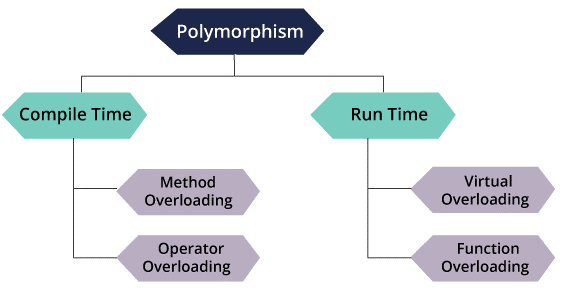
1. Compile Time Polymorphism :
A function is activated at the time of programme getting compiled in compile-time polymorphism. This particular kind of polymorphism is often referred to as early or static binding.
To achieve the Compile-time polymorphism, function overloading go hand in hand with operator overloading.
a. C++ Function Overloading
Function overloading occurs in the C++ programming language when two or more than two functions have a similar name but have dissimilar numbers and/or types of parameters. In contrast to this, the overloaded functions are the functions with the identical name but dissimilar parameters.
It is based on the amount and type of parameters supplied, in order for an overloaded function to be called. As a conclusion, during the compilation of the programme, the appropriate functions are selected by the compiler.
Example :
#include <iostream>
using namespace std;


void trial(int i) {
	cout << " The int value is " << i << endl;
}
void trial(double  f) {
	cout << "The float value is " << f << endl;
}
void trial(char const *ch) {
	cout << "The char* value is " << ch << endl;
}


int main() {
	trial(7);
	trial(7.5);
	trial("seven");
	return 0;
}
Output :
The int value is 7
The float value is 7.5
The char* value is seven
Explanation :
In the above example, we demonstrated the use of function overloading, which is an integral part of Compile time polymorphism. We created a function called trial() that takes an int value in i as an input. Then, we created a function called trial() that takes a float value in f as an input. Then we created a function called trial() that takes a char value in ch as input. Then, in the main() function we called the three trial() methods along with some given values. Hence, we had three different types of values for a same function, which means the polymorphism occurred.
b. C++ Operator Overloading
In C++, user might overload operators additionally. For client-defined types like objects and structures, we may even adjust the behaviour of the operators accordingly.
For example, the '+' operator, which is used to add two strings of the std::string class, could also be used to concatenate two strings. Its acts will be influenced by the operands. When put between integers, it adds them and it concatenates strings when placed between chars, according to our definition.
Example :
#include<iostream>
using namespace std;


class CmplxNum {
private:
	int real, imaginary;
public:
	CmplxNum(int rl = 0, int img = 0) {
		real = rl;
		imaginary = img;
	}


	CmplxNum operator + (CmplxNum const &obj) {
		CmplxNum ans;
		ans.real = real + obj.real;
		ans.imaginary = imaginary + obj.imaginary;
		return ans;
	}
	void print() {
		cout << real << " + " << imaginary << "i" << endl;
	}
};
int main()
{
	CmplxNum cn1(11, 6), cn2(4, 2);
	CmplxNum cn3 = cn1+cn2;
	cn3.print();
}
Output :
15 + 8i
Explanation :
In the above example, we demonstrated the use of operator overloading, which is an integral part of Compile time polymorphism. We created a function called CmplxNum() that takes two int values in real and imaginary as the input. In order to override the meaning of the + operator, we created the data type result of CmplxNum() data type. We used the + operated to add the real part of one number to another and the imaginary part of one number to another. Then in the main function we called the CmplxNum() method with passing two diff values in it and creating another variable cn3 to store the sum of those two values. Finally, the sum was printed as a complex number.
2. Run-Time polymorphism in C++ :
When the functions are called during the run time of a program, run-time polymorphism occurs. It's sometimes considered as dynamic or late binding. Run-time polymorphism can be acquired by function overriding or using virtual functions.
a. C++ Function Overriding :
In C++, function overriding usually occurs whenever a member method of the base class is defined again in a derived class with the similar arguments and return type. It is claimed that the base class function has been overridden.
The function call is not resolved by the compiler, rather it is resolved during runtime of a program.
Example :
#include <iostream>
using namespace std;
class Animal {


public:
	void eats() {


		cout << "Animals eat...";
	}


};


class Deer: public Animal {


public:
	void eats() {


		cout << "Deers eat grass...";
	}
};
int main(void) {


	Deer d = Deer();


	d.eats();


	return 0;


}
Output :
Deers eat grass...
Explanation :
In the above mentioned program, we explained the use of Function overriding, which is an integral part of Run-time polymorphism. We created a class called Animal and made it public too. Then we created a function called eats(). Then we override the Animal class with another class Deer. After that, a new instance of the class Deer was created and was named d. Then we invoked the eats() method from the Deer class and got the output of the eats() function.
b. C++ Virtual functions :
A virtual function is the one that is declared only by using the virtual keyword in the base class. The virtual function's sole purpose is to make sure that the function is not overwritten.
It is very much feasible that the base class method will not be overridden if the virtual keyword is not being used. We can still make the use of a base class pointer to reach to it. The base class method will be called if the base class pointer is set to the derived class object.
Let's look at an example to help you understand :
Example :
#include <iostream>
using namespace std;
class ClassV1 {
		public:
		virtual void show() {
			cout << "The show() function in the base class is invoked..." << endl;
		}
	};
	class ClassV2 :public ClassV1 {
	public:
		void show() 	{
			cout << "The show() function in the derived class is invoked...";
		}
	};
	int main() {
		ClassV1* V1;
		ClassV2 V2;
		V1 = &V2;
		V1->show();
	}
Output :
The show() function in the derived class is invoked...
Explanation :
In the above mentioned program, we explained the utilization of Virtual functions overriding, which is an integral part of Run-time polymorphism. We created a class called ClassV1 and made it public too. Then we created a virtual function show(). Then we created a new class called ClassV2, which inherits from Classv1. ClassV1 was designated as the base class, whereas ClassV2 was designated as the derived class. To make a class member publicly available, we used the public access modifier and redefined the value of show() function. Then we created a pointer variable with the name V1, which was pointing to the ClassV1 class. Then a new instance V2 of the ClassV2 class was created. Later, we assigned the values stored in the variable V1 to the address V2 and invoked the show() method, inside the derived class to print the solution.
Difference between Compile-time Polymorphism and Run-time Polymorphism in C++ :
| Compile-time Polymorphism | Run-Time Polymorphism |
| Also known as early binding or static binding. | Also known as late binding or dynamic binding. |
| Overloading was used to achieve this. | Overriding was used to do this. |
| It’s during the compile-time that the function to be performed is known. | It’s during the run-time that the function to be executed is known. |
| Execution is faster. | Execution is slow. |
| Allows for little flexibility. | It gives you extra flexibility. |
Summary :
- Polymorphism is a term that refers to the existence of several forms.
- Whenever there is a hierarchical structure of classes that are connected by inheritance, something happens.
- Polymorphism allows a function to act differently depending on the object that calls or invokes it.
- The method to be executed is determined at time of compilation in compile-time polymorphism.
- The method to be executed is determined during the running time of the program under run-time polymorphism.
- Function overloading and operator overloading are used as a component to determine compile-time polymorphism.
- There are numerous functions with identical names but differing arguments in function overloading.
- The quantity and kind of parameters might vary.
- The term "operator overloading" refers to the definition of a new meaning for C++ operators.
- Function overriding and virtual functions are used to provide runtime polymorphism.
- In function overriding, a derived class provides a function specified in the base class a new definition.