
C++ Inheritance
What do you mean by Inheritance ?
The ability to define new classes based on existing classes in order to reuse and organise code is referred to as inheritance. Single inheritance is simple to implement in C by actually inserting the inherited class attribute structure as the first member of the derived class attribute structure.
For example,
class Animal {
    // eat() function
    // sleep() function
};


class Dog : public Animal {
    // bark() function
};
The Dog class is derived from the Animal class in this case. Members of Animal are available to Dog since it is derived from Animal.
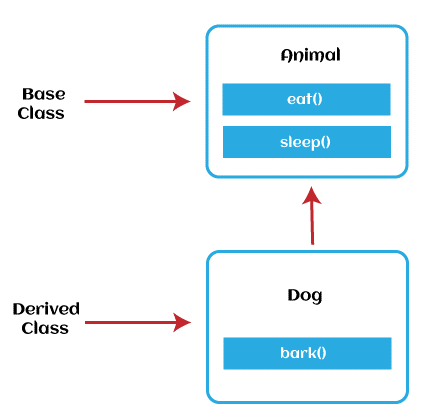
Take note of how the term public is used when inheriting Dog from Animal.
class Dog : public Animal {...};Instead of public, we might use the phrases private and protected. Later in this lesson, we will learn about the distinctions between utilising private, public, and protected.
Is-a connection
Inheritance is defined as an is-a connection. We utilise inheritance only when there is an is-a connection between the two classes.
Following are some examples:
- A automobile is a type of vehicle.
- Orange is a kind of fruit.
- A surgeon is a type of doctor.
- A dog is a kind of animal.
Example
// C++ program to demonstrate inheritance


#include <iostream>
using namespace std;


// base class
class Animal {


   public:
    void eat() {
        cout << "I can eat!" << endl;
    }


    void sleep() {
        cout << "I can sleep!" << endl;
    }
};


// derived class
class Dog : public Animal {

   public:
    void bark() {
        cout << "I can bark! Woof woof!!" << endl;
    }
};


int main() {
    // Create object of the Dog class
    Dog dog1;


    // Calling members of the base class
    dog1.eat();
    dog1.sleep();


    // Calling member of the derived class
    dog1.bark();


    return 0;
}
Output
I can eat!
I can sleep!
I can bark! Woof woof!!
Dog1 (the object of the derived class Dog) has access to members of the base class Animal in this case. It's because Dog is a descendant of Animal.
// Calling members of the Animal class
dog1.eat();
dog1.sleep();
What Is the Difference Between Child and Parent Classes?
To fully grasp the notion of inheritance, you must first learn about two concepts that serve as the foundation for the whole concept: child class and parent class.
- Child class or derived class: A class that inherits the attributes of another class is referred to as a child class or derived class. The kind of inheritance determines the amount of child classes that can be inherited from a single parent class. A child class will access the data members of the parent class based on the visibility mode set during the child class's definition.
- The parent class or base class: It is the class from which the child class derives its attributes. Numerous child classes can be derived from a single parent class (Hierarchical Inheritance), or multiple parent classes can inherit a single base class (Multiple Inheritance). This is determined by the various forms of inheritance in C++.
Access Modifiers in C++
Access modifiers are used to perform Data Hiding, which is an important feature of Object-Oriented Programming. In a class, Access Modifiers or Access Specifiers are used to assign accessibility to class members. That is, it places some constraints on the class members, preventing them from being directly accessible by outside functions.
In C++, there are three types of access modifiers:
- Public
- Private
- Protected
Let's take a closer look at each of these access modifiers:
- Public: Every class members stated with the public specifier are accessible to all. Other classes and methods can access the data members and member functions that have been defined as public. A class's public members can be accessed from anywhere in the programme by using the direct member access operator (.) with the class's object.
- Private: Class members defined as private can only be accessible by the class's member functions. They may not be accessed directly by any object or method that is not a member of the class. Only member functions or friend functions have access to a class's private data members.
- Protected: The Protected access modifier is similar to the Private access modifier in that it cannot be accessible outside of its class unless it is accessed through a buddy class; however, class members designated as Protected may be accessed by any subclass (derived class) of that class as well.
The table below depicts the control of the derived classes over the members of the base class in various visibility modes:
| BASE CLASS | DERIVED CLASS | DERIVED CLASS | DERIVED CLASS |
| Public | Protected | Private | |
| Public | Public | Protected | Private |
| Protected | Protected | Protected | Private |
| Private | Not Inherited / Remains Private | Not Inherited / Remains Private | Not Inherited / Remains Private |
Inheritance Member Function Override
Assume the base and derived classes both have member functions with the same name and parameters.
When we create an object of the derived class and try to access that member function, the derived class's member function is executed rather than the base class's.
The member function of the derived class takes precedence over the member function of the base class.
The Benefits of C++ Inheritance
Reusability of code: You may now reuse the members of your parent class. As a result, there is no need to redefine the member. As a result, less code is required in the class.
Types of Inheritance

In this tutorial, you will learn about five different forms of inheritance in C++. These are their names:
Single Inheritance
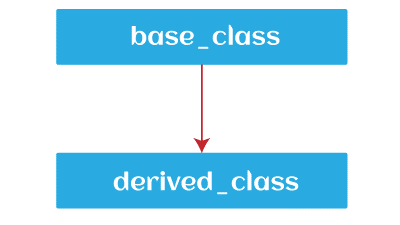
Single Inheritance is the most fundamental form of inheritance in C++. A single class inherits the attributes of a base class in this inheritance. The derived class has access to all of the base class's data members based on the visibility mode (private, protected, or public) that was set during inheritance.
Multiple Inheritance
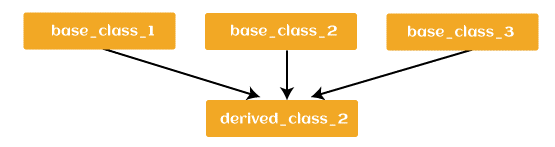
Multiple Inheritance is the inheritance in which a class can inherit or derive the traits of multiple classes, or a derived class can have more than one source class. At the moment of inheritance, it provides access specifiers independently for each base class. The derived class can derive the shared characteristics of all of these classes, and the data members of all of the base classes are accessible by the derived or child class using the access specifiers.
Multilevel Inheritance
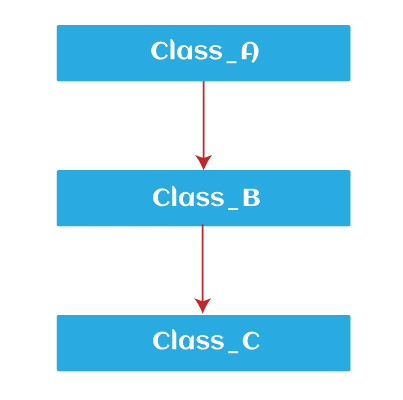
Multilevel Inheritance refers to inheritance in which a class can be derived from another derived class. Assume that there are three classes: A, B, and C. Class A is the ancestor of class B. As a result, B is the derived class of A. C is the class that is descended from B. As a result, class B is the foundation class for class C but a derived class of class A. This is known as the Multilevel Inheritance situation. The data elements of each each base class are accessible by their respective derived classes based on the visibility modes given.
Hierarchical Inheritance
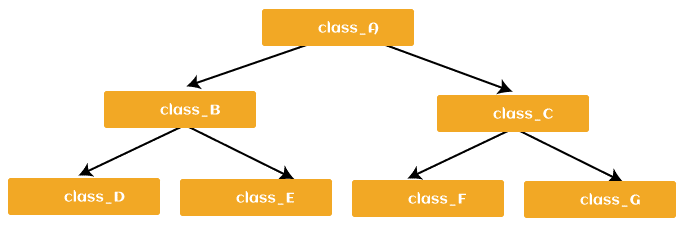
Hierarchical inheritance refers to inheritance in which a single base class inherits numerous derived classes. Because each class serves as a base class for one or more child classes, this inheritance has a tree-like structure. During inheritance, the visibility mode for each derived class is set independently, and it accesses the data members accordingly.
Hybrid Inheritances
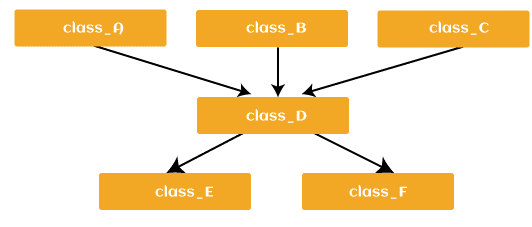
As the name implies, hybrid inheritance is the blending of two or more types of inheritances. For example, the classes in a programme may be organised in such a way that they exhibit both single and hierarchical inheritance. This is referred to as the Hybrid Inheritance. Among all the inheritance types in C++, this is likely the most complicated. The data members of the base class will be accessible based on the visibility mode provided.
When and Why Should You Use Inheritance?
Inheritance improves the efficiency of programming and is employed for the benefits it gives. The following are the most important applications of inheritance:
- Reusability of code: One of the primary motivations for using inheritance is the ability to reuse code. Consider the following animals as distinct classes: tiger, lion, and panther. You may construct member methods for these classes such as predator() since they are all predators, canine() because they all have canine teeth to hunt with, and claws() because all three creatures have large and sharp claws. Because all three functions are the same for these classes, creating separate methods for each would result in data redundancy and may raise the risks of mistake. In this case, you can utilise inheritance instead. You may add these functions to a base class called carnivores, which will then be inherited by the tiger, lion, and panther classes.
- Transitive nature: Because of its transitive nature, inheritance is also utilised. For example, consider the derived class mammal, which derives its attributes from the base class animal. Because of the transitive nature of inheritance, all of the child classes of 'mammal' will now inherit the properties of the class 'animal.' To a large extent, this aids in debugging. You may remove the defects from your base class, and all derived classes will be debugged automatically.
How Can a Private Member Be Made Inheritable?
Private members of a base class are not inherited by derived classes under inheritance. As a result, the base class's members are inaccessible to the derived class's objects. Only the public and protected members are inherited and accessible to the derived classes.
The base class's private members can be made inheritable in two ways:
Change the visibility mode from private to public.
Making the private member's access modifier public makes it inheritable by the derived classes. However, there is an issue with this technique. The data concealing attribute for that member is no longer present since it is now visible to all other operations of the application.
Change the visibility mode from Private to Protected.
This method preserves the private member's data-hiding feature. When a private member's access specifier is changed to protected, it becomes inheritable and accessible by the derived class. If these elements must be inheritable beyond the immediately derived class, they must be inherited as public. Otherwise, they should be inherited as private, which will bring the inheritance hierarchy down to the level of the directly derived class.