Preventing Object Copy in C++
C++ is an object-oriented programming language that provides the ability to create objects, define class and pass objects to functions. When passing an object to a function or returning an object from a function, a copy of the object is usually created. However, in some cases, it is necessary to prevent object copying in C++. In this article, we will discuss why we may want to prevent object copying and how to do it in C++.
Why Prevent Object Copying?
There are several reasons why we may want to prevent object copying in C++. One of the most common reasons is to prevent unintended side-effects when copying objects. For example, consider an object that represents a unique resource, such as a file handle. When you copy this object, you are creating two references to the same resource. This can lead to unintended behavior when one of the objects is used to modify the resource, as the changes will affect both objects.
Another reason to prevent object copying is to improve performance. Copying large objects can be a time-consuming operation, especially if the objects contain many data members. Preventing object copying can help to reduce the amount of time spent copying objects and can help to improve overall performance.
How to Prevent Object Copying in C++:
There are several ways to prevent object copying in C++.
1. Private Copy Constructor and Assignment Operator:
One of the most common methods of preventing object copying is to declare the copy constructor and assignment operator as private members in the class definition. This makes them inaccessible to client code and prevents the creation of objects using these methods.
Here's an example of a class definition that prevents object copying using this method:
class NonCopyable
{
private:
    NonCopyable(const NonCopyable&) = delete;
    NonCopyable& operator=(const NonCopyable&) = delete;


public:
    NonCopyable() = default;
    virtual ~NonCopyable() = default;
};
In the example above, the copy constructor and assignment operator are declared as private members and are deleted using the delete keyword. This ensures that objects of this class can only be created and assigned using the default constructor and default assignment operator.
Program:
#include <iostream>


class NonCopyable
{
private:
    NonCopyable(const NonCopyable&) = delete;
    NonCopyable& operator=(const NonCopyable&) = delete;


public:
    NonCopyable() = default;
    virtual ~NonCopyable() = default;
};


int main()
{
    NonCopyable obj1;
    // NonCopyable obj2 = obj1; // error: copy constructor is deleted
    // NonCopyable obj3;
    // obj3 = obj1; // error: assignment operator is deleted


    std::cout << "Objects created successfully!" << std::endl;
    return 0;
}
Explanation:
- The code defines a class NonCopyable that is designed to prevent the creation of objects using the copy constructor and assignment operator.
- The class definition has two private member functions, the copy constructor and the assignment operator, which are declared using the delete keyword.
- This keyword indicates that the copy constructor and the assignment operator are inaccessible to client code and will result in a compile-time error if used.
- The class also has a default constructor and a virtual destructor, which are both declared using the default keyword.
- In the main function, objects of the NonCopyable class are created using the default constructor. Attempts to copy the objects using the copy constructor or the assignment operator result in compile-time errors, as these functions have been deleted.
- Finally, a message is displayed indicating that the objects have been created successfully.
Program Output:

2. Make the copy constructor and the copy assignment operator private members of the class:
Another way to prevent object copying in C++ is to make the copy constructor and the copy assignment operator private members of the class and not provide a definition for them. This makes them inaccessible to client code, and if they are used, it results in a linker error.
For example:
class NonCopyable
{
private:
    NonCopyable(const NonCopyable&);
    NonCopyable& operator=(const NonCopyable&);


public:
    NonCopyable() = default;
    virtual ~NonCopyable() = default;
};
In this example, the copy constructor and the copy assignment operator are declared as private member functions but not defined. This makes them inaccessible to client code and results in a linker error if they are used.
This method is similar to the previous method, but it allows objects of the class to be passed by value or returned by value from functions, since the copy constructor and copy assignment operator are implicitly defined by the compiler. However, it also means that it is not immediately clear to client code that the objects of the class are not meant to be copied.
Program:
#include <iostream>


class NonCopyable
{
private:
    NonCopyable(const NonCopyable&);
    NonCopyable& operator=(const NonCopyable&);


public:
    NonCopyable() = default;
    virtual ~NonCopyable() = default;
};


int main()
{
    NonCopyable obj1;
    // NonCopyable obj2(obj1); // error: copy constructor is private
    // NonCopyable obj3;
    // obj3 = obj1; // error: assignment operator is private


    std::cout << "Objects created successfully!" << std::endl;
    return 0;
}
Explanation:
- In this program, a class NonCopyable is defined that has a private copy constructor and copy assignment operator. This means that these member functions can only be used by other members and friend functions of the NonCopyable class and are inaccessible to client code.
- In the main function, an object obj1 of the NonCopyable class is created.
- Attempts to create another object obj2 by copying obj1 using the copy constructor and to assign obj1 to another object obj3 using the copy assignment operator are commented out, as they would result in compile-time errors, due to the private access specifier for the copy constructor and copy assignment operator.
- The program outputs the message "Objects created successfully!", indicating that the objects were created without any issues.
Program Output:

3. final Keyword:
Another method to prevent object copying is to declare the class as final. The final keyword in C++11 prevents the class from being inherited, which in turn prevents the creation of objects using the copy constructor or assignment operator.
Here's an example of a class definition that prevents object copying using the final keyword:
class NonCopyable final
{


public:
    NonCopyable() = default;
    virtual ~NonCopyable() = default;
};
In the example above, the final keyword is used to declare the class as non-inheritable, preventing the creation of objects using the copy constructor or assignment operator.
Program:
#include <iostream>


class NonCopyable final
{


public:
    NonCopyable() = default;
    virtual ~NonCopyable() = default;
};


int main()
{
    NonCopyable obj1;
    // NonCopyable obj2 = obj1; // error: copy constructor is deleted
    // NonCopyable obj3;
    // obj3 = obj1; // error: assignment operator is deleted


    std::cout << "Objects created successfully!" << std::endl;
    return 0;
}
Explanation:
This program demonstrates another way of preventing object copying in C++, using the final keyword. The code defines a class NonCopyable that is designed to prevent the creation of objects using the copy constructor and assignment operator.
The class definition uses the final keyword to indicate that the class cannot be subclassed. This has the side effect of making the copy constructor and assignment operator inaccessible to client code, thus preventing object copying.
The class has a default constructor and a virtual destructor, both declared using the default keyword.
In the main function, objects of the NonCopyable class are created using the default constructor. Attempts to copy the objects using the copy constructor or the assignment operator result in compile-time errors, as these functions are inaccessible due to the use of the final keyword.
Finally, a message is displayed indicating that the objects have been created successfully.
Program Output:

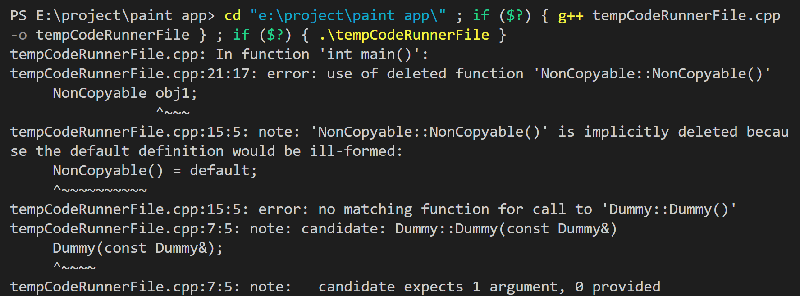
4. Inherit a Dummy class with a private copy constructor and a private copy assignment operator:
One way to prevent object copying in C++ is to inherit a dummy class that has a private copy constructor and a private copy assignment operator. This dummy class can be used as a base class for the class that needs to prevent object copying.
Here's an example of how this technique can be implemented:
Program:
#include <iostream>


// Define a dummy class with private copy constructor and copy assignment operator.
class Dummy
{
private:
    Dummy(const Dummy&);
    Dummy& operator=(const Dummy&);
};


// Define a class that needs to prevent object copying.
class NonCopyable : public Dummy
{
public:
    NonCopyable() = default;
    virtual ~NonCopyable() = default;
};


int main()
{
    NonCopyable obj1;
    // NonCopyable obj2(obj1); // error: copy constructor is private
    // NonCopyable obj3;
    // obj3 = obj1; // error: assignment operator is private


    std::cout << "Objects created successfully!" << std::endl;
    return 0;
}
Explanation:
- This program demonstrates how to prevent object copying in C++ using inheritance.
- The program defines a dummy class named Dummy which has a private copy constructor and a private copy assignment operator.
- These private functions make it impossible to create a new instance of the Dummy class by copying an existing object.
- Next, the program defines another class named NonCopyable which inherits from the Dummy class.
- By inheriting from Dummy, NonCopyable also acquires the private copy constructor and copy assignment operator, making it impossible to copy instances of the NonCopyable class.
- In the main function, an instance of NonCopyable named obj1 is created.
- If we try to create another instance of NonCopyable by copying obj1, the program will give an error because the copy constructor is private.
- Similarly, if we try to assign obj1 to another instance of NonCopyable, the program will give an error because the copy assignment operator is private.
- Despite these errors, the program still runs and outputs "Objects created successfully!" to the console.
Error: