Hospital Management Project in C++
The following capabilities are required to build a hospital management project: These are as follows: hospitals' names, contact information, and lists of doctors and patients.
Activities Supported
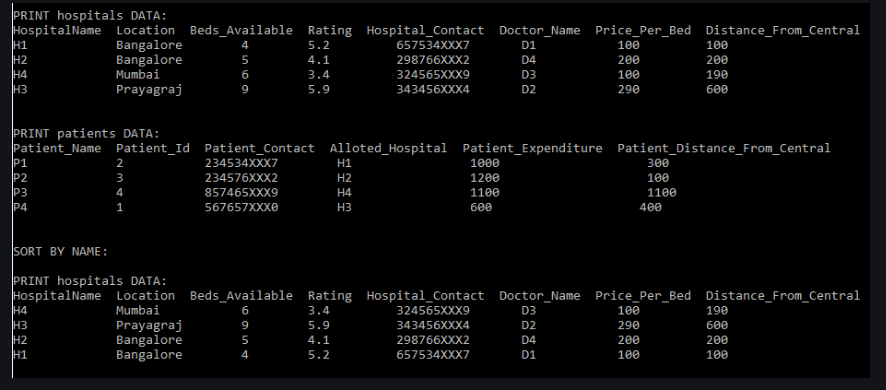
- Hospital Data Print
- Patients' data to print
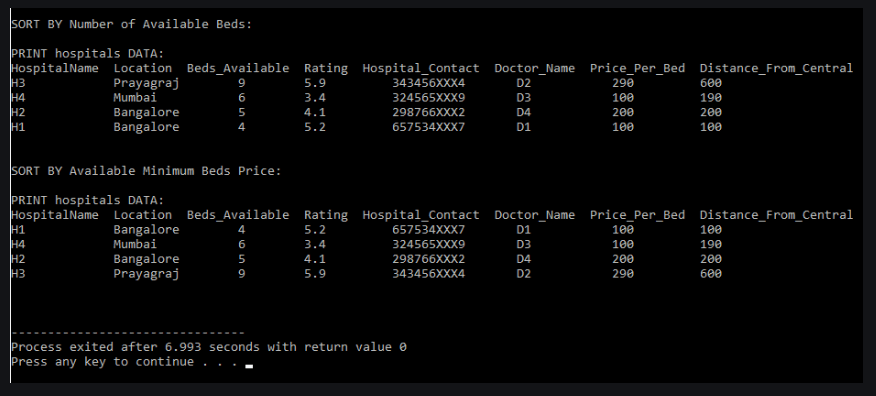
- Beds Price Sort
- Order By Available Beds
- Order By Name
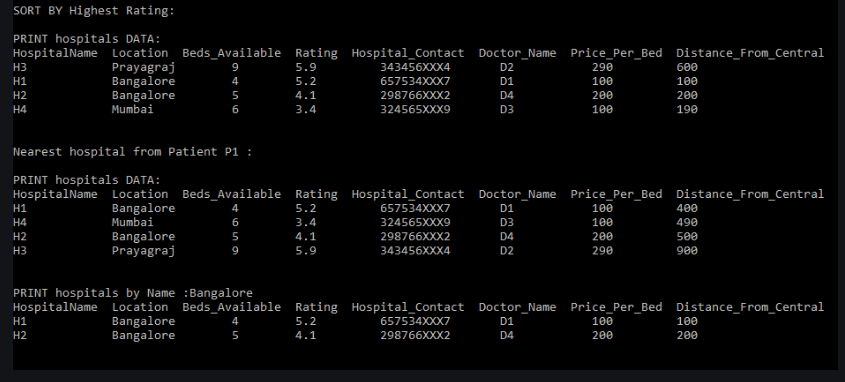
- Rating and reviewing the order
- Print the Hospital for any city.
The program's primary features are:
- All hospital data will be printed using the PrintHospitalData() method.
- All hospital data will be printed using the PrintPatientData() method.
- SortHospitalByName(): List all hospitals in alphabetical order by name
- SortHospitalByRating(): Arrange hospitals by rating
- Sort hospitals by beds available using the SortByBedsAvailable() method.
- Hospitals can be sorted by bed price using the SortByBedsPrice() method.
Approach
- Create classes for the Patient dataset as well as the Hospital dataset.
- Set up the variables that store patient and Hospital data.
- Create objects for patient classes and hospitals with the patient and hospital data access.
- Employ two arrays to hold the patient data and the hospital dataset.
- Apply the provided functionality as indicated below.
The application of the strategy is shown below:
Example 1:
#include <bits/stdc++.h>
usingnamespace std;
class Hospital {
Public:
    string H_name;
    string location;
    intavailable_beds;
    float rating;
    string contact;
    string doctor_name;
    int price;
};
classPatient:public Hospital {
public:
    string P_name;
    intP_id;
};
voidPrintHospitalData(
    vector<Hospital>& hospitals)
{
    cout<< "PRINT hospitals DATA:"
         <<endl;

    cout<< "HospitalName     "
<< "Location."
         << "Beds_Available     "
<< "Rating."
         << "Hospital_Contact     "
         << "Doctor_Name     "
         << "Price_Per_Bed     \n";
    for (inti = 0; i< 4; i++) {
        cout<< hospitals[i].H_nam
<< "                 "
             << "        "
             << hospitals[i].location
             << "           "
             << hospitals[i].available_beds
             << "                    "
             << hospitals[i].rating
             << "            "
             << hospitals[i].contact
             << "             "
             << hospitals[i].doctor_name
             << "                  "
             << "        "
             << hospitals[i].price
             << "            "
             <<endl;
    }
    cout<<endl
         <<endl;
}
voidPrintPatientData(
    vector<Patient>& patients,
    vector<Hospital>& hospitals)
{
    cout<< "PRINT patients DATA:"
         <<endl;
    cout<< "Patient_Name     "
         << "Patient_Id     "
         << "Patient_Contact     "
         << "Alloted_Hospital     "
         << "Patient_Expenditure     \n";
    for (inti = 0; i< 4; i++) {
        cout<< patients[i].P_name
             << "                "
             << "          "
             << patients[i].P_id
             << "              "
             << "          "
             << patients[i].contact
             << "                   "
             << hospitals[i].H_name
             << "                   "
             << patients[i].price
             << "            "
             <<endl;
    }
    cout<<endl
         <<endl;
}
boolname(Hospital& A, Hospital& B)
{
    returnA.H_name>B.H_name;
}

voidSortHospitalByName(
    vector<Hospital> hospitals)
{
    sort(hospitals.begin(),
         hospitals.end(),
         name);
    cout<< "SORT BY NAME:"
         <<endl
         <<endl;
    PrintHospitalData(hospitals);
}
boolrating(Hospital& A, Hospital& B)
{
    returnA.rating>B.rating;
}
voidSortHospitalByRating(vector<Hospital> hospitals)
{
    sort(hospitals.begin(),
         hospitals.end(),
         rating);
    cout<< "SORT BY Rating:"
         <<endl
         <<endl;
    PrintHospitalData(hospitals);
}
boolbeds(Hospital& A, Hospital& B)
{
    returnA.available_beds>B.available_beds;
}
voidSortByBedsAvailable(
    vector<Hospital> hospitals)
{
    sort(hospitals.begin(),
         hospitals.end(),
         beds);
    cout<< "SORT BY Available Beds:"
         <<endl
         <<endl;
    PrintHospitalData(hospitals);
}
boolbeds_price(Hospital& A, Hospital& B)
{
    returnA.price<B.price;
}
voidSortByBedsPrice(
    vector<Hospital> hospitals)
{
    sort(hospitals.begin(),
         hospitals.end(),
         beds_price);
    cout<< "SORT BY Available Beds Price:"
         <<endl
         <<endl;

    PrintHospitalData(hospitals);
}
voidPrintHospitalBycity(
    string city, vector<Hospital> hospitals)
{
    cout<< "PRINT hospitals by Name:"
         << city <<endl;
    cout<< "HospitalName     "
<< "Location."
         << "Beds_Available     "
<< "Rating."
         << "Hospital_Contact     "
         << "Doctor_Name     "
         << "Price_Per_Bed     \n";
    for (inti = 0; i< 4; i++) {
        if (hospitals[i].location != city)
            continue;
        cout<< hospitals[i].H_name
             << "                  "
             << "       "
             << hospitals[i].location
             << "           "
             << hospitals[i].available_beds
             << "                    "
             << hospitals[i].rating
             << "            "
             << hospitals[i].contact
             << "             "
             << hospitals[i].doctor_name
             << "                "
             << "          "
             << hospitals[i].price
             << "            "
             <<endl;
    }
    cout<<endl
         <<endl;
}
voidHospitalManagement(
    string patient_Name[], intpatient_Id[],
    string patient_Contact[], intbookingCost[],
    string hospital_Name[], string locations[], int beds[],
    floatratings[], string hospital_Contact[],
    string doctor_Name[], int prices[])
{
    vector<Hospital> hospitals;
    Hospital h;
    for (inti = 0; i< 4; i++) {
        h.H_name = hospital_Name[i];
        h.location = locations[i];
        h.available_beds = beds[i];
        h.rating = ratings[i];
        h.contact = hospital_Contact[i];
        h.doctor_name = doctor_Name[i];
        h.price = prices[i];
        hospitals.push_back(h);
    }
    vector<Patient> patients;
    Patient p;
    for (inti = 0; i< 4; i++) {
        p.P_name = patient_Name[i];
        p.P_id = patient_Id[i];
        p.contact = patient_Contact[i];
        p.price = bookingCost[i];
        patients.push_back(p);
    }
    cout<<endl;
    PrintHospitalData(hospitals);
    PrintPatientData(patients, hospitals);
    SortHospitalByName(hospitals);
    SortHospitalByRating(hospitals);
    PrintHospitalBycity("Bangalore", hospitals);
    SortByBedsAvailable(hospitals);
    SortByBedsPrice(hospitals);
}
intmain()
{
    string patient_Name[] = { "P1", "P2", "P3", "P4" };
    intpatient_Id[] = { 2, 3, 4, 1 };
    string patient_Contact[]
        = { "234534XXX7", "234576XXX2", "857465XXX9",
            "567657XXX0" };
    intbookingCost[] = { 1000, 1200, 1100, 600 }
    string hospital_Name[] = { "H1", "H2", "H4", "H3" };
    string locations[] = { "Bangalore", "Bangalore",
                           "Mumbai   ", "Prayagraj" };
    intbeds[] = { 4, 5, 6, 9 };
    floatratings[] = { 5.2, 4.1, 3.4, 5.9 };
    string hospital_Contact[]
        = { "657534XXX7", "298766XXX2", "324565XXX9",
            "343456XXX4" };
    string doctor_Name[] = { "D1", "D4", "D3", "D2" };
    intprices[] = { 100, 200, 100, 290 };
    hospital management(
        patient_Name, patient_Id, patient_Contact,
        booking cost, hospital_Name, locations, beds,
        ratings, hospital_Contact, doctor_Name, prices);

    return 0;
}
Output: