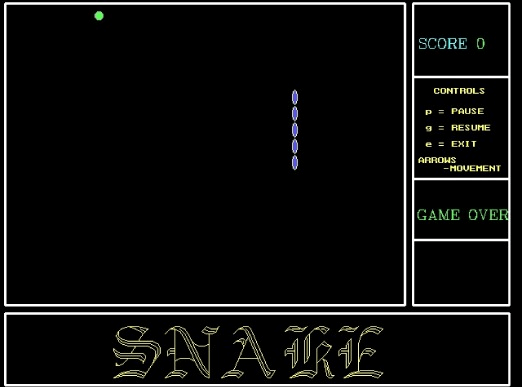
Snake Code in C++
Snake is a popular game that can be played on almost any device and runs on any operating system. In this game, snakes can move in any direction, including left, right, up, and down; after consuming the food, the snake's length increases. Snake food will be generated at a predetermined interval.
With the help of C++ and graphics functions, I'll make a snake game. The concept of C++ classes and computer graphics functions will be applied to this.
Computer Graphics
Information displayed on drawings, graphs, photographs, and visual symbols or on a typewriter called computer graphics.
C++ Graphics Primitives
A graphics primitive is a non-divisible graphical element used in a computer graphics system for input or output. To render and create any images on the screen, we'll need a header file called < graphics.h >. It can also be defined as the way a computer visualizes and manipulates data. All animation and multimedia work best in a photo studio, without having to draw figures of various shapes.
In the snake game, the following activities are used to create graphics:
- The initgraph () function is used to initialize the graphics function.
- Syntax: void Intergraph(int *graph driver, int *graph mode, char *path);
- The graphics driver is represented by gd.
- The graphics mode is represented by gm.
- path: This indicates the location of the graphic file.
- closegraph(): It's used to turn off the graphics feature.
- Syntax: void closegraph ();
- Outputting text: The functions outtext () and outtextxy in C graphics can be used to output text().
- outtext(): It's used to show the current location of the text.
- Syntax: void outtext (char *str);
- outtexttxy(): It's used to show text in a certain location.
- Syntax: void outtextxy (int x, int y, char *str);
Example of a code showing snake game in C++:
#include<iostream.h>
#include<conio.h>
#include<graphics.h>
#include<dos.h>
#include<stdlib.h>
#include<stdio.h>
#include<time.h>
#include<string.h>
class Snake
{
 int p1,p2,v1,v2,v3, e1, e2,prev,now,n,colr,dsp,cnt,dly,m;
 int stp, egGen;
 int xr, yr;
 void caught();
 public:
  long scr;
 int strtX,strtY,endX,endY;
 int pos[100][2];
 void show();
 void init();
 void egg();
 void transpose();
 void gnrtCond();
 void gnrtUnCond();
 void check();
 void checkegg();
 void move();
 void chngDir();
 void sndet();
 void sndCgt();
 int test();
 void score();
 Snake();
 Snake(Snake*);
 ~Snake();
 };
Snake::Snake()
 {
 }
Snake::~Snake()
{
}
void Snake::checkegg()
{
 if((e1 == p1) && (e2 == p2))
 { sndet();
  egg();
  dly--;
  score();
  n++;
  }
}
void Snake::sndet()
{ nosound();
 sound(2500);
 delay(2);
 nosound();
}
void Snake::sndCgt()
{ nosound();
 for(int x=1000;x>0;x--)
 { sound(x);
  delay(1);
  }
 nosound();
}
void Snake::score()
{ char *p;
  ltoa(scr,p,10);
  settextstyle(8,0,1);
  setcolor(0);
  outtextxy(585,40,p);
  if(egGen != 1){
  scr = scr + dly / 10;
  }
  ltoa(scr,p,10);
  setcolor(10);
  outtextxy(585,40,p);
}
void Snake::gnrtCond()
{ if(n < 367)
 { if(now == 8 && (prev != 8 && prev != 2))
  { pos[0][0] = p1;
   pos[0][1] = p2 - dsp;
   prev = now;
   }
  if(now == 4 && (prev != 4 && prev != 1))
  { pos[0][0] = p1 + dsp;
   pos[0][1] = p2;
   prev = now;
   }
  if(now == 2 && (prev != 8 && prev != 2))
  { pos[0][0] = p1;
   pos[0][1] = p2 + dsp;
   prev = now;
   }
  if(now == 1 && (prev != 1 && prev != 4))
  {pos[0][0] = p1 - dsp;
   pos[0][1] = p2;
   prev = now;
   }
}
}
void Snake::gnrtUnCond()
{
  if( prev == 8 )
  { pos[0][0] = p1;
   pos[0][1] = p2 - dsp;
   }
 if( prev == 4 )
  {pos[0][0] = p1 + dsp;
   pos[0][1] = p2;
   }
 if( prev == 2 )
  { pos[0][0] = p1;
   pos[0][1] = p2 + dsp;
   }
 if( prev == 1 )
  {pos[0][0] = p1 - dsp;
   pos[0][1] = p2;
   }
 p1 = pos[0][0];
 p2 = pos[0][1];
}
void Snake::check()
{
 if(p1 > endX)
  {p1 = strtX;}
 else if(p1 < strtX)
  { p1 = endX;}
 if(p2 > endY)
  { p2 = strtY;}
 else if(p2 < strtY)
  { p2 = endY;}
 pos[0][0] = p1;
 pos[0][1] = p2;
for(int i = 1;i < n;i++)
  { if(p1 == pos[i][0] && p2 == pos[i][1])
  { caught();
   break;
  }
 }
}
void Snake::show()
{
  int x = getcolor();
  if(egGen != 1)
  {
  setcolor(getbkcolor());
  setfillstyle(1,getbkcolor());
  fillellipse(v1,v2,yr,yr);
   }
  else
   egGen = 0;
  if (egGen == 2)
   egGen--;
  setcolor(colr);
  setfillstyle(1,9);
  if(now == 8 || now == 2)
   fillellipse(pos[0][0],pos[0][1],xr,yr);
  else if(now == 4 || now == 1)
   fillellipse(pos[0][0],pos[0][1],yr,xr);
  setcolor(x);
}
void Snake::transpose()
{ int i,j,x,y;
   p1 = pos[0][0];
   p2 = pos[0][1];
   if(!egGen){
   v1 = pos[n-1][0];
   v2 = pos[n-1][1];
   }
   else
    egGen = 0;
   for(i = n-1;i >= 1;i--)
   {pos[i][0] = pos[i-1][0];
    pos[i][1] = pos[i-1][1];
   }
}
void Snake::move()
{ int st = 0;
  do{
   if(!kbhit())
   { checkegg();
    if(!st)
     show();
    else
     st = 0;
    delay(dly/4);
    transpose();
    delay(dly/4);
    gnrtUnCond();
    delay(dly/4);
    check();
   delay(dly/4);
    }
   else if(stp){
   chngDir();
   gnrtCond();
   check();
   show();
   st = 1;
   }
   } while(stp);
}
void Snake::init()
{time_t tm;
 srand(time(&tm));
 dsp = 20;
 n = 5;
 prev = 4;
 for(int i = 4;i >= 0;i--)
 { pos[i][0] = 201 + (n - i - 1) * dsp;
  pos[i][1] = 301;
  }
  strtX = 21;
  strtY = 21;
  endX = 481;
  endY = 361;
  colr = 14;
  now = prev;
  dsp = 20;
  stp = 111;
OUTPUT: