
×

C++ Program to Implement Merge Sort

C++ Program to Implement Merge Sort

The technique of merge sort is based on the strategy of divide and conquer. We divide the set of while data into smaller bits, arranged in sorted order followed by combining them into a larger item. It is also very good for the worst cases because, for the worst-case, this algorithm also has lower time complexity.

The complexity of Merge Sort Technique

  • Time Complexity: O(n log n) for all cases
  • Space Complexity: O(n)

Input ? the unsorted list: 14 20 78 98 20 45

Output ? Array after Sorting: 14 20 20 45 78 98

Algorithm

Merge (array, left, middle, right)

Input: The data set array, left, middle and right index

Output: The merged list

   nLeft := m - left+1
   nRight := right – m
   define arrays leftArr and rightArr of size nLeft and nRight respectively
   for i := 0 to nLeft do
      leftArr[i] := array[left +1]
   done
   for j := 0 to nRight do
      rightArr[j] := array[middle + j +1]
   done
   i := 0, j := 0, k := left
   while i < nLeft AND j < nRight do
      if leftArr[i] <= rightArr[j] then
         array[k] = leftArr[i]
         i := i+1
      else
         array[k] = rightArr[j]
         j := j+1
         k := k+1
   done
   while i < nLeft do
      array[k] := leftArr[i]
      i := i+1
      k := k+1
   done
   while j < nRight do
      array[k] := rightArr[j]
      j := j+1
      k := k+1
   done

mergeSort(array, left, right)

Input: An array of data, and lower and upper bound of the array

Output: The sorted Array

Begin
   if lower < right then
      mid := left + (right - left) /2
      mergeSort(array, left, mid)
      mergeSort (array, mid+1, right)
      merge(array, left, mid, right)
End

Example Code:

#include<iostream>
using namespace std;
void swapping(int &a, int &b) {     //swap the content of a and b
   int temp;
   temp = a;
   a = b;
   b = temp;
}
void display(int *array, int size) {
   for(int i = 0; i<size; i++)
      cout << array[i] << " ";
   cout << endl;
}
void merge(int *array, int l, int m, int r) {
   int i, j, k, nl, nr;
   //size of left and right sub-arrays
   nl = m-l+1; nr = r-m;
   int larr[nl], rarr[nr];
   //fill left and right sub-arrays
   for(i = 0; i<nl; i++)
      larr[i] = array[l+i];
   for(j = 0; j<nr; j++)
      rarr[j] = array[m+1+j];
   i = 0; j = 0; k = l;
   //marge temp arrays to real array
   while(i < nl && j<nr) {
      if(larr[i] <= rarr[j]) {
         array[k] = larr[i];
         i++;
      }else{
         array[k] = rarr[j];
         j++;
      }
      k++;
   }
   while(i<nl) {       //extra element in left array
      array[k] = larr[i];
      i++; k++;
   }
   while(j<nr) {     //extra element in right array
      array[k] = rarr[j];
      j++; k++;
   }
}
void mergeSort(int *array, int l, int r) {
   int m;
   if(l < r) {
      int m = l+(r-l)/2;
      // Sort first and second arrays
      mergeSort(array, l, m);
      mergeSort(array, m+1, r);
      merge(array, l, m, r);
   }
}
int main() {
   int n;
   cout << "Enter the number of elements: ";
   cin >> n;
   int arr[n];     //create an array with given number of elements
   cout << "Enter elements:" << endl;
   for(int i = 0; i<n; i++) {
      cin >> arr[i];
   }
   cout << "Array before Sorting: ";
   display(arr, n);
   mergeSort(arr, 0, n-1);     //(n-1) for last index
   cout << "Array after Sorting: ";
   display(arr, n);
}

Output:
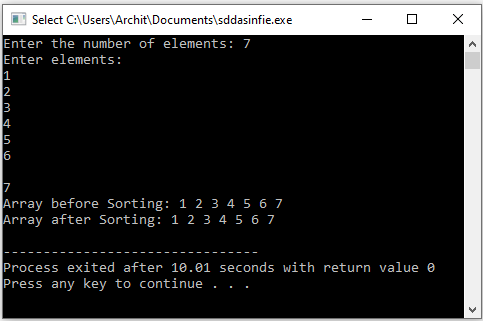
CPP Program to Implement Merge Sort

Related Topics

C++ Continue

In C++, the continue statement is a useful tool for avoiding specific scenarios without breaking the loop. It is employed inside loops to move directly to the following iteration and...

4 minutes read.

How to concatenate two strings in C++

In the C++ programming language, the concatenation of two or even more strings is covered in this section. The term "string concatenation" refers to a collection of characters that join two...

4 minutes read.

Initialize Array of objects with parameterized constructors in C++

Initialize Array of objects with parameterized constructors in C++ When a class is defined, only the specification for the object is specified; no memory or capacity is allocated. You need to...

3 minutes read.

C++ Void Pointer

A void pointer is a general purpose pointer that can have an address of any data type but is not related to any data type. Void Pointer Syntax: void *ptr;  We can't...

2 minutes read.

Single Handling in C++

Introduction: Single handling in C++ refers to a technique for processing multiple events or requests with a single function or handler rather than creating separate functions for each task. This allows...

5 minutes read.

C++ First Program

Let's write a simple basic program structure of C++, its compilation and its execution (how it runs). This program is compiled using GCC compiler. Open any editor to write C++ program. #include<iostream>   using namespace std;   int main(){       cout<<"Welcome to C++ program"<<endl;   } Output...

2 minutes read.

Array of Vectors in C++ STL

Prerequisites: C++ STL Arrays and C++ STL Vector. A group of items kept in consecutive memory region is known as an array. It is to group similar objects of the same...

4 minutes read.

Returning a Function Pointer from a Function in C/C++

Pointers to functions can be used in the C programming language just like standard data pointers such as "int *," "char *," etc. The following is a basic example of a...

3 minutes read.

Is it fine to write void main() or main() in C/C++?

In C programming language: The default function return type in the C programming language is "int," which implies that main() will always return an integer value. In C, the void main()...

3 minutes read.

C++ User Defined Exceptions

Overriding and inheriting exception class capabilities may be used to define the new exception. Exception handling can also be used with classes. We may also make an exception for user-defined...

4 minutes read.

Pthread in C++ Parameters

Pthreads, also known as POSIX threads, is a POSIX standard for multithreading in C/C++. It allows a program to control multiple different threads of execution concurrently. Using pthreads, you can create...

4 minutes read.

C++ Queue

C++ queue: Queue in C++ is also a container adapter with the functionality of a queue. Queue is just the opposite of the stack in C++ because stack works on...

4 minutes read.

Difference between Exit and Return

Define Exit() At the point when a client needs to leave a program from this capability is utilized. A void return type capability calls all capabilities enrolled at the exit and ends...

3 minutes read.

OOPs Concepts in C++

C++ Object-Oriented Programming Concepts C++ uses the concept of object-oriented programming. Object Oriented Programming has some prominent features: Object Class Data abstraction Encapsulation Polymorphism Inheritance Message passing Object An object is the basic unit...

2 minutes read.

Char Array to String in C++

Regardless of the programming language you use, data structure is critical to the success of your project. Although each programming language has its own collection of data structures, C++ contains a...

4 minutes read.

How to call a void function in C++

Generally, any function has two types: 1. Void function: It doesn't return any value. 2. Non-void function: It returns some value. Program to call a void function in C++ #include <iostream> using namespace std;  void check() {  ...

2 minutes read.

Hybrid Inheritance

C++ Hybrid Inheritance When more than one type of inheritance is combined in single inheritance is called as hybrid inheritance. C++ Hybrid Inheritance Example #include<iostream>   using namespace std;   class Student{       protected:           int rollno;       public:           void getRoll(int a){               rollno=a;           }           void putRoll(void){               cout <<"Roll No: "<< rollno<<endl;           }   };   class Test : public Student{       protected:           float subject1, subject2;       public:           void getMarks(float x, float y){               subject1=x;               subject2=y;           }           void putMarks(void){               cout<< "Marks gain: "<<endl <<"Subject1 =  "<<subject1<<endl<<"Subject2 = "<<subject2 <<endl;           }   };   class Sport{       protected:           float score;       public:           void getScore(float s){               score=s;           }           void putScore(void){               cout<<"Sports score: "<<score<<endl;           }   };   class Result : public Test, public Sport{       float total;       public:           void display(void);   };   void Result:: display(void){       total=subject1+subject2+score;       putRoll();       putMarks();       putScore();       cout<<"Total Score: "<<total<<endl;   }   int main(){       Result stu;       stu.getRoll(10);       stu.getMarks(40,50);       stu.getScore(60);       stu.display();       return 0;   } Output: Roll No: 10 Marks gain: Subject1 = 40 Subject2 = 50 Sports score: 60 Total...

1 minute read.

C++ Pointer

Pointer is a derived data type that stores the address of a variable. A pointer is used for memory management and dynamic memory allocation. Pointer works on the address of data rather than...

2 minutes read.

Scope Resolution Operator in C++

The scope resolution operator and its different usage in the C++ programming language will be discussed in this section. The scope resolution operator is used to refer to an out-of-scope...

6 minutes read.

10 Best C and C++ Books for Beginners & Advanced Programmers

If you want to become a skilled software developer, you should never stop learning, whether you're a working professional or a student. Why, therefore, only C or C++? The fundamental...

6 minutes read.