
×

std::distance() in C++

The primary function of std::distance is to facilitate the total number of elements if we have two iterators. It is defined inside the header files. It has both magnitude and direction and so many essential features. It is used to calculate the distance between the first and last points. Suppose, we move in a backward direction, and then a negative sign is associated with it.

Syntax:

std::distance(InputIterator first, InputIterator last)
Here, first and last are input iterators between which we have to calculate distance.
Returns: The number of elements between first and last.

Example:

Input: p = 5 6 7 8 9 10

first pointing to p.begin() and last pointing to p.end()

Output: 

No. of elements: 6

C++ Example 1:

#include <iostream>
#include <vector>
#include <iterator>
using namespace std;
int main()
{
 vector<int> p;
 int i;


 for (i = 0; i < 10; ++i)
 {
  p.push_back(i);
 }


 vector<int>::iterator first;
 vector<int>::iterator last;
 first = p.begin();
 last = p.begin() + 8;
 int num = std::distance(first, last);
 cout << num <<"\n";
 return 0;
}

Output:
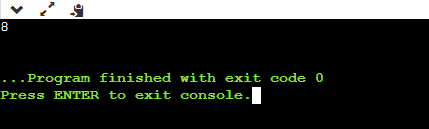
std::distance in C++

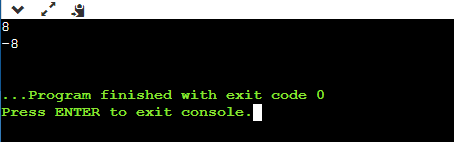
See, what happens when we reverse the order while calculating distance?

C++ Example 2:

#include <iostream>
#include <vector>
#include <iterator>
using namespace std;
int main()
{
 vector<int> p;
 int i;


 for (i = 0; i < 8; ++i)
 {
  p.push_back(i);
 }
 int num = std::distance(p.begin(), p.end());
 cout << num <<"\n";
 num = std::distance(p.end(), p.begin());
 cout << num <<"\n";
 return 0;
}

Output
std::distance in C++

Related Topics

C++ Variable

In this article, we will discuss variables in C++ with their types and examples. What are Variables? Variables are specific memory storage spaces that hold a value. During the execution of a...

4 minutes read.

Inheritance in C++ vs Java

Just like we inherit traits from our parents, object-oriented programming has a concept called inheritance. In terms of object-oriented programming, a class's traits and behaviours, or its data and methods,...

4 minutes read.

Diamond Pattern in C++ using For Loop

For Loop: A for loop is a repetitive control structure that allows you to create a loop for executing a specific number of times. The syntax of for loop: In C++, a for...

5 minutes read.

Maps in C++

Maps: Maps in C++ are the containers associated with key and mapped values. By keys and mapped values, we mean that the maps are used to store elements formed by the...

4 minutes read.

C++ Inline function

A C++ function that extends in line when called is known as an inline function. It reduces function call overhead by having the compiler use the function code rather than...

4 minutes read.

sort() function in C++

This tutorial covers the various built-in sort functions found in the C++ algorithm’s library.  What Does C++ Sort Mean? The concept of sorting in C++ entails rearranging an array's elements in a...

3 minutes read.

C++ Fork

A new process known as a "child process" is created with the fork system function and runs concurrently with the process that invoked fork() (parent process). Both processes will carry...

4 minutes read.

Virtual class in C++

Introduction to Virtual Base class Virtual base classes can be utilized in virtual inheritance as a mechanism for examining many "instances" of a certain class while searching through multiple inheritances in...

6 minutes read.

Differences between Local and Global Variable

Define Global Variable Global variables are those that may be accessible worldwide across a programme and are defined outside of any functions or blocks. It may be accessed by any function in...

3 minutes read.

C++ History

C++ is a middle-level programming language developed in 1980s by Bjarne Stroustrup at Bel Labs. C ++ development initially started in 1979, four years before its launch. It is started with...

1 minute read.

Constructor Overloading in C++

A Constructor is a class member function that is used to initialize the class's objects. Constructors have no return type and are called automatically when an object is formed. Constructor Characteristics Constructors...

3 minutes read.

C++ For loop

C++ loop Statement C++ Loop statement allows us to repeat the execution of a statement or group of statements multiple times. The statement(s) repeat execution within loop until the condition of loop...

2 minutes read.

C++ array of Pointers

Array of Pointers: In high-level programming languages like C++, the array's name is its pointer. The name of an array contains an address which is the address of an element. In...

4 minutes read.

Returning a Function Pointer from a Function in C/C++

Pointers to functions can be used in the C programming language just like standard data pointers such as "int *," "char *," etc. The following is a basic example of a...

3 minutes read.

C++ Math Functions

C++ Math Functions: Like other programming languages, C++ offers plenty of mathematical functions needed for various purposes. These functions are defined mainly in the math library in C++. Let us...

4 minutes read.

Vector resize() in C++

Vector resize() in C++ Vectors are called dynamic arrays and can automatically adjust their size when a component is added or deleted. This container is used for storage. The function modifies the...

3 minutes read.

C++ Data Abstraction

Object-oriented programming (OOP) provides a number of characteristics that enable programmers to design programmes based on a variety of ideas, reducing errors and increasing program flexibility. The abstraction of data...

7 minutes read.

C++ Queue

C++ queue: Queue in C++ is also a container adapter with the functionality of a queue. Queue is just the opposite of the stack in C++ because stack works on...

4 minutes read.

C++ Do while loop

In this article, we will discuss the C++ Do-While loop with its syntax, working, key features, algorithm, and examples. Do-While Loop: The do-while loop constitutes a specific style of looping construct in...

5 minutes read.

How to Declare Unordered Sets in C++

The implementation of an unordered set using a hash table ensures that the insertion is always randomised by hashing the keys into hash table indices. When we define keys of...

4 minutes read.