
×

Lambda Expression in C++

The lambda expression was introduced in C++ 11. It is used to write the inline function in C++. The code written in lambda expression cannot be reused further. The syntax for lambda expression is written as follows:

Syntax:

The general syntax to define a C++ lambda is as follows:

[capture clause] (parameters) mutable exception ->return_type
{
   // definition of the lambda body
}

Return Value:

C++ lambda function executes a single expression. A value may or may not be returned by this expression. It also returns function objects using a lambda.

There are some types of variable that can be held by the lambda variable. These are as follows:

  • Local variables
  • Global Variables
  • Captured variables (variables within [ ] )
  • Arguments/Parameters
  • Data members of a class

The compiler only re-evaluates the lambda expression. Below is some code for lambda expression using C++.

Example 1:

#include <iostream>
#include <string>
using namespace std;
int main()
   {
      auto sum = [](int p, int q) {
      return p + q;
      };
  
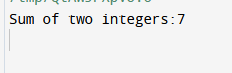
   cout <<"Sum of two integers:"<< sum(7, 0) << endl;
  
   return 0;
   }

Output:
Lambda Expression in C++

Example 2:

#include <vector>
#include <iostream>
#include <algorithm>
#include <functional>
int main()
{
    std::vector<int> c = {1, 2, 3, 4, 5, 6, 7};
    int x = 5;
    c.erase(std::remove_if(c.begin(), c.end(), [x](int n) { return n < x; }), c.end());
 
    std::cout << "c: ";
    std::for_each(c.begin(), c.end(), [](int i){ std::cout << i << ' '; });
    std::cout << '\n';
 
    // the type of a closure cannot be named, but can be inferred with auto
    // since C++14, lambda could own default arguments
    auto func1 = [](int i = 6) { return i + 4; };
    std::cout << "func1: " << func1() << '\n';
 
    // like all callable objects, closures can be captured in std::function
    // (this may incur unnecessary overhead)
    std::function<int(int)> func2 = [](int i) { return i + 4; };
    std::cout << "func2: " << func2(6) << '\n';
 
    constexpr int fib_max {8};
    std::cout << "Emulate `recursive lambda` calls:\nFibonacci numbers: ";
    auto nth_fibonacci = [](int n)
    {
        std::function<int(int, int, int)> fib = [&](int n, int a, int b)
        {
            return n ? fib(n - 1, a + b, a) : b;
        };
        return fib(n, 0, 1);
    };
 
    for (int i{1}; i <= fib_max; ++i)
    {
        std::cout << nth_fibonacci(i) << (i < fib_max ? ", " : "\n");
    }
 
    std::cout << "Alternative approach to lambda recursion:\nFibonacci numbers: ";
    auto nth_fibonacci2 = [](auto self, int n, int a = 0, int b = 1) -> int
    {
        return n ? self(self, n - 1, a + b, a) : b;
    };
 
    for (int i{1}; i <= fib_max; ++i)
    {
        std::cout << nth_fibonacci2(nth_fibonacci2, i) << (i < fib_max ? ", " : "\n");
    }
 
#ifdef __cpp_explicit_this_parameter
    std::cout << "C++23 approach to lambda recursion:\n";
    auto nth_fibonacci3 = [](this auto self, int n, int a = 0, int b = 1)
    {
         return n ? self(n - 1, a + b, a) : b;
    };
 
    for (int i{1}; i <= fib_max; ++i)
    {
        std::cout << nth_fibonacci3(i) << (i < fib_max ? ", " : "\n");
    }
#endif
}

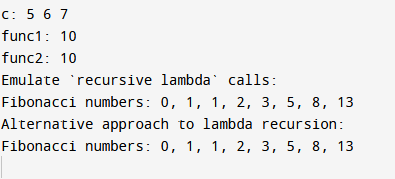
Output:
Lambda Expression in C++

Example 3:

#include<bits/stdc++.h>
using namespace std;
int main(void)
{
    vector<int> v = {6,7,8,9,10};
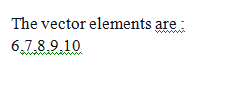
    cout <<"The vector elements are: \n";
    // define an inline lambda expression
    // to print the vector elements
    for_each(v.begin(), v.end(), [](int element) {
            cout << element <<"";
        });
    cout <<"\n";
    return 0;
}

Output:
Lambda Expression in C++

Related Topics

C++ cin and cout

In this article, we will discuss the C++ cin and cout with their library and examples. C++ Standard Input/Output: User-program communication is made possible by C++’s usage of input and output (I/O)...

5 minutes read.

Vector in C++

Vector in C++ In today’s article, we will be learning all the things about vector in C++ and how vector is different form an array in C++. So basically, vector is very...

3 minutes read.

C++ File Handling

File handling is a mechanism that manipulates the data stored in files. File handling store output data from the program to external file and read file data to the program. There...

3 minutes read.

How to create the Processes with Fork in C++

 In this article, we are going to explain the different methods that help us to create processes with a fork(). There are two methods to do so. These methods are...

2 minutes read.

Dynamic Memory Allocation in C++

In some programming situations, the number of data items changes as the program is running, which is known as dynamic data or input. Consider a real-world situation where a program...

3 minutes read.

C++ Continue

In C++, the continue statement is a useful tool for avoiding specific scenarios without breaking the loop. It is employed inside loops to move directly to the following iteration and...

4 minutes read.

getline() Function and Character Array in C++

In this article, we will explore about some concepts on getline() function and character array in the most useful language C++. The getline() method in C++ is simply a standard library...

6 minutes read.

C++ Try-Catch

Every useful program will eventually encounter unexpected outcomes. By entering data that are incorrect, users might create mistakes. Sometimes the program's creator didn't consider all of the options or was...

7 minutes read.

Armstrong Number Program in C++

Let's first define Armstrong number before writing the C++ program to check whether the number is Armstrong or not. The sum of the cubes of its digits is equal to the...

2 minutes read.

Difference between Exit and Return

Define Exit() At the point when a client needs to leave a program from this capability is utilized. A void return type capability calls all capabilities enrolled at the exit and ends...

3 minutes read.

C++ Prime number program

In this lesson, you'll learn how to verify whether a given number is a prime number or not in C++, and you'll obtain code to do it. What is the definition...

3 minutes read.

C++ Comments

Comment/Remark A Comment or a Remark is text that is ignored by the compiler yet is beneficial to programmers. Code is usually annotated with comments for future reference. They are treated...

3 minutes read.

Bitwise Operator vs Logical Operator

Bitwise Operator  Bitwise operators perform operations bit by bit on bits.The value is converted to abinary during operations like addition, subtraction, division, and so on. These operations are carried out at the...

3 minutes read.

C++ Friend Functions

In C++, friends are special functions that are not a part of a class yet have access to its private and protected members. The friend keyword is used to declare...

4 minutes read.

C++ If-else-if

Introduction: If-else-if control statement is an if statement used with an optional else if control statement to check multiple conditions. In this control statement, when any one of the condition returns...

4 minutes read.

Structure of C++ Program

Many people believe that C++, an object-oriented programming (OOP) language, is the finest language for developing demanding applications. A superset of the C language is C++. Java, a closely comparable...

4 minutes read.

Bits stdc++.h in C++

<bits/stdc++.h> in C++ In essence, it is a header file that contains all the standard libraries. It makes sense to use this file in programming competitions to speed up work, especially...

2 minutes read.

Dynamic Binding in C++

The notion of dynamic binding solved the challenges associated with static binding. Static binding refers to bindings that can be resolved by the compiler at runtime. All storage, stationary, and...

3 minutes read.

C++ Call by Value

In this article, we will discuss C++ Call by Value with their syntax, examples, use cases, advantages, and disadvantages. C++ Function A function is a set of statements that executes a task....

5 minutes read.

Random Number Generator in C++

In programming, we need to frequently create the randomly. For example, a dice game, handing out cards to players, apps for rearranging tunes, etc. T There are two tools available in...

4 minutes read.