
×

Dynamic Constructor in C++

Dynamic constructors create dynamic memory by using a dynamic memory allocator new within the constructor. This allows us to initialize objects dynamically. The term dynamic constructor is used when memory allocation is done dynamically inside a constructor using the keyword new.

The dynamic constructor will not create any memory for the object. However, it creates a memory block that the objects could access.

Example-1:

#include<iostream>
using namespace std;


class example
{
  const char* ptr;


public:


  // default constructor
  example()
  {
    // allocating memory at run time by using the new keyword
    ptr = new char[15];
    ptr = "Hi from example constructor ";
  }


  void display()
  {
    cout << ptr;
  }
};


int main()
{
  example  obj1;
  obj1.display();
}

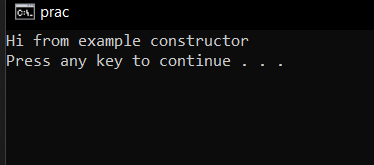
Output:
Dynamic Constructor in C++

Explanation:

In the above example, we have created a class example inside which we have given a constructor with the same name as the class name. We have declared a pointer for a character. We have used the pointer and created a char using the pointer.

Example-2:

#include<iostream>
using namespace std;


class example
{
  int num1;
  int num2;
  int *ptr;


public:
  // default constructor (here, it is a dynamic constructor also)
  example()
  {
    num1 = 0;
    num2 = 0;
    ptr = new int;
  }


  //dynamic constructor with parameters
  example(int x, int y, int z)
  {
    num1 = x;
    num2 = y;


    ptr = new int;
    *ptr = z;
  }


 void display()
 {
   cout << num1 << " " << num2 << " " << *ptr;
 }
};


int main()
{
  example obj1;
  example obj2(20, 50, 1);


  obj1.display();
  cout << endl;


  obj2.display();
}

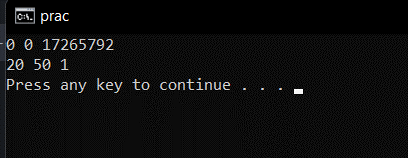
Output:
Dynamic Constructor in C++

Explanation:

In the above example, we used the dynamic constructor and passed a few arguments. Unlike in the previous example, we have passed a few arguments.


Related Topics

C++ Constructor

Constructor is a specific method in C ++ that is automatically called when an object is created. Typically, it is used to set the data members of a new object....

4 minutes read.

Two dimension array

C++ Two dimension (2D) Array Two dimension (2D) array is an array of arrays. It is represented in the form of row and column. The elements of 2D array are accessed through the...

2 minutes read.

Do-While Loop Examples in C++

Before we move on the examples of Do-While loop, let’s learn little bit about the Do-While loop in C++ language. Do While loop An iterative loop that checks the condition at the...

5 minutes read.

C++ Object Class

C++ Object Class Overview: C++ is a high-level programming language and an object-oriented programming language. An object-oriented language always has some properties of classes and objects. In this article, we...

4 minutes read.

C++ Fork

A new process known as a "child process" is created with the fork system function and runs concurrently with the process that invoked fork() (parent process). Both processes will carry...

4 minutes read.

Features of OOPS in C++

What is OOPs? The main reason programmers prefer C ++ language over C is because of the support of object-oriented programing in C++. As the name suggests, object-oriented programming or OOPs...

3 minutes read.

Hexadecimal to Decimal in C++

In computers, hexadecimal numbers are represented with base 16 and decimal numbers are represented with base 10 and values 0-9, whereas hexadecimal numbers have digits ranging from 0 to 15,...

3 minutes read.

C++ Queue

C++ queue: Queue in C++ is also a container adapter with the functionality of a queue. Queue is just the opposite of the stack in C++ because stack works on...

4 minutes read.

How to create a button in C++

A button is an option through which a user can control to click a provided input to an application. There are several buttons, each with different styles, to maintain the...

3 minutes read.

Auto keyword in C++

The primary function of auto keyword is to assign and detect the value of the data type automatically in C++. The compiler knows the data type of the variable by...

2 minutes read.

C++ Functions

In other programming languages, a function is referred to as a process or a subroutine. We can design functions to execute any task. A function can be used repeatedly. It...

5 minutes read.

Passing a Vector to a function in C++

A pointer is sent to the function when we feed it an array. However, there are two ways to pass a vector: Pass by Value Pass by Reference A copy of a vector...

3 minutes read.

C++ Writing to file

In file handling, write() function is used to write data into the file. The write() uses ofstream or fstream library to write into the file. Syntax file-stream-class   file-stream-object;   file-stream-object.write((char *)&var , sizeof (var)); The write() takes two arguments. The first argument is the address of variable var...

2 minutes read.

CPP Templates

C++ provides a powerful feature called template, which allows the definition of generic classes and generic functions. Generic programming is a technique where different algorithms work in communion by using...

4 minutes read.

Top best IDEs for C/C++ Developers in 2024

Nothing in the current digital world is conceivable without programming. Everything needs programming, from the cell phones in our pockets to self-driving cars. Programming is also necessary for the mouse...

9 minutes read.

Factorial Program in C++

C++ Factorial Program: The product of all positive descending integers is the factorial of n. n! denotes the factorial of n. For instance: 5! = 5*4*3*2*1=120 4! = 4*3*2*1=24 In Combinations and Permutations, the...

4 minutes read.

How to find the length of the vector in C++

Like dynamic arrays, vectors can automatically adjust their size when an element is added or removed, and the container manages its storage. Because vector items are stored in contiguous storage, iterators...

3 minutes read.

C++ Date and Time

The date and time formats in C++ will be covered in this article. Because C++ lacks a proper date and time format, we must rely on the c language. The...

7 minutes read.

Queue in C++

What is Queue? As the name suggests, the queue is the type of data structure that follows the FIFO (First In - First Out) mechanism. In simple words, it is...

4 minutes read.

Initialize Vector in C++

Initialize Vector in C++  The following comparison operators are defined for vector and those are given below. ==, <, <=, !=, >,>=  This allows you to access the element of a vector using...

3 minutes read.