
Call by Pointer in C++
What is Pointer?
Every variable in C++ has a specific address or location in the computer's memory, and this address is known as the memory address. A pointer can be defined as a variable that stores the memory address of another variable.
It enables the programmer to manage the memory.
The C++ language has a wide range of pointer-based features.
It has characteristics like the ability to refer to the same memory location from several memory locations, which means that we can update one point in the program and have the changes appear in other areas.
It is feasible to have a more flexible memory allocation and deallocation because of pointers. It's also utilized in function pointers and polymorphism.
Call by Pointer:
A function's address is copied into a formal parameter when arguments are passed to it using the call-by-pointer method. The address is used inside the function to determine the actual parameter used in the call. The passed argument is affected by modifications made to the parameter, in other words.
Argument pointers are supplied to functions the same way as other values to transmit values by the pointer. Since the following function swap() swaps the values of the two integer variables pointed to by its arguments, you must specify the function parameters as pointer types.
Due to the fact that both variables' addresses are the same, the variable inside the function is an alias for the variable that was supplied. As a result, any changes made to the variable within the function will likewise be reflected in the calling function.
A function that has the capacity to reflect changes may return more than one value. Additionally, this technique might theoretically allow a void function to return a value or several values. Values passed through the pass-by-pointer in a function are indicated by the & (address of) operator in the actual arguments.
Function Call by Pointer:
The term "call-by-pointer" refers to a technique where the variable address from the calling function is passed and used as a pointer inside the function.
Using this way, functions where the given variables' values could change are more clearly seen.
Specifically, with a pass-by-reference implementation, the function call does not contain any information that could be exploited to infer that the supplied variables' values might change during its execution (as the call is identical to call by value).
The address operator & is used in the function call when calling via a pointer, giving additional information about the function's purpose.
Program:
#include <iostream>
using namespace std;


// prototype for a function that takes pointers as parameters
void swap(int*, int*);


int main()
{


    // initialize variables
    int x = 12, y = 14;


    cout << "Before swapping" << endl;
    cout << "x = " << x << endl;
    cout << "y = " << y << endl;


    // calling a function with a variable address
    swap(&x, &y);


    cout << "\nAfter swapping" << endl;
    cout << "x = " << x << endl;
    cout << "y = " << y << endl;
    return 0;
}


//To swap numbers, here we define the function
void swap(int* a, int* b ) {
    int temp;
    temp = *a;
    *a = *b;
    *b = temp;
}
Explanation:
- First, we created a swap function, which takes pointers as a function parameter. This function has void data types, which means this function is Returns Nothing type.
- In the main() function, we initialize two variables, "x" and "y," which have an int data type.
- Then we called the swap function with the address of the (&) operator.
- Then We define the swap function for swapping the number.
- When calling a function, the address of the variable is provided rather than the variable itself.
- A dereference operator * must be used to access the value stored in the address since it is being passed rather than the value.
- The value kept at addresses a and b, respectively, is given by the functions *a and *b.
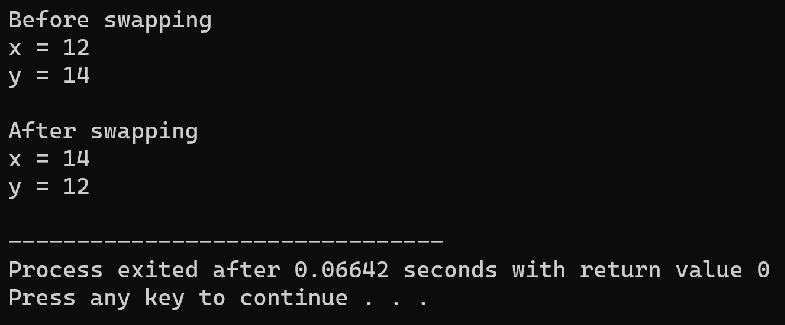
- Because a and b hold the addresses for x and y, any changes made to *a and *b will alter the actual values of x and y. Due to this, the values are altered when we print the values of x and y in the main() function.
Program output:
Program:
#include <iostream>
using namespace std;


// Function define


void fun(int *a)
{
*a = *a - 1;
}


int main()
{
int x = 5;
cout << "Value of x before modification:  "<< x << endl;


// function call
fun(&x);
cout <<"Value of x after modification:  "<< x << endl;
}
Explanation:
- 1st we define a function whose name is "fun" with the return type void and takes in value as a pointer. Here pointer (*) is denoted by an asterisk sign in the formal parameter.
- In the fun() function body, the value of the formal parameter(*a) is decreased by 1.
- In the main() function, we initialize a variable "x" with the value of 5, which has an int data type.
- The execution will start from the main() function, the line "value of x before modification" will execute first, and the value of x will display.
- Then the fun() function called the address of the variable is passed as an argument, and inside the function, the value of pointer a will decrease by 1.
- Then the execution of this function will finish and execution takes back to the main() function.
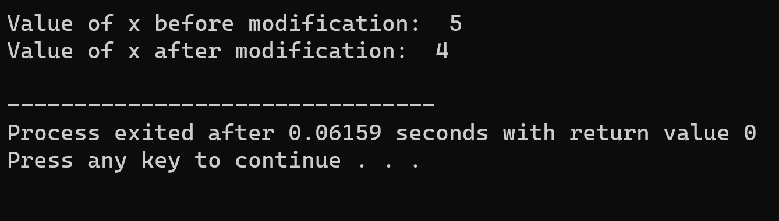
- And upon returning from the function, “the value of x after modification” will display, which turns out to be 1 less than the original value.
Program Output:
Conclusion:
- Call-by-pointer is quick and effective even when passing huge data items because a pointer or address' size is tiny and fixed (for instance, the size of a pointer to an int is the same as the size of a pointer to an enormous structure).
- Programs can use the arguments to pass data into and out of functions using call-by-pointer technology (i.e., data can flow into the function, out of the function, or flow in both directions).
- In C++, a call by the pointer is a technique for passing values to function parameters. When using a pointer to call a function, the formal parameter receives the address of the actual arguments. This means that if the values inside the function are changed, the actual parameters will also be affected.