
IoT Tutorial

IoT stands for the Internet of Things. The term "Things" refers to objects (home appliances and devices) that we use in our daily life. These objects are accessible or connected through the Internet, called Internet of Things.

Internet of Things can be defined as, a network of physical objects that are integrated into the software, electronic devices, and sensors, allowing these objects to collect and exchange data.

The goal of IoT is to extend Internet connectivity from standard devices such as a computer, mobile phone, and electronic devices. IoT makes virtually everything "smart" by improving certain aspects of our lives with the power of data collection, artificial intelligence algorithms, and networks.
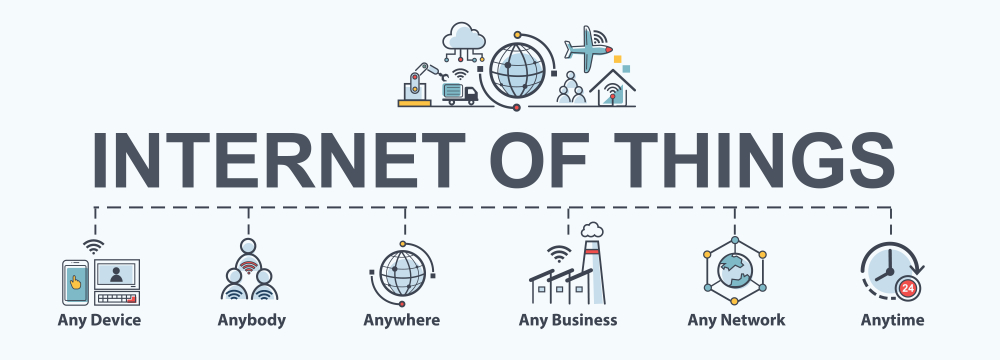
What is IoT | Internet Of Things

For Example: Let's take the example of Home automation. Suppose, your family goes out for a holiday, and by mistakenly the machine was left switched on. In that case, without IoT, we had no option, and this could also result in the damage of the appliance. But, with the help of IoT, the appliances can be controlled with the help of your mobile or computer, and it can be switched ON or OFF at any time and from anywhere.

History of IoT

The term "Internet of Things" is in existence since twenty years. But the real idea of connected devices has existed for longer, at least since the 70s. At that time, the idea was often called "integrated Internet" or "generalized computing". The term "Internet of Things" was invented by Kevin Ashton in 1999 while he was working with Procter & Gamble (which was later MIT's Auto-ID Centre). Kevin Ashton, who worked on supply chain optimization, wanted to draw senior management's attention to an exciting new technology called RFID. Because the Internet was the most popular in 1999 and it made sense, he called his presentation of the Internet of Things.

Features of IoT
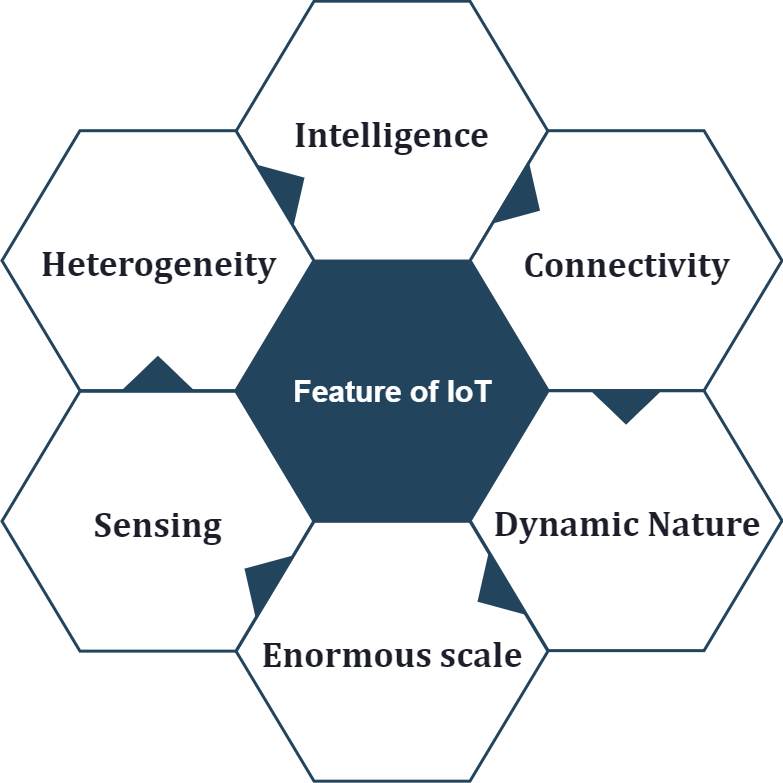
Features of IoT

1. Intelligence

IoT comes with the combination of algorithms, computer, software, and hardware that make it smart. Environmental information in IoT enhances their capabilities, enabling them to respond intelligently to a given situation and helping them to perform specific tasks. IoT intelligence is not seen as a means of interaction between devices, while the communication between users and devices is achieved through standard input methods and a graphical user interface.

2. Connectivity

Connectivity enhances the Internet of Things by bringing together objects from everyday life. The connectivity of these objects is essential because simple object-level interactions contribute to collective intelligence within the IoT network. It allows network accessibility and compatibility in things. With this connectivity, new opportunities for the Internet of Things can be created by networking smart objects and applications.

3. Dynamic Nature

The main activity of the Internet of Things is to collect data from then environment, achieved by the dynamic changes that occur around the devices. The status of these devices dynamically changes. For example, sleeping and waking up, connected and disconnected, as well as in the context of devices or appliances, including temperature, location, and speed. In addition to the device state, the number of devices also dynamically changes with a person, a place, and a time. 

4. Enormous scale

The number of devices to be managed and communicating with each other will be much higher than the number of devices connected to the current Internet. The management of data generated from these devices, and their interpretation for application objects becomes more critical.

Gartner, Inc. confirms the considerable size of the IoT in the estimated report.The report indicates that 5.5 million new things will be connected each day and that 6.4 billion connected things will be in use worldwide in 2016, an increase of 30% per year percentage since 2015. The report also predicts that the number of connected devices will reach 20.8 billion by 2020.

5. Sensing

IoT does not work without sensors. A sensor detects or measure changes in the environment. It generates data that can inform its status or even interact with the situation. Sensing technologies creates capabilities that reflects real awareness of the physical world and the people who make it up. Sensing information is simply the analog inputs of the physical world, but it can provide a rich understanding of our complex world.

6. Heterogeneity

The heterogeneity is the key features IoT. IoT devices are based on different hardware and network platforms. It can interact with other devices or service platforms across multiple networks. The IoT architecture supports direct network connectivity between heterogeneous networks. The essential design requirements for heterogeneous objects and their IoT environments are scalability, scalability, scalability, and interoperability.

IoT (Internet of thing) Topics

  1. Introduction and History of IoT
  2. Advantages and Disadvantages of IoT
  3. Application of IoT
  4. IoT Hardware
  5. IoT Software
  6. Protocols of IoT
  7. Components of IoT
  8. IoT Ecosystem
  9. IoT Architecture
  10. IoT Technologies
  11. IoT Platforms
  12. Challenges of IoT
  13. Major Boards of IoT
  14. Contiki OS
  15. Skills required for an IoT Developer
  16. What is an IoT Device?
  17. Installation Ardunio software for windows
  18. Projects of IoT

Related Topics

IoT GE Predix

The GE Predix stands for the General Electric Predix. GE Predix is a software platform that collects data from industrial instruments. It provides a cloud-based PaaS (platform as a service)...

1 minute read.

IoT - Platform

IoT Platform: As in IoT, all IoT devices are connected to other IoT devices and applications to transmit and receive information through protocols. There is a difference between the IoT...

2 minutes read.

Applications of IoT

Smart Home: A smart home encapsulates the connectivity inside our homes. It includes home appliances, smoke detectors, windows, light bulbs, door locks, etc. Smart City: A Smart City is a technically advanced...

2 minutes read.

IoT Technologies

The IoT is based on three main technologies: Hardware (includes chips and sensors)Communication (includes wireless network)  Software (includes data storage, analytics, front-end applications) The reason the Internet of Things is emerging so rapidly today...

1 minute read.

IoT Tutorial

IoT stands for the Internet of Things. The term "Things" refers to objects (home appliances and devices) that we use in our daily life. These objects are accessible or connected...

4 minutes read.

Salesforce IoT Cloud

Salesforce IoT Cloud IoT Cloud is a platform from Salesforce. Salesforce is designed to store and process IoT data. It is powered by Thunder. Thunder is an event processing engine designed to capture, filter, and...

2 minutes read.

IoT Architecture

Our approach to the IoT architecture is reflected in the IoT architecture diagram that presents the diagram of an IoT system and explains how it is connected to store, collect,...

2 minutes read.

Session Layer Protocols

1) MQTT MQTT stands for Message Queue Telemetry Transport. It was introduced by IBM in 1999 and standardized by OASIS in 2013. It is used for remote monitoring in IoT. Its...

2 minutes read.

IoT Hardware

IoT hardware includes a wide range of devices, such as routing devices, bridges, sensors, etc. These IoT devices support key tasks and functions such as system activation, security, action specifications, communication, and detection...

2 minutes read.

Major Boards of IoT

Major Boards of IoT Arduino:  Arduino UNO is the popular open-source electronics platform based on easy-to-use software and hardware. It is intended for artists, hobbyists, designers, and anyone interested in building interactive objects. It...

2 minutes read.

IoT Software

The IoT software addresses significant areas of networking and action through platforms, integrated systems, associated systems, and middleware. These applications are responsible for data collection, device integration, real-time analysis, and process extension in the...

1 minute read.

Download and Install Arduino in Windows

Download and Install Arduino in Windows Step 1. Download  IDE from https://www.arduino.cc/en/Main/Software. Step 2. Scroll down the page and click on Windows app link, as shown in the following figure. Step 3. Click on the...

1 minute read.

Network layer Protocols

Network layer Encapsulation ProtocolsNetwork Layer Routing Protocols 1. Network layer Encapsulation Protocols a) 6LoWPAN 6LoWPAN stands for IPv6 Over Low-Power Wireless Personal Area Network. It is mostly used standard in this category. It...

2 minutes read.

Arduino UNO Distance Project

Ultrasonic Sensor HC-SR04 and Arduino to distance calculation using Processing App: Let's build an IoT project using Ultrasonic HC-SR04 Sensor and Arduino UNO to calculate the distance between the Ultra Sonic HC-SR04 device and...

2 minutes read.

IoT Ecosystem

The following figure shows the seven-layer model of the IoT Ecosystem. The first layer represents the market or application domain that includes smart grid, connected home, smart health, or smart cities, etc.The second layer consists...

1 minute read.

Skills required for an IoT Developer

"Internet of Things" is about communication between software and devices. An IoT development team should be essentially large, and developers are divided into different areas according to their respective work. Some of these...

1 minute read.

Detect darkness Using Arduino and LDR Sensor

Detect the darkness with the help of Arduino board and LDR Sensor In this project, Arduino and LDR Sensor turns on lights automatically, when an LDR sensor detects darkness. Requirements of hardware...

2 minutes read.

Arduino UNO Home Automation

Build a Bluetooth controlled Home Automation Setup Using Arduino UNO board and Relay module Do you want to automate your home? Have you ever wanted to control your home appliances by swipe the screen...

4 minutes read.

Arduino UNO Bluetooth LED Controls

How to Build a Bluetooth controlled LED light Setup Using Arduino UNO board: Let's build an IoT project using Arduino UNO and the Bluetooth module HC-05 to control an LED. In this project,...

2 minutes read.

What is an IoT Device?

A device in which a sensor is connected and able to transfer data from one device to another over the internet is called an IoT device. IoT devices consist of software, wireless sensors, actuators,...

1 minute read.