R Line Graphs

Line graph or line chart is a graph that connects a series of points by drawing segments between them. A line graph represents the relationship between 2 variables. These points are ordered in one of their coordinates (usually the x- coordinate) value. The plot() function is R is used to create the line graph.
Syntax:
plot(v,type,col,xlab,ylab)
v is a vector containing the numeric values. type is used to set the value if it is ‘p’ then it draws only the points, if ‘I’ is used to draw the lines and if “o” then is used to draw both points and lines. xlab is the label for the x-axis ylab is the label for the y-axis main is the title of the chart col is for the color to both points and lines
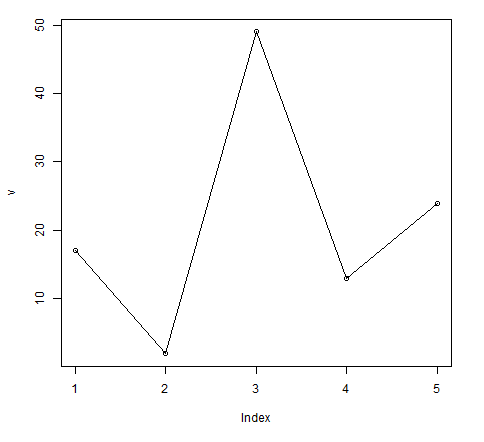
Example 1: Let's create a simple line chart using the input vector and type parameter as “o”.
# Create the data for the chart.
v <- c(17,2,49,13,24)
# Give the chart file a name.
png(file = "line_chart.jpg")
# Plot the bar chart.
plot(v,type = "o")
# Save the file.
dev.off()
Output:

R Line Graph Example 1 

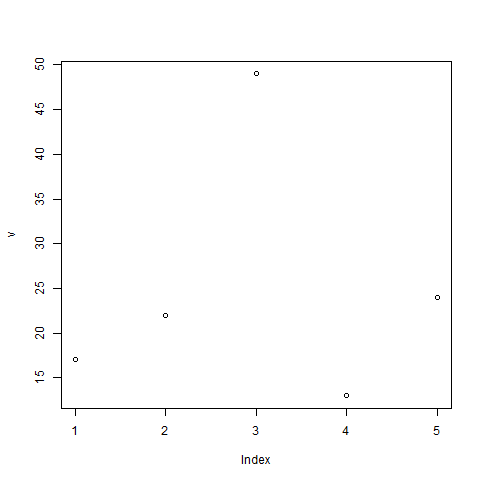
Example 2: Let's create a simple line chart using the input vector and type parameter as “p”.
# Create the data for the chart.
v <- c(17,22,49,13,24)
# Give the chart file a name.
png(file = "line_chart_o.jpg")
# Plot the bar chart.
plot(v,type = "p")
# Save the file.
dev.off()
Output:

R Line Graph Example 2


Line Chart with Title, Color, and Label

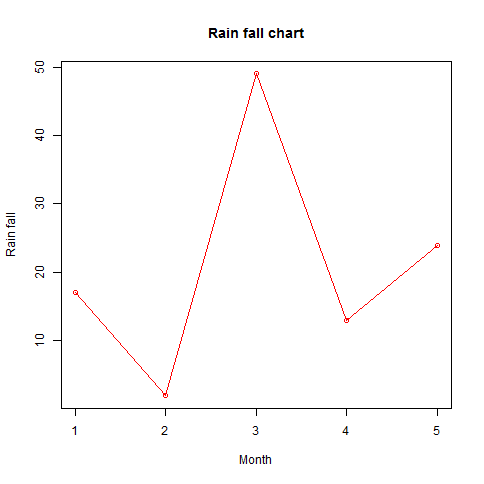
We can add more parameters to expand the feature of a line chart. We can add the color parameter, give the title to the chart and we can also add labels to the axes.
R Line Graph Example 3

Multiple Lines in a Line Graph
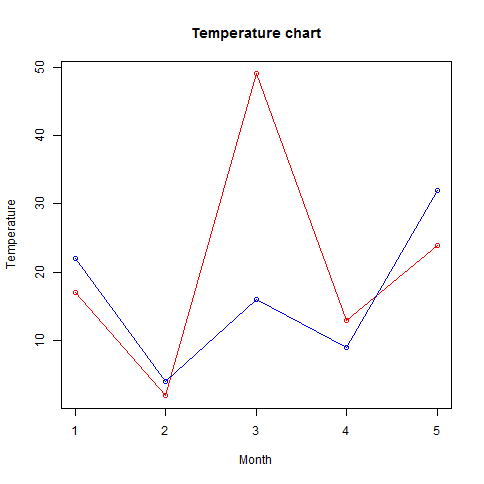
We can draw more than one line on the same chart by using the lines() function. Let’s see an example.

Example:
# Create the data for the chart.
v <- c(17,2,49,13,24)
t <- c(22,4,16,9,32)
# Give the chart file a name.
png(file = "line_chart_2_lines.jpg")
# Plot the bar chart.
plot(v,type = "o",col = "red", xlab = "Month", ylab = "Temperature", main = "Temperature chart")
lines(t, type = "o", col = "blue")
# Save the file.
dev.off()
Output: 

R Line Graph example 4

Related Topics

Poisson Distribution in R Programming

Poisson distribution is a type of distribution that deals with the probability distribution of the data values by taking the mean into consideration. Poisson distribution will estimate the probability value for...

3 minutes read.

R Pie Charts

R programming language provides many numbers of libraries to create charts and graphs. A pie-chart is a representation of data as slices of a circle with different colors representing counts...

2 minutes read.

R Basic Data Types

Data types are used to define the size and type of the variable. In R, there is no need to declare a variable as some data types. The variables are...

4 minutes read.

How to create Histograms in R

R Histograms A Histogram is the graphical representation of the distribution of numeric data. It takes only one numeric variable as input. The variable is cut into several bars (also called...

2 minutes read.

R Switch Statement

It is an alternate way to a nested if…else statement. A switch statement permits an expression to be tested against a list of case values. In short, we can say...

1 minute read.

Normal Distribution in R Programming

In statistics, the normal distribution is a type of probability function. Normal distribution tells the user about the distribution of data values in the dataset. It is a very important...

3 minutes read.

Linear Regression in R Programming

Linear Regression is an unsupervised machine learning algorithm in R programming. Linear Regression is a type of regression analysis that shows the relationship between two or more variables. And one...

3 minutes read.

Introduction to R Programming

What is R Programming? R is a programming language which provides an environment for software used for statistical analysis, graphics representation and reporting. It possesses an extensive catalog of...

4 minutes read.

R Tutorial

Introduction to R Programming R is nothing but a programming language, also a free software environment. This software used for predictive analysis, statistical analysis, graphical representation, data modeling, and reporting. R...

9 minutes read.

R Data Types

Data types are used to define the size and type of the variable. In R, there is no need to declare a variable as some data types. The variables are...

4 minutes read.

First R Program

First  Hello World R Program As a convention, our first R program will be the “Hello World!” program. We can run our R program either at R command prompt or we...

3 minutes read.

R JSON File

JSON stands for JavaScript Object Notation. It is a lightweight format for storing and transporting data. JSON file is often used when data is sent from a server to a...

2 minutes read.

R Variables, Constants and Reserved Words

R Variables Variables are very similar to an open box, where you can put any value of your wish. We can change the values as well. Variables are used to store...

4 minutes read.

Measures of Central Tendency in R Programming

Central Tendency or CT is one of the features of descriptive statistics. The Central tendency will let us know how the various groups of data are clustered around the central...

4 minutes read.

Decision Tree in R Programming

The decision tree uses the branching method to show every possible output for the specific input. We can draw a decision tree by hand or create it using specialized software...

2 minutes read.

R Functions

In programming, a function is a group of instructions that you want to use repeatedly, because of their complexity, are better self-contained in sub-program and called when needed. Hence, we can...

4 minutes read.

Pie Charts in R Programming

R programming has various libraries to plot various types of charts and graphs. A pie chart is a circular statistical chart or graph, which is divided into slices to represent the numerical...

4 minutes read.

Logistic Regression in R Programming

Logistic Regression is a classification supervised machine learning algorithm in R programming. Logistic Regression can also be termed Binomial Logistic Regression, Binary Logistic Regression, or Logit Model. Logistic Regression is...

4 minutes read.

Analysis of Covariance in R Programming

Analysis of Covariance can also be named ANCOVA. We know that we use the concept of regression analysis for creating models which can explain the effect of the variation in...

2 minutes read.

How to make Boxplots in R

R Boxplots Boxplot is a measure of how well the data is distributed in a data set. It is used to give a summary of one or several numeric variables. The...

3 minutes read.