R Pie Charts

R programming language provides many numbers of libraries to create charts and graphs. A pie-chart is a representation of data as slices of a circle with different colors representing counts or proportions. Each slice is labeled and the numbers corresponding to each slice is also represented in the chart. In R, pie() function is used to create a pie chart. This function takes positive numbers as a vector input. The additional parameters are used to control colors, labels, title, etc.
Syntax:
pie(x, labels, radius, main, col, clockwise)
Here, x is a vector of numeric values used in the pie chart. lables is the description of the slices. radius is the radius of the circle of the pie chart (Value between -1 and +1) main is the title of the chart col represents the color. clockwise is a logical value represents if the slices are drawn clockwise or anti clockwise.
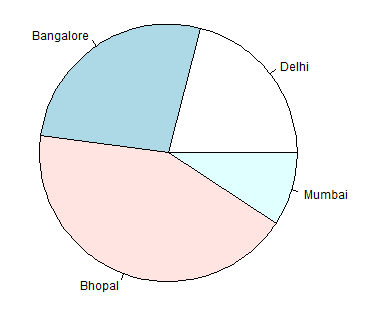
Example: Let's create a simple pie chart using the input vector and labels. The following script will create and save the pie chart in the current R working directory:
# Create data for the graph.
x <- c(25, 32, 51, 11)
labels <- c("Delhi", "Bangalore", "Bhopal", "Mumbai")
# Give the chart file a name.
png(file = "city.jpg")
# Plot the chart.
pie(x,labels)
# Save the file.
dev.off()
Output: 
pie chart in the current R 

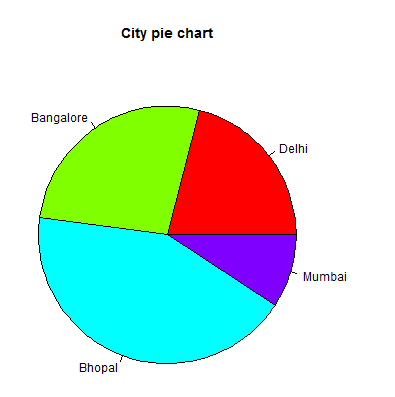
Pie Chart Title and Color We can add more parameters to the pie function. Here, we will use main and col parameter.

Example:
# Create data for the graph.
x <- c(25, 32, 51, 11)
labels <- c("Delhi", "Bangalore", "Bhopal", "Mumbai")
# Give the chart file a name.
png(file = "city_title_colours.jpg")
# Plot the chart with title and rainbow color pallet.
pie(x, labels, main = "City pie chart", col = rainbow(length(x)))
# Save the file.
dev.off()
Output:

city pie function 

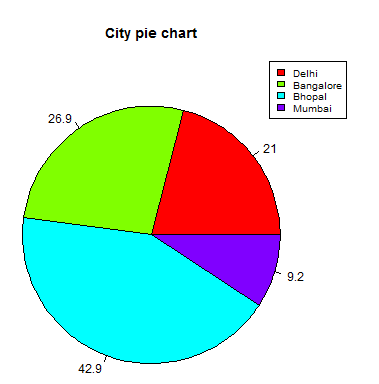
Slice Percentage and Chart Legend We can also add slice percentage and a chart legend by creating additional chart variables.

Example:
# Create data for the graph.
x <- c(25, 32, 51, 11)
labels <- c("Delhi", "Bangalore", "Bhopal", "Mumbai")
piepercent<- round(100*x/sum(x), 1)
# Give the chart file a name.
png(file = "city_percentage_legends.jpg")
# Plot the chart.
pie(x, labels = piepercent, main = "City pie chart",col = rainbow(length(x)))
legend("topright", c("Delhi", "Bangalore", "Bhopal", "Mumbai"), cex = 0.8,
       fill = rainbow(length(x)))
# Save the file.
dev.off() 
Output:
Slice Percentage and Chart Legend

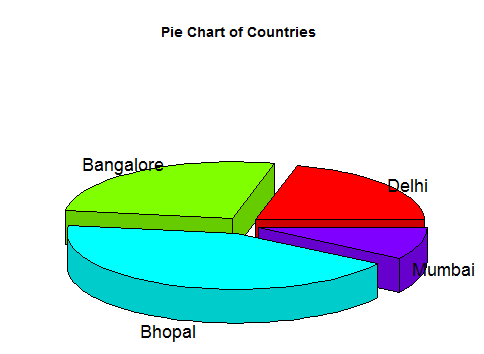
3D pie Chart R provides additional package to draw a pie chart in 3 dimensions. The name of the package is plotrix. This package has a function pie3D() that is used for 3D design.

Example:
# install the pacakage
install.packages("plotrix")
# Get the library.
library("plotrix")
# Create data for the graph.
x <- c(25, 32, 51, 11)
lbl <- c("Delhi", "Bangalore", "Bhopal", "Mumbai")
# Give the chart file a name.
png(file = "3d_pie_chart.jpg")
# Plot the chart.
pie3D(x,labels = lbl,explode = 0.1, main = "Pie Chart of Countries ")
# Save the file.
dev.off()
Output: 

3D pie Chart

Related Topics

Measures of Central Tendency in R Programming

Central Tendency or CT is one of the features of descriptive statistics. The Central tendency will let us know how the various groups of data are clustered around the central...

4 minutes read.

R Inheritance

One the main concept of object oriented programming is inheritance which allows us to define a new class of existing classes. This means that we can derive new classes from...

5 minutes read.

R Basic Data Types

Data types are used to define the size and type of the variable. In R, there is no need to declare a variable as some data types. The variables are...

4 minutes read.

R Operators

A symbol that tells the compiler to perform specific mathematical or logical operations is called operator. R language supports mainly 5 different types of operators, which are listed below: Arithmetic...

3 minutes read.

R JSON File

JSON stands for JavaScript Object Notation. It is a lightweight format for storing and transporting data. JSON file is often used when data is sent from a server to a...

2 minutes read.

Logistic Regression in R Programming

Logistic Regression is a classification supervised machine learning algorithm in R programming. Logistic Regression can also be termed Binomial Logistic Regression, Binary Logistic Regression, or Logit Model. Logistic Regression is...

4 minutes read.

Analysis of Covariance in R Programming

Analysis of Covariance can also be named ANCOVA. We know that we use the concept of regression analysis for creating models which can explain the effect of the variation in...

2 minutes read.

Bubble Chart in R Programming

In this article, we will talk about another type of chart in R programming, i.e., the Bubble chart. A bubble chart is a type of data visualization chart that helps display multiple...

4 minutes read.

R Variables, Constants and Reserved Words

R Variables Variables are very similar to an open box, where you can put any value of your wish. We can change the values as well. Variables are used to store...

4 minutes read.

First R Program

First  Hello World R Program As a convention, our first R program will be the “Hello World!” program. We can run our R program either at R command prompt or we...

3 minutes read.

Linear Regression in R Programming

Linear Regression is an unsupervised machine learning algorithm in R programming. Linear Regression is a type of regression analysis that shows the relationship between two or more variables. And one...

3 minutes read.

Poisson Distribution in R Programming

Poisson distribution is a type of distribution that deals with the probability distribution of the data values by taking the mean into consideration. Poisson distribution will estimate the probability value for...

3 minutes read.

R Data Types

Data types are used to define the size and type of the variable. In R, there is no need to declare a variable as some data types. The variables are...

4 minutes read.

Decision Tree in R Programming

The decision tree uses the branching method to show every possible output for the specific input. We can draw a decision tree by hand or create it using specialized software...

2 minutes read.

Scatter Plot in R Programming

A Scatter plot is a type of dispersion graph built to represent the various data points of variables. A Scatter plot is also known as a scatter graph or scattergram.  A scatter plot is used...

4 minutes read.

Various types of Charts in R Programming

As we know, R Language is mostly used for analyzing the data and statistics purposes to represent our data graphically & pictorially in R studio. Charts and graphs are plotted in...

4 minutes read.

R Pie Charts

R programming language provides many numbers of libraries to create charts and graphs. A pie-chart is a representation of data as slices of a circle with different colors representing counts...

2 minutes read.

R Line Graphs

Line graph or line chart is a graph that connects a series of points by drawing segments between them. A line graph represents the relationship between 2 variables. These points...

2 minutes read.

R Switch Statement

It is an alternate way to a nested if…else statement. A switch statement permits an expression to be tested against a list of case values. In short, we can say...

1 minute read.

R Date and Time

R provides very large range of capabilities to deal with times and dates. Generally, dates are internally stored as integers, and depending on the operations we will need, we could...

3 minutes read.