×

Single dimension array

C++ Array

An array is a collection of data (elements) of the same data types. The elements of an array are allocated in contiguous memory allocation. Elements of the array are accessed through the index (indices) of that element.  

Types of array

  • Single dimension array
  • Two dimension array
  • Multi-dimension array

Declaration of Array

data_type array_Name[size];
In the above declaration, data_type is C++ data type, array_Name is the name of array and size is the total size of elements.
int student[50];

Initialization of Array

An array is initialized with data type followed by an array name and the total size of elements. Here, elements are assigned into an array.
int mark[5] = { 80,75,85,60,90};
Another way to initialize array is as follow:
int mark[] = { 80,75,85,60,90};

Access of Array

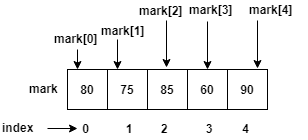
Elements of the array are accessed through the index (indices) of that element. The index of an array is started from 0 and end at size-1 of array. CPP Access of Array Suppose we want to access the individual elements of an array, this can be done by the passing index of the element in array name.
mark[0]=80;  
mark[1]=75;  
mark[2]=85;  
mark[3]=60;  
mark[4]=90;

Single dimension array Example

Printing the elements of an array using 'for' loop.
#include <iostream>  
using namespace std;  
int main()   
{  
    int mark[5]={80,75,85,60,90},i;  
    for (int i = 0; i < 5; ++i)   
    {  
        cout<< mark[i]<<endl;  
    }   
    return 0;  
}
Output:

80
75
85
60
90

Related Topics

Ascending order in C++

In C++, the term "ascending order" refers to a specific order in which a list of elements is arranged. When a list of elements is arranged in ascending order, the...

3 minutes read.

C++ Friend Functions

In C++, friends are special functions that are not a part of a class yet have access to its private and protected members. The friend keyword is used to declare...

4 minutes read.

Bitwise Operator vs Logical Operator

Bitwise Operator  Bitwise operators perform operations bit by bit on bits.The value is converted to abinary during operations like addition, subtraction, division, and so on. These operations are carried out at the...

3 minutes read.

C++ find missing in the second array

Given two arrays A and B of sizes n and m. Find the elements from array A that are not present in array B. Example Input : a[] = {1, 2, 3, 5,...

3 minutes read.

C++ Continue

In C++, the continue statement is a useful tool for avoiding specific scenarios without breaking the loop. It is employed inside loops to move directly to the following iteration and...

4 minutes read.

Factorial of a Number in C++ using while Loop

What is a factorial? The factorial of a number is the product of all the positive numbers less than or equal to n, indicated by n! According to the standard for an...

6 minutes read.

Vector Size in C++

What are Vectors?  In the C++ programming language, vectors are run-time sequence containers representing arrays with variable sizes, which are contained within STL (Standard Template Library). They utilize contiguous storage spaces...

6 minutes read.

Accumulate() and partial_sum() in C++ STL Numeric header

The C++ STL's numeric library includes the numeric header. This library provides efficient numeric arrays, support for random number generation, and fundamental mathematical operations and types. Several of the numeric...

3 minutes read.

C++ String Class and its Applications

The String class is available in C++. The character array is represented by the C string. The string class in C++ has a few different attributes. It contains several functions...

4 minutes read.

Boost split in C++ library

Boost::split in C++ library Boost offers strong tools for adding mature, well-tested libraries to the C++ standard library. The boost: split function, which is a component of the Boost string algorithm...

2 minutes read.

Substring in C++

A substring is a function in c++ that is imported from the string library. An element of a string is called a substring. A substring contains two parameters length and...

2 minutes read.

Abstract class in C++

In this article, you will get exposure to an abstract class in C++. We will discuss this topic using some practical examples too. To understand the abstract classes, you should...

6 minutes read.

Check for Balanced Brackets in an Expression (well-formedness) using Stack

Write a program that check the correctness of the pairs and ordering of the characters “{“, “}”, “(“, “)”, “[“, “]” in the expression string exp. Example: Checking for balanced parenthesis is one of...

2 minutes read.

Iostream in C++

Using Iostream in C++, we can perform input and output operation capabilities. This represents input and output, and the stream is used to carry out this capability. A stream is...

4 minutes read.

How to Reverse a String in C++ using Do-While Loop

Strings In C++, a string is an object that represents a group (or sequence) of various characters. Strings are part of the standard string class in C++ (std::string). The characters of...

4 minutes read.

Array of Vectors in C++ STL

Prerequisites: C++ STL Arrays and C++ STL Vector. A group of items kept in consecutive memory region is known as an array. It is to group similar objects of the same...

4 minutes read.

C++ Bitset

Overview In C++, bitset represents a fixed-sequence of some bits values by either 0 and 1. Zero represents the value as false or unset, while 1 represents the value as true...

4 minutes read.

Upcasting and Downcasting in C++

With the help of various examples in the C++ programming language, this section will cover Upcasting and Downcasting. Upcasting and downcasting, on the other hand, are two forms of object typecasting. Consider...

3 minutes read.

How to run program in turbo c++

What is Turbo C++? Turbo c++ is an integrated development environment (IDE) and a compiler to run C++ code. Turbo c++ helps to link the header files with the main code....

2 minutes read.

Queue in C++

What is Queue? As the name suggests, the queue is the type of data structure that follows the FIFO (First In - First Out) mechanism. In simple words, it is...

4 minutes read.