×

C++ If

C++ Control Statement

C++ control statement or decision-making statement is used to control the flow of program statement according to condition applied.
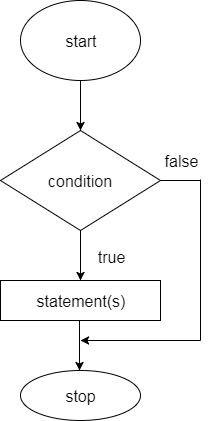
C++ if Control Statement

An if control statement in C++ is used to control the flow of program statement on behalf of condition applied. When if condition returns true boolean value, then statement within if block will be executed. And when if condition returns false boolean value, then statement after if the condition will be executed.

Syntax

if(check_condation){  
      statement 1;  
      statement 2;  
      ...;  
}
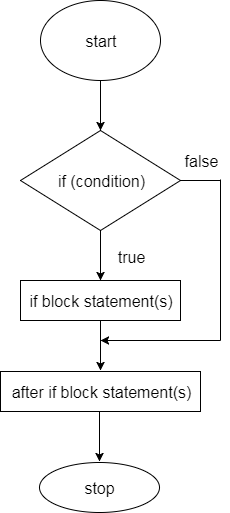
Example

#include <iostream>  

using namespace std;  

int main () {  

    int a = 10;  

    int b=20;  

    if( a < b ) {  

     cout << "a is less than b:" << endl;  

   }  

   cout << "value of a is : " << a <<endl << "value of b is : "<< b;  

    return 0;  

}
Output
a is less than b:
value of a is : 10
value of b is : 20

Related Topics

Program to convert infix to postfix expression in C++

Parentheses are frequently employed in mathematical formulas to make their interpretation easier to understand. However, with computers, parenthesis in an expression might lengthen the time it takes to find a...

7 minutes read.

Factorial of a Number in C++ using while Loop

What is a factorial? The factorial of a number is the product of all the positive numbers less than or equal to n, indicated by n! According to the standard for an...

6 minutes read.

Floating Point Operations and Associativity in C, C++ and Java

In this tutorial, we are going to compare Floating-point operations and the concept of associativity. Before we apply the concept of associativity in the floating-point operations in all three programming...

3 minutes read.

Factorial Program in C++

C++ Factorial Program: The product of all positive descending integers is the factorial of n. n! denotes the factorial of n. For instance: 5! = 5*4*3*2*1=120 4! = 4*3*2*1=24 In Combinations and Permutations, the...

4 minutes read.

Skyline Problem in C++

We have given n rectangular buildings in a 2-dimensional city. Here, to compute the Skyline of the given n rectangle structures in a two-dimensional metropolis while removing hidden lines, the...

3 minutes read.

C++ Forward Iterators

Iterators : Iterators serve as a link between algorithms and STL containers, allowing the data inside the container to be modified. They let you to iterate through the container, access and...

3 minutes read.

goto statement in C and C++

goto statement in C and C++ The goto statement is a jump statement, also sometimes referred to as an unconditional jump statement. Within a function, the goto statement can be used...

3 minutes read.

C++ First Program

Let's write a simple basic program structure of C++, its compilation and its execution (how it runs). This program is compiled using GCC compiler. Open any editor to write C++ program. #include<iostream>   using namespace std;   int main(){       cout<<"Welcome to C++ program"<<endl;   } Output...

2 minutes read.

Function overloading in C++

Function overloading in C++ As we know that C++ works on the OOP Concepts, that are abstraction, encapsulation, and data hiding, it also uses the other important feature of OOP, which...

8 minutes read.

Containership in C++

In C++, it is possible to create an object in one class into another class, and that object is a member of another class. This relationship is known as a...

4 minutes read.

Object in C++

In this article, we will learn about Object in C++. In short, an object is a stateful entity with behaviour. Data is referred to as state, and functionality is referred to...

3 minutes read.

C++ Global Variable

In C++, a global variable is a variable that is defined outside of any function or class and can be accessed by any function or class in the program. Global...

4 minutes read.

getline() Function and Character Array in C++

In this article, we will explore about some concepts on getline() function and character array in the most useful language C++. The getline() method in C++ is simply a standard library...

6 minutes read.

Advanced C++ with Boost Library

The goal of the Boost Libraries is to be widely applicable and used in a variety of applications. For instance, they can in handy when working with huge numbers whose...

4 minutes read.

C++ Range-based For Loop

In C++ language, the range-based for loop was added, which is far superior than the ordinary For loop. The implementation of a range-based for loop doesn't really need much code. It's a...

4 minutes read.

Lexicographically Next Permutation in C++

In this tutorial, we'll look at how to use C++ to generate the lexicographically next permutation of a string. The lexicographically next permutation is the larger permutation. "ACB," for example,...

3 minutes read.

Scope Resolution Operator vs this Pointer in C++

In this tutorial, we will compare the Scope Resolution operation to this Pointer in C++ language. Scope Resolution Operator The Scope Resolution Operator in C++ programming language is usually denoted by (::)....

3 minutes read.

How to create a stack in C++

A stack is a data structure, which is of linear type. A specific order has to be followed while inserting and deleting the elements from the stack. Generally, stack follows...

5 minutes read.

Initialization of Data Members

In this tutorial, we'll look at how to initialise static member variables in C++. Static members, such as functions or variables, can be added to C++ classes. After declaring the...

1 minute read.

C++ Bitset

Overview In C++, bitset represents a fixed-sequence of some bits values by either 0 and 1. Zero represents the value as false or unset, while 1 represents the value as true...

4 minutes read.