×

Default Constructor

C++ Default Constructor

A default constructor is such constructor which does not take any parameter. A constructor initializes the data member when a class object created. If a programmer does not create any constructor explicitly, then C++ compiler implicitly creates a default constructor and initialize data member with its default value. Syntax:
className(){  
// Constructor definition  
}

C++ Default Constructor Example 1

Creating a class with the name 'Employee' and a default constructor 'Employee()' which initialize data member 'id'.
#include <iostream>  
using namespace std;  
class Employee  
{  
    int id;  
    public:  
    Employee(){  
        id=101;  
    }  
    void display(){  
        cout<<id;  
    }  
};  
int main(){  
    Employee emp;  
    emp.display();  
    return 0;  
}
Output:
101

C++ Default Constructor (Implicit) Example 2

In this example compiler itself internally (implicit) create default constructor and initialize the value to a data member.
#include<iostream>  
#include<string>  
using namespace std;  
class Employee  
{  
    int id;  
    string name;  
    public:  
        int ph;  
    void display(){  
        cout<<"id="<<id<<endl;  
        cout<<"name="<<name<<endl;  
    }  
};  
int main(){  
    Employee emp;  
    emp.display();  
    cout<<"ph="<<emp.ph<<endl;  
    return 0;  
}
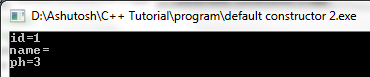
Output: Expected Output
id=2029045920
name=
ph=0
Garbage value Output 

Some time default implicit constructor initialize garbage value to a data member.

Related Topics

How to declare a 2D array dynamically in C++

In this article, we will learn how to declare the dynamic array in C++. We also learn the initialization of a 2D array using a pointer in C++. Here, we...

3 minutes read.

Roadmap to C++ Programming

Introduction There are so many programming languages available in the market, but among them, C++ is something that never lost its charm. It has a powerful impact on the programming world....

4 minutes read.

Substring in C++

A substring is a function in c++ that is imported from the string library. An element of a string is called a substring. A substring contains two parameters length and...

2 minutes read.

Reverse function in C++

The function std::reverse() is included in the standard template library of C++. It takes in a beginning and ending iterator, reversing the order. To use the reverse statement, we need...

2 minutes read.

Two dimension array

C++ Two dimension (2D) Array Two dimension (2D) array is an array of arrays. It is represented in the form of row and column. The elements of 2D array are accessed through the...

2 minutes read.

Decimal to Hexadecimal in C++

We need to write a program in C++ that converts a decimal number into an equal hexadecimal number given a decimal value as input i.e. convert a number having a...

2 minutes read.

Virtual base class in C++

Consider in a C++ program, there are 4 classes named class A, class B, class C, and class D. If class B and class c inherit properties from class A....

3 minutes read.

C++ Tricks for Competitive Programming

If you are interested in Computer science or Information technology, you must have heard about competitive programming. Competitive programming is a way to improve your problem-solving skills. There are various...

7 minutes read.

Difference between exit() and _Exit() in C++

Before understanding the difference between the exit() and _Exit(), one must know about exit() and _Exit() functions. The exit() function in C/C++ The exit() method in the C language kills the calling...

3 minutes read.

Constexpr in C++

Constexpr is a keyword in C++ that is used to declare variables or functions as compile-time constants. This means that the value of a constexpr variable or the return value...

3 minutes read.

Factory Method for Designing Pattern in C++

In C++, the factory method is a type of conditional design pattern. The factory method is related to creating a new object in C++. With the help of a factory...

3 minutes read.

rand() and srand() in C / C++

In this tutorial, we'll explore the syntax, usage, and examples of the C++ STL functions rand() and srand(). What exactly is rand()? The C++ STL's built-in rand() function is defined in the...

3 minutes read.

Vector Size in C++

What are Vectors?  In the C++ programming language, vectors are run-time sequence containers representing arrays with variable sizes, which are contained within STL (Standard Template Library). They utilize contiguous storage spaces...

6 minutes read.

C++ Date and Time

The date and time formats in C++ will be covered in this article. Because C++ lacks a proper date and time format, we must rely on the c language. The...

7 minutes read.

Lexicographically Next Permutation in C++

In this tutorial, we'll look at how to use C++ to generate the lexicographically next permutation of a string. The lexicographically next permutation is the larger permutation. "ACB," for example,...

3 minutes read.

Delete Operator in C++

Overview We can reserve allocation for a variable or an array at runtime in C++. Dynamic memory allocation is the term for this. After utilising a variable in C++, we must...

4 minutes read.

Initialization of Data Members

In this tutorial, we'll look at how to initialise static member variables in C++. Static members, such as functions or variables, can be added to C++ classes. After declaring the...

1 minute read.

Program that produces different results in C and C++

Introduction: There are many such programs that compile run both in C and C++ but give different outcomes when compiled by the C and C++ compilers. There are a variety of such...

6 minutes read.

Bits stdc++.h in C++

<bits/stdc++.h> in C++ In essence, it is a header file that contains all the standard libraries. It makes sense to use this file in programming competitions to speed up work, especially...

2 minutes read.

Print Table Using For-loop in C++

Multiplication Table In mathematics, a table is created by multiplying a certain number by all of the counting numbers, i.e., 1, 2, 3, 4, 5, 6, and so on. It is...

3 minutes read.