
×

Print Table Using Do while Loop in C++

Multiplication Table

In mathematics, a table is created by multiplying a certain number by all of the counting numbers, i.e., 1, 2, 3, 4, 5, 6, and so on. It is also referred to as a multiplication table. Suppose, we need to create a table of the number 7, then we have to multiply 7 by each natural number as follows:

7 * 1 = 7
7 * 2 = 14
7 * 3 = 21
7 * 4 = 28
7 * 5 = 35

What is Do-While Loop?

An iterative loop that checks the condition at the end.
The Do-While loop can be used whenever a test condition is specific, as the control enters the loop at a minimum once before the condition is evaluated. This loop checks the given condition after the execution of looping statements.

The loop actions or statements will be repeated infinitely as long as the test requirements are met.

Note: DO-WHILE LOOP means “first do it, then check”.

Syntax:

The Syntax of the DO-WHILE loop is:

Do
           { 
            statement(s);
           } 
         while(expression);

Program to print multiplication of 2 tables from (1 to 12)

Algorithm

Step 1: Start

Step 2: Read n, res, I;

Step 3: Take a number “n” from the user to print the table

Step 4: Use Do While loop to print table. Initialize (i=1) and check condition until i becomes 12. when, the condition becomes wrong, then control moves to step 6.

Step 5: res=num*i;

Step 6: Print “res”.

Step 7: End.

Program

#include<iostream>
using namespace std;
int main()
{
    int num=2, i, res;
   i=1; 
do{
        res = num*i;
        cout<<num<<" * "<<i<<" = "<<res;
        cout<<endl;
i++;
    }while(i<12);
    cout<<endl;
    return 0;
}

Output

2 * 1 = 2
2 * 2 = 4
2 * 3 = 6
2 * 4 = 8
2 * 5 = 10
2 * 6 = 12
2 * 7 = 14 
2 * 8 = 16
2 * 9 = 18
2 * 10 = 20
2 * 11 = 22
2 * 12 = 24

Explanation

The above code prints the table of 2.
The do while loop is used in this program. And, the control enter in the loop and execute the operation and stores the value of num*i, i.e., 2*1, i.e., 2.

Then, the following statement will exexute:
cout<<num<<" * "<<i<<" = "<<res;

The above statement prints the first line like this 2 *1 = 2 in the output. In the loop, (cout<<endl) is next statement that indicates the program will write the output from new line.

Initially, value of i is initialized to 1, and the update statement which increases the value of i. After that, the condition checks and evaluates to true because (2<12), which allows the program to enter in loop again.
This process will continue until the condition is determined to be untrue.
The multiplication table of 2 is printed on the output screen.

Program to print a table of any user-defined number

#include<iostream>
using namespace std;
int main()
{
    int num, i, res;
    cout<<"Enter the Number: ";
    cin>>num;
    i=1;
    do{
        res = num*i;
        cout<<num<<" * "<<i<<" = "<<res;
        cout<<endl;
    i++;
} while(i<=10);
    cout<<endl;
    return 0;
}

Output

Enter a number: 10
10 * 1 = 10
10 * 2 = 20
10 * 3 = 30
10 * 4 = 40
10 * 5 = 50
10 * 6 = 60 
10 * 7 = 70
10 * 8 = 80
10 * 9 = 90
10 * 10 = 100

Program to print table from 1 to 10

Algorithm

Step 1: Start the program.

Step 2: Read n, i=1, j=1.

Step 3: Use two do-while loops to print the tables

               Iterate the value of i until i=10

                  à in the inner loop itearate j until (j<=n) else go to step4

 Step 4: If (j<n-1)

                 Cout<<j<<”x”<<i<<i*j

               Else

                 Cout<<j<<”x”<<i<<i*j

Step 5: End the program.

Flowchart:
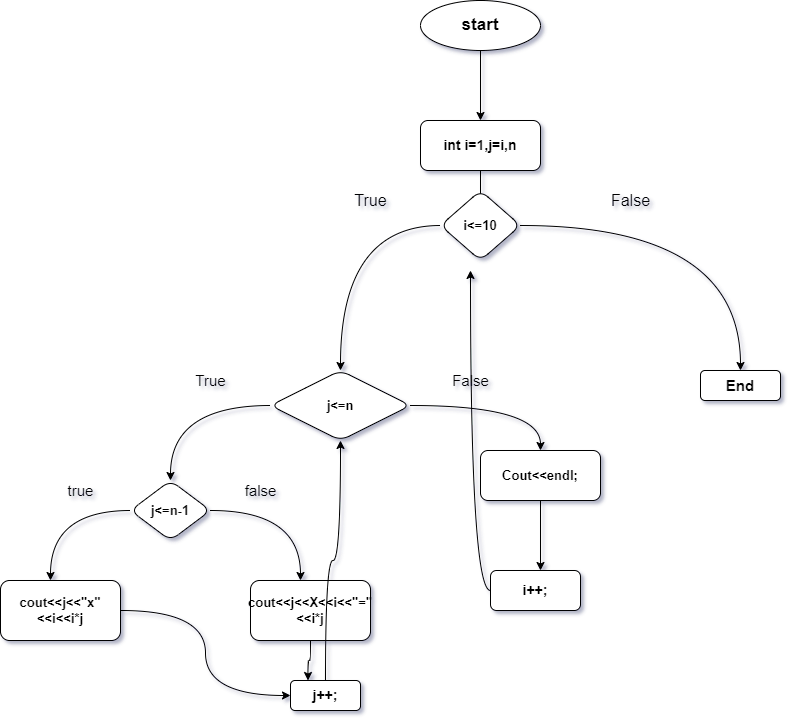
Print Table Using Do-While loop

Program

#include <iostream>
using namespace std;
int main()
{
    int j, i, n;
   cout << "\n\n the multipliaction table from 1 to n:\n";
    cout << "-------------------------------------------------------------\n";
    cout << "Input the number upto 5: ";
    cin >> n;
    cout << "Multiplication table from 1 to " << n << endl;
    i=1;
   do {
        j=1;
        do{
            if (j<=n-1)
                cout<<j<<"x"<<i<<"="<<i*j<<"\t";
            else
                cout<<j<<"x"<<i<< "=" <<i*j<<endl;
        j++;
    }while(j<=n);
i++;
}while(i<=10);
        cout << endl;
     }

Output

Enter any number: 
The multiplication table from 1 to 4
1x1=1    2x1=2      3x1=3         4x1=4  
1x2=2    2x2=4      3x2=6         4x2=8  
1x3=3    2x3=6      3x3=9         4x3=12  
1x4=4    2x4=8      3x4=12        4x4=16                                  
1x5=5    2x5=10    3x5=15         4x5=20                                
1x6=6    2x6=12   3x6=18          4x6=24                                
1x7=7    2x7=14   3x7=21          4x7=28                                  
1x8=8    2x8=16   3x8=24          4x8=32                                
1x9=9    2x9=18   3x9=27          4x9=36                              
1x10=10  2x10=20  3x10=30         4x10=40  

Program to print table using recursive:

#include <iostream>
using namespace std;
 void mul_table(int N, int i)
{
    // Base Case
    if (i > 10)
        return;
       cout << N << " * " << i << " = " << N * i << endl;
      return mul_table(N, i + 1);
}
 
// Driver Code
int main()
{
    int N = 7;
    mul_table(N, 1);
    return 0;
}

Output:

7 * 1 = 7
7 * 2 = 14
7 * 3 = 21
7 * 4 = 28
7 * 5 = 35
7 * 6 = 42
7 * 7 = 48
7 * 8 = 56
7 * 9 = 63
7 * 10 = 70

Related Topics

C++ Identifier

In a program, C++ identifiers relate to the names of variables, functions, arrays, and other user-defined data types that the programmer has developed. They are a prerequisite for learning any...

4 minutes read.

C++ Math Functions

C++ Math Functions: Like other programming languages, C++ offers plenty of mathematical functions needed for various purposes. These functions are defined mainly in the math library in C++. Let us...

4 minutes read.

Difference between exit() and _Exit() in C++

Before understanding the difference between the exit() and _Exit(), one must know about exit() and _Exit() functions. The exit() function in C/C++ The exit() method in the C language kills the calling...

3 minutes read.

Function overloading in C++

Function overloading in C++ As we know that C++ works on the OOP Concepts, that are abstraction, encapsulation, and data hiding, it also uses the other important feature of OOP, which...

8 minutes read.

Types of polymorphism in C++

What is polymorphism in C++ ? Polymorphism literally translates to "multiple forms". This indicates that the same thing behaves differently depending on the context in programming. Polymorphism is a feature of C++...

6 minutes read.

C++ Variable

In this article, we will discuss variables in C++ with their types and examples. What are Variables? Variables are specific memory storage spaces that hold a value. During the execution of a...

4 minutes read.

C++ Switch

In C++, an expression or variable can be tested against a range of constant values using a switch statement, which is a control flow statement. It offers a productive method...

4 minutes read.

Char Array to String in C++

Regardless of the programming language you use, data structure is critical to the success of your project. Although each programming language has its own collection of data structures, C++ contains a...

4 minutes read.

strcat() vs strncat() in C++

In this tutorial, we will explore about strcat() and strncat() in the most usable language C++. We will also look at the difference between them. strcat() C++ is a computer language with...

4 minutes read.

Hybrid Inheritance

C++ Hybrid Inheritance When more than one type of inheritance is combined in single inheritance is called as hybrid inheritance. C++ Hybrid Inheritance Example #include<iostream>   using namespace std;   class Student{       protected:           int rollno;       public:           void getRoll(int a){               rollno=a;           }           void putRoll(void){               cout <<"Roll No: "<< rollno<<endl;           }   };   class Test : public Student{       protected:           float subject1, subject2;       public:           void getMarks(float x, float y){               subject1=x;               subject2=y;           }           void putMarks(void){               cout<< "Marks gain: "<<endl <<"Subject1 =  "<<subject1<<endl<<"Subject2 = "<<subject2 <<endl;           }   };   class Sport{       protected:           float score;       public:           void getScore(float s){               score=s;           }           void putScore(void){               cout<<"Sports score: "<<score<<endl;           }   };   class Result : public Test, public Sport{       float total;       public:           void display(void);   };   void Result:: display(void){       total=subject1+subject2+score;       putRoll();       putMarks();       putScore();       cout<<"Total Score: "<<total<<endl;   }   int main(){       Result stu;       stu.getRoll(10);       stu.getMarks(40,50);       stu.getScore(60);       stu.display();       return 0;   } Output: Roll No: 10 Marks gain: Subject1 = 40 Subject2 = 50 Sports score: 60 Total...

1 minute read.

C++ String Concatenation

C++ String Concatenation In this section, we will learn about C ++ String Concatenation, what it does, how it works, and will also see its programs. What is the String Concatenation? The + operator...

3 minutes read.

C++ Virtual Destructor

In C++, a destructor is a class member function that is used to free up space or remove an object of the class that has gone out of scope. The...

4 minutes read.

CPP Templates

C++ provides a powerful feature called template, which allows the definition of generic classes and generic functions. Generic programming is a technique where different algorithms work in communion by using...

4 minutes read.

Features of OOPS in C++

What is OOPs? The main reason programmers prefer C ++ language over C is because of the support of object-oriented programing in C++. As the name suggests, object-oriented programming or OOPs...

3 minutes read.

Program that produces different results in C and C++

Introduction: There are many such programs that compile run both in C and C++ but give different outcomes when compiled by the C and C++ compilers. There are a variety of such...

6 minutes read.

C++ Socket Programming

In this world, computer networking has become very important for sharing of data. Every good programmer has some knowledge about computer networking. Socket programming is one of the critical topics...

6 minutes read.

Stack in C++

Stack: The stack is a very popular data structure. It is the form of data structure that follows a particular order called FIFO(First-In-First-Out). In simple words, a stack is an Abstract...

4 minutes read.

C++ array to function

Arrays in C++ : Instead of defining distinct variables for each item, arrays are used to hold numerous values in a single variable. An array can be declared by specifying the variable...

4 minutes read.

Boost split in C++ library

Boost::split in C++ library Boost offers strong tools for adding mature, well-tested libraries to the C++ standard library. The boost: split function, which is a component of the Boost string algorithm...

2 minutes read.

Top 5 IDEs for C++ That You Should Try Once

In the past decades, creating an application or interface from the very basic idea, the developer has to struggle a lot for it. Because an application is a combination of...

3 minutes read.