
×

Limitations of Blockchain

Blockchain is a timestamped collection of immutable records that are attached in the form of a never-ending linear chain. Its characteristics, such as decentralized network and anonymity, make it the most trustworthy technology by far. But everything has its pros and cons, so does blockchain. Blockchain is one of the best technologies developed, but due to the lack of technical awareness and its relation with Bitcoin makes it doubtful.

In this article, the obstacles faced in efficiently implementing the blockchain technology are discussed in detail.
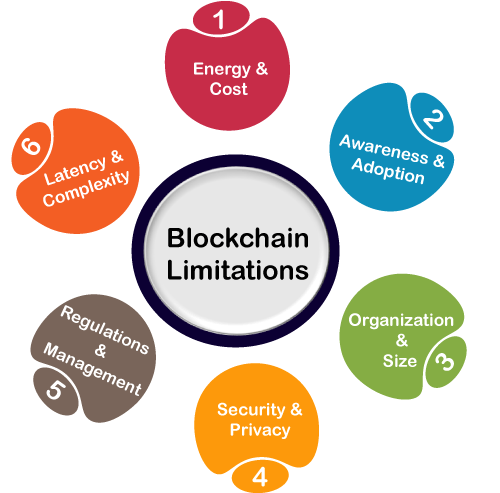
Limitations of Blockchain
  • Immutable

 Immutable means something which cannot be changed or improvised. The records of the blockchain cannot be modified once created and broadcasted on the chain network. It protects the integrity of data making it tamper-proof, but at the same time, it has its drawbacks. No corrections or revision can be done in order to reverse the errors made while entering the data. Once the data is on record, it is imperishable.

  • Organization and Size

Every transaction needs to be validated or verified by every block over the network in order to reach a mutual consensus. A blockchain network may be vast in size, depending upon its growth and dispersion. The number of nodes and blocks determines the network size. The bigger the network size, the more time is consumed in the process of reaching consensus in an authentic manner. This leads to considerable consumption of time and resources.

  • Scalability

The consensus mechanism requires every participating node to validate the transactions. This restricts the number of transactions that can be carried out over the blockchain network during a given time. As a result, an existing blockchain, Bitcoin can only process seven transactions a second.

  • Plethora Proof of Work

Proof of work is an overload. The fact still holds true even if disregarding the energy consumption in terms of electricity and processor time. The dependability on a single linear chain even by Proof of Stake and other solutions is a soft underbelly or flaw. Options are being explored to avoid this discrepancy.

  • Excessive Energy Consumption

The energy consumed by miners and giant mining sites in terms of electricity does not diminish with the outcome, which is the creation of a new block. According to statistical reports, Bitcoin’s energy usage is alone equivalent to Switzerland’s annual energy usage.

The most doubtful angle is that even after reducing the number of miners and energy consumption corresponding to it by ten folds, the Bitcoin would remain as efficient and stable as it is now. It would work at the same speed, processing the same number of transactions and produce an equal amount of blocks at the same interval of time.

  • Lack of Technical Awareness

The developers these days are mostly trained in technologies like Java, C++, or Python. The lack of technical expertise in blockchain restricts its development and management. Even if it is developed, the users of the blockchain are unaware or incompetent to use its implementation. Thus, awareness about blockchain’s development, implementation, and usage must be spread.

  • Regulation and Management

One might assume that if the blockchain is recorded at every node, then a single person or participant cannot shut down a blockchain. The absence of any central authority would make the closing down of any blockchain impossible.

This is probably a misconception. For instance, in Bitcoin, miners tend to operate in competing pools. This is done in order to ensure that they earn a reward for their work in which they have invested through electricity consumption and processor time. The main aim here is to avoid concentration.  The indestructibility of a blockchain is proportional to its dispersion. For instance, if more than 63% of miners of blockchain are from the same country, then the jurisdiction of that country can hamper indestructibility by halting communication services or seizing server sites.


Related Topics

Blowfish Algorithm in Cryptography

What is Blowfish? Blowfish is a length variable and symmetric in nature. It is a 64-bit block cipher. It is a general proposed algorithm. It is developed by Bruce Schneier in...

25 minutes read.

What are the steps to becoming a Blockchain developer

What do you need to do to become a Blockchain Developer? Blockchain is one of the most rapidly emerging technology and industry in today's IT market. The world market for Blockchain...

5 minutes read.

DNA cryptography

What is DNA Cryptography? DNA Cryptography is the branch of science that is used to encrypt and decrypt the data for hiding propose. It has a significant role in the field...

3 minutes read.

Bitcoin Mitigating Attacks

Bitcoin is the most secure & protected cryptocurrency, with security built into the protocol at numerous levels. It frequently executes persistent sophisticated attacks. In this part, we will look at numerous...

4 minutes read.

Kerberos in Cryptography and Network Security

Kerberos is a system that is used for managing user authentication. With the help of Kerberos, the user can access their service without remembering multiple authentication passwords. It is not...

3 minutes read.

IP Security in Cryptography

IPsec (Internet Protocol Security) is a collection of algorithms and protocols used to secure the data transmitted over a public network. The Internet Engineering Task Force (IETF) was developed in...

6 minutes read.

How to choose Bitcoin Wallet

This section will walk you through the process of selecting a Bitcoin wallet. If you wish to participate in Bitcoin, you'll need a wallet. You may receive Bitcoins, transmit Bitcoins,...

3 minutes read.

Decentralized Voting System using Blockchain

In the era of Industry 4.0, Blockchain is a technology that is fast gaining traction. It is widely utilized in supply chain management systems, healthcare, payments, business, IoT, voting systems,...

3 minutes read.

Working of Blockchain

How Blockchain Works A Blockchain is simply a collection of records of time-stamped transactions that are managed by a group of servers. There is no central authority who controls the database....

2 minutes read.

Blockchain Versions

Blockchain Versions Blockchain technology has gained popularity because it offers decentralized and transparent storage to record transactions and data. Generally  Blockchain relates with the bitcoin and cryptocurrency. Since 2009, Blockchain technology has been...

2 minutes read.

Difference between Blockchain and Database

A Blockchain is a distributed database or ledger in which data is stored in blocks. It is built on distributed ledger technology, which may be utilized between parties that do...

3 minutes read.

Key Concepts in Bitcoin

There are many countries in this world and each country uses their currency for trading purpose. Some of them use the dollar, pound, euro, yen & rupee etc. These currencies...

3 minutes read.

Blockchain Merkle Trees

Blockchain Merkle Trees Merkle Trees are foundation components of the blockchain mechanism. The methodical, systematic, and reliable verification of content in unbounded and dispersed data sets is enabled with the use of Merkle Trees....

3 minutes read.

Project Ideas on Blockchain for Professionals

We have moved on from the days when Blockchain was solely employed in the context of cryptocurrencies. It is currently used in a broader range of applications, and it will continue...

4 minutes read.

Ethereum 2.0

What is Eth2? Eth2 refers to a set of improvements to security, Ethereum's scalability and long-term sustainability. These improvements are being worked on by a number of teams from throughout the Ethereum...

6 minutes read.

Converting Bitcoins to Fiat Currency

Fiat money is a legal tender currency issued by a government for use in its governed areas. Fiat money is money that has value only due to government regulation or...

4 minutes read.

Bitcoin Forks and SegWit

We will learn about Bitcoin forks and Segregated Witness in this section (SegWit). What Is the Definition of a Segregated Witness (SegWit)? Segregated Witness (SegWit) is a Bitcoin transaction format modification. Its...

3 minutes read.

Need of Blockchain

Blockchain is an open and decentralized network, which stores redundant data at multiple sites called nodes (computers). Its properties, such as immutability, distributed control, highly secured encrypted blocks, and anonymity, make it ideal...

3 minutes read.

Blockchain Cryptocurrency

As we know, cryptocurrencies are digital assets which can also be exchanged between two parties. For securing, verifying the transfer of assets & to have control over the creation of...

3 minutes read.

Elliptic curve in cryptography

What is Elliptical Curve Cryptography (ECC)? Elliptic Curve Cryptography (ECC) is public key cryptography based on elliptic curve theory. It can be used to create smaller, faster and more efficient public...

4 minutes read.