
×

React Component API

React Component API

It is a top-level API. It provides reusability to the code in the application and makes it completely individual. It has several methods for:

  • Creating Elements.
  • Transforming Elements.
  • Fragments.

Now, we are explaining the three important methods that are available in the React component API:

  • findDOMNode()
  • setState()
  • forceUpdate()

findDOMNode()

For manipulating the DOM, you have to use ReactDOM.findDOMNode() method. This method helps us to find or access the underlying DOM node.

Syntax:

ReactDOM.findDOMNode(component);

Example:

App.js

import React, { Component } from 'react';
import ReactDOM from 'react-dom'; 
class App extends React.Component {
constructor() {
super()
this.findDomNodeHandler1 = this.findDomNodeHandler1.bind(this);
this.findDomNodeHandler2 = this.findDomNodeHandler2.bind(this);
};
findDomNodeHandler1() {
var div1 = document.getElementById('One');
 ReactDOM.findDOMNode(div1).style.color = 'red';
}
findDomNodeHandler2() {
var div2 = document.getElementById('Two');
ReactDOM.findDOMNode(div2).style.color = 'blue';
}
render() {
:return (

ReactJS Find DOM Node Example

Red Color

Blue Color

) } } export default App;

Output:
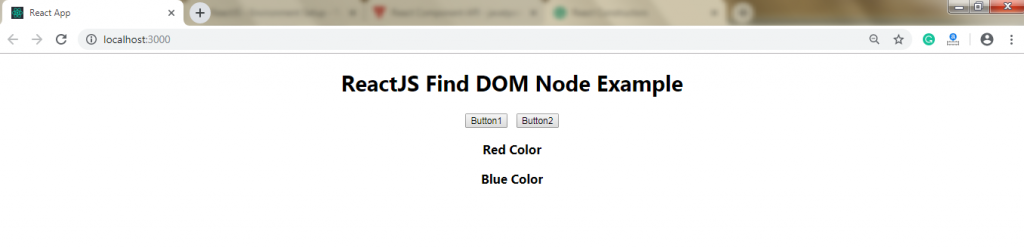
Reactjs find Dom node Example

When you click on the button, the color of the text gets changed. The output after clicking on the button is as follows:
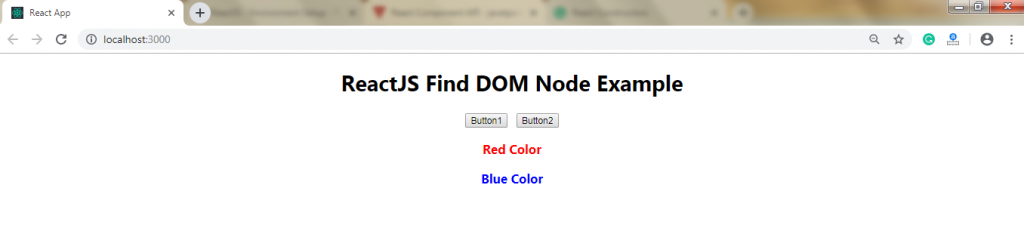
React js Find dom node

setState()

This method is used for updating the state of the component. Instead of replacing the state immediately, it only adds changes to the original state. It is a primary method that is used for updating the user interface (UI) as a response to the event handlers and the responses of the server.

Syntax:

this.stateState(object newState[, function callback]);

Example:

App.js

import React, { Component } from 'react';
import PropTypes from 'prop-types'; 
class App extends React.Component { 
constructor() {
super();
this.state = {
data: "!!!! Hello World !!!!"
}
this.updateSetState = this.updateSetState.bind(this);
}
updateSetState() {
this.setState({
data:"Welcome to tutorialandexample.com"
});
}
render() {
return (

{this.state.data}

) } } export default App

Main.js

import React from 'react';
import ReactDOM from 'react-dom';
import App from './App.js'; 
ReactDOM.render(, document.getElementById('app')); 

Output:

Hello world!

After clicking on the SET STATE button, you will get the following output:

welcome to tutorialandexample

forceUpdate()

This method allows the manually updating of the components.

Syntax:

Component.forceUpdate(callback);

Example:

App.js

import React, { Component } from 'react';
class App extends React.Component {
constructor() {
super()
this.forceUpdateState = this.forceUpdateState.bind(this);
}
forceUpdateState() {
this.forceUpdate();
};
render() {
return (

Example of Force Update method

Example to Generate Random Number

Random number: {Math.random()}

); } } export default App;

Output:
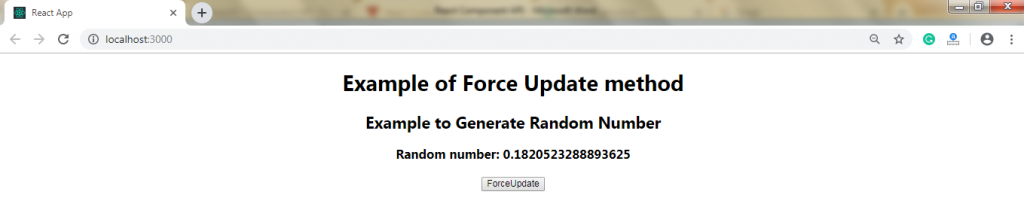
Example of force update method

When you click on the ForceUpdate button, you will always get the new random number. It is shown in the following image:
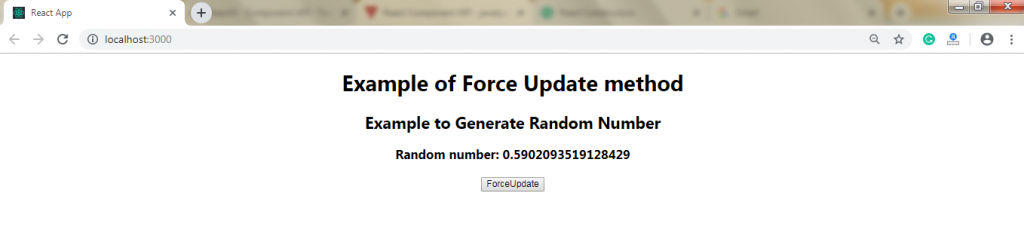
to generate random number

Related Topics

React Refs

React Refs The word ‘Refs’ is an abbreviation of ‘References’ in React. It is as similar as Keys in React. Refs are a function in React which is used for accessing the DOM element and...

7 minutes read.

React Bootstrap

React Bootstrap React has a widely used JavaScript framework for creating web applications, and Bootstrap has become the most popular CSS framework. Single-page apps have become popular from the last few...

9 minutes read.

React Props

React Props A prop is an abbreviation of ‘properties.' State and props are mainly different from each other because props are immutable. Props are the read-only components. It is the object that stores the attribute...

3 minutes read.

React Table

React Table The table represents an arrangement that organizes the information in the form of rows and columns. The table is mainly used for storing and displaying the data within a structured format. Features of...

2 minutes read.

React Higher-Order Components

React Higher-Order Components In short form, Higher-Order Components are represented as HOC. The Higher-order component is an advanced technique to use component logic. HOC is a function that takes the component and returns the new...

2 minutes read.

React Fragments

React Fragments The fragments in React are introduced from the 16.2 and above versions. Fragments allow you to group a list of child elements without adding any extra node in the DOM. In React,...

2 minutes read.

React Animation

React Animation The animation is a procedure in which an image is manipulated to appear as a moving image. It is widely used to create an interactive web application. In React, we have to...

4 minutes read.

React Component Life-Cycle

React Component Life-Cycle In ReactJS, the creation process of every component includes several lifecycle methods. These methods, together stated as component's lifecycle. Four phases of the component's life cycle are as...

4 minutes read.

React Portals

React Portals React portals were introduced by React 16.0 in September 2017. It gives you a way to render the element outside of the component hierarchy, i.e., within a separate component. Before React 16.0, it...

3 minutes read.

React Props Validation

React Props Validation As we know, props are a suitable mechanism for passing the read-only attributes to react components. The props are required to be correctly used in the component. If it is...

5 minutes read.

React Environment Setup Step by Step

React Environment Setup This section will provide you the information about how to set up an environment for the successful development of ReactJS application: Pre-Requisite for ReactJS NodeJS and NPMReact and React DOMWebpackBabel There are two...

5 minutes read.

React State

React State The state is an updatable structure which is used for containing data or information about the component. The state in a component can be changed over time. The change...

3 minutes read.

React Events

React Events An event is an action that triggers a response of the user action or system-generated event. As HTML, React can also perform actions based on user events. React has the...

2 minutes read.

React Constructors

What is constructor? The constructor is a method that is used for initializing the state of the object in the class. It calls automatically during the creation of an object in...

4 minutes read.

Difference Between State and Props in React

Comparison between State and Props State The state is an updatable structure which is used for containing data or information about the component. The state in a component can be changed over...

2 minutes read.

React Native vs ReactJS

Difference between React Native and ReactJS React Native React Native is also an open-source JavaScript framework that is used for the development of a mobile application for iOS Android and Windows. It...

6 minutes read.

React Error Boundaries

React Error Boundaries In the past, the errors of JavaScript within the components were used to corrupt the internal state of react and cause it to emit the cryptic errors on the next...

3 minutes read.

How to use React Context

React Context React Context is used to pass the data through the component tree without passing the props down manually at the every level. In React Application, the data is passed in a top-down approach...

4 minutes read.

React CSS

What is React CSS React CSS is used to provide the style to the React applications. The style attribute adds dynamically-computed styles at render time, and it is one of the most used...

5 minutes read.

Features of ReactJS

ReactJS Features As of now, within the developers, ReactJS is gaining much popularity as the best JavaScript framework. It is crucial for the front-end ecosystem. There are some of the crucial features of ReactJS that are...

2 minutes read.