
×

DBMS Generalization, Specialization, and Aggregation

DBMS Generalization

Generalization is a bottom-up approach in which the common attributes of two or more lower-level entities combines to form a new higher-level entity. In generalization, the generalized entity of higher level can also combine with entities of the lower-level to make further higher-level entity.
It is like a superclass and subclass system, but the only difference is that it uses the bottom-up approach. It helps in reducing the schema size. It is always applied to the group of entities and result in the formation of a single entity.

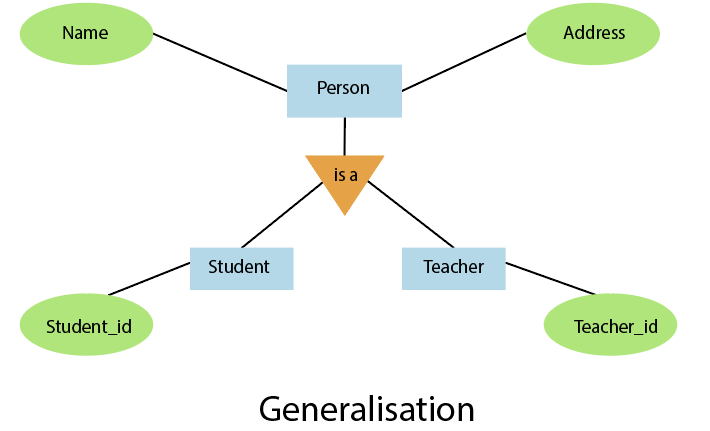
According to the below diagram, there are two entities, namely teacher and student. The teacher entity contains attributes such as teacher_id, name, and address and student entity include student_id, name, and address. Both entities can be combined to create a higher-level entity person. The address and name are common to both the entities. The teacher entity has its attribute teacher_id, and the student has its attribute student_id. The entities teacher and student are generalized further into the person entity.
A lower-level entity is called a subclass, and the higher-level entity is called a superclass. So, the person entity is the superclass of two subclasses teacher and student.
DBMS Generalization

DBMS Specialization

It is opposite or inverse of generalization. A specialization is a top-down approach in which an entity of higher-level entity is broken down into two or more entities of lower level. In specialization, a higher-level entity set may not have any lower-level entity set. It is always applied to a single entity and results in the formation of multiple new entities. It increases the size of schema due to the increase in the number of entities.

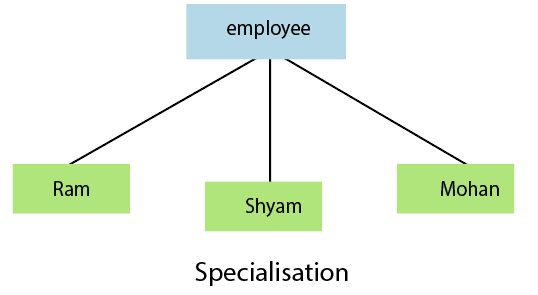
In the below example, it can be seen that the employee is a high-level entity which is divided into three sub-entities (Ram, Shyam, and Mohan). The sub-entities are the names of the employees (relating to the high-level entity). Therefore, splitting a high-level entity into a low-level entity is called specialization.
DBMS Specialization

DBMS Aggregation

Through the Entity-Relationship model, we cannot express a relationship set with another relationship set. Thus we use the concept of aggregation to express it.

Aggregation is an abstraction in which the relationship between two entities is treated as a higher-level entity. It allows you to indicate that a relationship set participates in another relationship set.

Example:

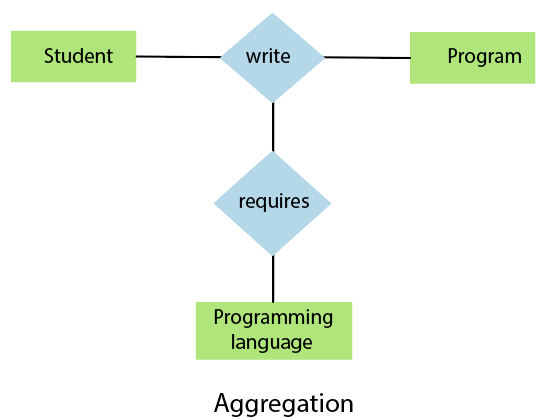
The student and program are two entity set and related through a relationship set write. Suppose, a student who writes any program must require a programming language installed in their system. So, there will be another relationship set requires. You need to connect the relationship set requires with an entity set programming language and relationship set write. But, we can connect only entity set to a relationship set.
One relationship set cannot be connected with another relationship set; for this, we need aggregation. Here, the write (relationship set) will treat like a higher-level entity and can be associated with a relationship set requires. So, aggregation is needed when you express a relationship set with another relationship set. 
DBMS Aggregation


Related Topics

Multivalued Dependency

Multivalued Dependency exists in a relation when two attributes depend on the third attribute but independent to each other. It is a full constraint between two sets of attributes in a relation. It...

2 minutes read.

Advantages of Threaded Binary Tree in DBMS

We know that every node in a binary tree contains both its data value and the address pointers for its left and right children. A null pointer is used to...

3 minutes read.

Fragmentation in Distributed DBMS

Fragmentation is a course of isolating the entire or full information base into different sub tables or sub relations with the goal that information can be put away in various...

4 minutes read.

Advantages of DBMS

A Database Management System (DBMS) is a collection of programs which lets the end-users to manage and control the database. Database systems use query language for accessing, storing, and maintaining the...

3 minutes read.

Inference Rules

Armstrong’s axioms are the complete set of basic inference rules used to infer all the functional dependencies on the relational database. An inference rule is a type of assertion that a user can...

2 minutes read.

File Organization in DBMS

File Organization in DBMS: A database contains a huge amount of data, which is stored is in the physical memory in the form of files. A file is a set...

9 minutes read.

Components of Relational Database Management System

A relational database management system compromises various component. Tables, records, attributes, instances, schemas and keys together form a relational database. In this page, we will discuss each component of RDBMS in...

4 minutes read.

ER Diagram for Banking System in DBMS

Entity Relationship Diagram Entity Relationship Diagrams, or ER Diagrams for short, are diagrams that show the relationships among entity sets that are stored in databases. Alternatively said, ER diagrams assist in...

3 minutes read.

Generalization in DBMS

Generalization in DBMS In the database management system, generalization is a concept combining the common attributes of two or more lower-level entity and form a new higher level with the common...

3 minutes read.

Red-Black Tree Visualization in DBMS

Introduction to Red Black Tree A red-black tree is a self-balanced binary search tree with an extra bit per node, usually read as a color (red or black). The tree is...

4 minutes read.

Attributes in DBMS

What is Attribute? An attribute is an element in the database management system that describes the property or certain characteristics of the database entity. It is a crucial element of the...

3 minutes read.

ER Diagram for University Database in DBMS

What is an ER diagram? ER diagram, short for Entity Relationship Diagram, also known as ERD, is a diagram that shows the relationships of a set of entities stored in a...

9 minutes read.

Secondary Key in DBMS

What are Keys? Keys in DBMS are the attributes or set of attributes that uniquely identify a row in a set of relations. A table (relation) can have a column or...

3 minutes read.

B Tree in DBMS

How to perform Insertion operation in B Tree A new value is inserted at the leaf node. Same like in a binary search tree we traverse from starting root node to...

10 minutes read.

Structure of DBMS

DBMS means Database Management System, which is a tool or software used to create the database or delete, or manipulate the database. Query Processor, Storage Manager, and Disk Storage are the...

3 minutes read.

Advantages of RDBMS

The relational database management system collects related data stored in tabular format. The data is stored in rows and columns, where rows usually represent the individual entity of the collected...

6 minutes read.

DBMS Schema

Schema It is a physical representation of data that appears in the database management system. In simple words, a schema is the structure of any database.It defines how the data is stored...

2 minutes read.

Defference between Database and Data Warehouse

Database A database is a collection of related information is called a database. It has some elements that can be mapped to real-world objects. It is designed in such a manner...

4 minutes read.

What is Transaction in DBMS

A transaction is a collection of logically related operations which reads and possibly updates the various data items in the database. Usually, a transaction is initiated by a user program written in high-level...

3 minutes read.

Aggregate Functions in DBMS

Aggregate Functions in DBMS: Aggregate functions are those functions in the DBMS which takes the values of multiple rows of a single column and then form a single value by...

2 minutes read.