×

DBMS Languages

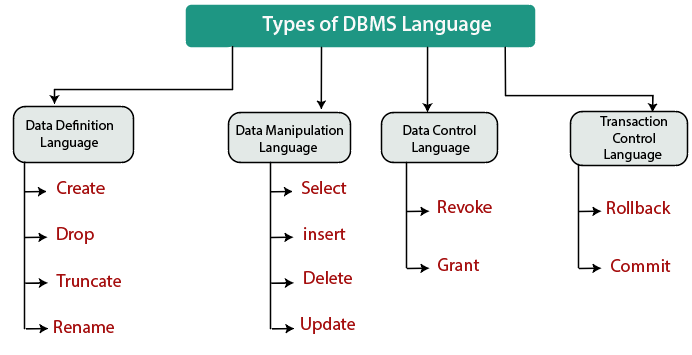
User can access, update, delete, and store data or information in the database using database languages. The following are the databases languages in the database management system:

  1. Data Definition Language
  2. Data Manipulation Language
  3. Data Control Language
  4. Transaction Control Language
DBMS Languages

Data Definition Language (DDL)

Data Definition Language is used for defining the structure or schema of the database. It is also used for creating tables, indexes, applying constraints, etc. in the database.
The main purpose of DDL is to store the information of metadata like the number of schemas and tables, their names, indexes, constraints, columns in each table, etc. The result of Data Definition Language statements will be a set of tables which are stored in a special file called data directory or data dictionary.
This language is used by the conceptual schema to access and retrieve the records from/to the database respectively, where these records describe entities, relationship, and attributes.

 There are following Data Definition Languages (DDL) Commands:

  • Create: This command is used to create a new table or a new database.
  • Alter: This command is used to alter or change the structure of the database table.
  • Drop: This command is used to delete a table, index, or views from the database.
  • Truncate: This command is used to delete the records or data from the table, but its structure remains as it is.
  • Rename: This command is used to rename an object from the database.
  • Comment: This command is used for adding comments to our table.

Data Manipulation Language (DML)

Data Manipulation Language is a language used to access or manipulate the data in the database. In simple words, this language is used to retrieve the data from the database, insert new data into the database, and delete the existing data from the database.

Data Manipulation Language is mainlyof two types:

  • Procedural DML: This type of DML describes what data is to be accessed and how to get that data.
  • Declarative DML or Non-procedural DML: This type of DML only describes what data is to be accessed without specifying how to get it.

There are following Data Manipulation Language (DML) Commands:

  • Select: This command is used to retrieve or access the data from the database table.
  • Insert: This command is used to insert the records into the table.
  • Update: This command is used to change/update the existing data in a table.
  • Delete: This command is used to delete one or all the existing records from the table.

Data Control Language

DCL is used to access the stored or saved data. It is mainly used for revoking and granting user access on a database. In the Oracle database, this language does not have the feature of rollback. It is a part of SQL.

There are following Data Control Language (DCL) Commands:

  • Grant: This command allows user’s access privileges to the database.
  • Revoke: This command removes the accessibility of users from the database objects.

Transaction Control Languages

Transaction Control language is a language which manages transactions within the database. It is used to execute the changes made by the data manipulation language (DML) statements.

There are following Transaction Control Language (TCL) Commands:

  • Commit: This command is used to save the transactions in the database.
  • Rollback: This command is used to restore the database to that state which was last committed.

Related Posts:


Related Topics

How to draw ER-Diagram in DBMS?

Entity Relationship Diagrams, or ERDs, are diagrams that assist you in visualizing your database design. An ERD, also called anER diagram or ER model,describes data and how parts of the data interact. ERDs are crucial in database architecture and projects that call for...

9 minutes read.

Aggregate Functions in DBMS

Aggregate Functions in DBMS: Aggregate functions are those functions in the DBMS which takes the values of multiple rows of a single column and then form a single value by...

2 minutes read.

File Organization in DBMS

File Organization in DBMS: A database contains a huge amount of data, which is stored is in the physical memory in the form of files. A file is a set...

9 minutes read.

DBMS Schedule

A schedule is a process of combining the multiple transactions into one and executing the operations of these transactions in a predefined order. A schedule can have multiple transactions in it, each transaction...

2 minutes read.

Advantages of RDBMS

The relational database management system collects related data stored in tabular format. The data is stored in rows and columns, where rows usually represent the individual entity of the collected...

6 minutes read.

Founder of DBMS

The first database management system was built to automate the business of the General Electric Company. It was built by a small group of programmers. The Integrated Data Store IDS...

4 minutes read.

ER Diagram for Student Management System in DBMS

Entity Relationship diagrams Entity Relationship Diagrams, or ER Diagrams for short, are diagrams that show the relationships among entity sets that are stored in databases. Alternatively said, ER diagrams assist in...

6 minutes read.

View Serializability in DBMS

View Serializability It is a type of serializability that can be used to check whether the given schedule is view serializable or not. A schedule called as a view serializable if it is view...

4 minutes read.

3- Tier Architecture in DBMS

Three-tier architecture is an application software architecture that arranges the output into three parts or tiers that are:  the presentation tier, where the user interacts with the application; the application...

4 minutes read.

Levels of Locking in DBMS

There are several levels of locks that can control the access to the elements stored at various levels in the Database. There can be multiple levels of the locks. These...

6 minutes read.

Hashing in DBMS: Static and Dynamic

Hashing in DBMS: Hashing is the technique of the database management system, which directly finds the specific data location on the disk without using the concept of index structure. In the...

4 minutes read.

B Tree in DBMS

How to perform Insertion operation in B Tree A new value is inserted at the leaf node. Same like in a binary search tree we traverse from starting root node to...

10 minutes read.

Meta Data in DBMS

Metadata: Metadata is simply described as information about information. It indicates that the data is described as well as its context. It makes data easier to find, interpret, and organize. I'll...

4 minutes read.

Generalization in DBMS

Generalization in DBMS In the database management system, generalization is a concept combining the common attributes of two or more lower-level entity and form a new higher level with the common...

3 minutes read.

Advantages of B-Tree in DBMS

A self-balancing search tree is the B-Tree. It is assumed that everything is in the main memory in most other self-balancing search trees (such as AVL and Red-Black Trees). We must...

3 minutes read.

Red-Black Tree Properties in DBMS

What is a Red-Black Tree? A red-black tree is a kind of self-balancing binary search tree. The extra bit that each node keeps denoting "color"-either "red" or "black"-is needed to keep...

3 minutes read.

What is a Database

A database is a structured collection of data that is often kept electronically on a computer system. Typically, a database is managed by a database management system (DBMS). Together, the...

9 minutes read.

Components of DBMS

The database management system (DBMS) represents an essential tool for processing data within effectively structured structures. The database management system consists of important components that work together to maintain the...

6 minutes read.

Disavantages of RDBMS

RDBMS offers many features when handling the data, but it also has certain limitations that can be overcome by choosing an alternative data model. The limitations of the Relational Data...

3 minutes read.

Advantages of Database Management System in DBMS

A database management system (DBMS) is a software tool that provides an interface for managing data stored in a database. Some advantages of using a DBMS include: data integration, data...

3 minutes read.