×

Serializability in DBMS

Serializability in DBMS

Serializability is the concept in a transaction that helps to identify which non-serial schedule is correct and will maintain the database consistency. It relates to the isolation property of transaction in the database.

Serializability is the concurrency scheme where the execution of concurrent transactions is equivalent to the transactions which execute serially.

Serializable Schedule

A serial schedule is always a serializable schedule because any transaction only starts its execution when another transaction has already completed its execution. However, a non-serial schedule of transactions needs to be checked for Serializability.

Note: If a schedule of concurrent ‘n' transactions can be converted into an equivalent serial schedule. Then we can say that the schedule is serializable. And this property is known as serializability.

Testing of Serializability

To test the serializability of a schedule, we can use the serialization graph.

Suppose, a schedule S. For schedule S, construct a graph called as a precedence graph. It has a pair G = (V, E), where E consists of a set of edges, and V consists of a set of vertices. The set of vertices contain all the transactions participating in the S schedule. The set of edges contains all edges Ti ->Tj for which one of the following three conditions satisfy:

  1. Create a node Ti ? Tj if Ti transaction executes write (Q) before Tj transaction executes read (Q).
  2. Create a node Ti ? Tj if Ti transaction executes read (Q) before Tj transaction executes write (Q).
  3. Create a node Ti ? Tj if Ti transaction executes write (Q) before Tj transaction executes write (Q).

Schedule S:

Time Transaction T1 Transaction T2
t1 Read(A)  
t2 A=A+50  
t3 Write(A)  
t4   Read(A)
t5    A+A+100
t6   Write(A)

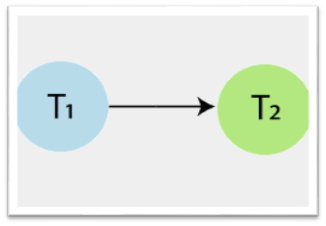
Precedence graph of Schedule S

Precedence graph of Schedule S

In above precedence graph of schedule S, contains two vertices T1 and T2, and a single edge T1? T2, because all the instructions of T1 are executed before the first instruction of T2 is executed.

If a precedence graph for any schedule contains a cycle, then that schedule is non-serializable. If the precedence graph has no cycle, then the schedule is serializable.
So, schedule S is serializable (i.e., serial schedule) because the precedence graph has no cycle.

Schedule S1:

Time Transaction T1 Transaction T2
t1 Read(A)  
t2   Read(A)
t3   Write(A)
t4 A=A+50  
t5 Write(A)  

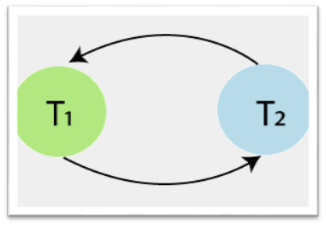
Precedence graph of Schedule S1

Precedence graph of Schedule S1

In above precedence graph of schedule S1, contains two vertices T1 and T2, and edges T1? T2 and T2? T1. In this Schedule S1, operations of T1 and T2 transaction are present in an interleaved manner.
The precedence graph contains a cycle, that’s why schedule S1 is non-serializable.

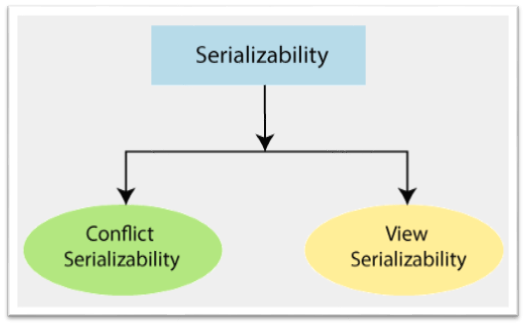
Types of Serializability

  1. Conflict Serializability
  2. View Serializability
Types of Serializability


Related Topics

Relational Algebra in DBMS

Relational Algebra is a widely used procedural query language, which takes instances of one or more relation as an input and generates a new relation as an output. It uses a different...

6 minutes read.

ER Diagram for Company Database in DBMS

What is ER Diagram? An ER diagram (short for Entity Relationship Diagram), also known as an ERD, is a diagram that shows the relationships of a set of entities stored in...

7 minutes read.

ER Diagram for Banking System in DBMS

Entity Relationship Diagram Entity Relationship Diagrams, or ER Diagrams for short, are diagrams that show the relationships among entity sets that are stored in databases. Alternatively said, ER diagrams assist in...

3 minutes read.

Entity and Entity set in DBMS

What is DBMS? A database management system (DBMS) is a software application that interacts with end-users, other applications, and the database itself to capture and analyze the data. A DBMS allows...

3 minutes read.

Query optimization in DBMS

Choosing an effective execution strategy to execute a query is a process known as query optimization. After the decision-making process of query parsing, which determines how many distinct ways a given...

5 minutes read.

ER Diagram for School Management System in DBMS

What is ER Diagram? An ERD, or entity relationship diagram, is a diagram that depicts the connections between a group of entities contained in a database. In other words, ER diagrams...

6 minutes read.

Domain Constraints in DBMS

Introduction about DBMS:- DBMS stands for DataBase Management System. DBMS(DataBase Management System) is a type of software by which we can save and retrieve the user's data with the security process....

3 minutes read.

Conversion of ER Diagram into Relational Model

After designing the Entity-Relationship diagram, you need to convert it into tables in the relational model. Because the relational model can be easily implemented by the Relational DBMS like Oracle, MySQL, etc....

2 minutes read.

Defference between Database and Data Warehouse

Database A database is a collection of related information is called a database. It has some elements that can be mapped to real-world objects. It is designed in such a manner...

4 minutes read.

DBMS Tutorial | Database Management System

Database Management System (DBMS) tutorial is all about managing and maintaining the data effectively. Our DBMS tutorial is designed for beginners as well as professionals. What is Data? Data is a real-world...

5 minutes read.

Data Abstraction in DBMS

Introduction Data abstraction is a fundamental concept in database management systems (DBMS). It refers to the process of hiding the details of how data is stored and retrieved from the user,...

3 minutes read.

Advantages of DBMS

A Database Management System (DBMS) is a collection of programs which lets the end-users to manage and control the database. Database systems use query language for accessing, storing, and maintaining the...

3 minutes read.

View Serializability in DBMS

View Serializability It is a type of serializability that can be used to check whether the given schedule is view serializable or not. A schedule called as a view serializable if it is view...

4 minutes read.

Er Diagram Symbols and Notations in DBMS

Entity Relationship Diagram Entity Relationship Diagrams, or ER Diagrams for short, are diagrams that show the relationships among entity sets that are stored in databases. Alternatively said, ER diagrams assist in...

6 minutes read.

Foreign key in DBMS

Foreign key in DBMS: The Foreign key is a field or the set of fields in the relational database table, which points to the existing field in another table. It...

2 minutes read.

Types of Data Abstraction in DBMS

What Is Data Abstraction? To ship an email, you want to know the address. But to send the email, you don't need to see where the email is physically stored. You...

6 minutes read.

ER Diagram for Student Management System in DBMS

Entity Relationship diagrams Entity Relationship Diagrams, or ER Diagrams for short, are diagrams that show the relationships among entity sets that are stored in databases. Alternatively said, ER diagrams assist in...

6 minutes read.

DBMS Schedule

A schedule is a process of combining the multiple transactions into one and executing the operations of these transactions in a predefined order. A schedule can have multiple transactions in it, each transaction...

2 minutes read.

Integrity Constraints in DBMS

Integrity constraints in DBMS (Database Management System) are used to ensure the accuracy and consistency of data in a database. They are a set of rules that define the allowed...

1 minute read.

BCNF in DBMS

BCNF stands for Boyce–Codd Normal Form. What is the Normal form? The normal form is mainly used to reduce the redundancy of the database tables. Or we can say that the normal form...

4 minutes read.