
×

DBMS Schema

Schema

  • It is a physical representation of data that appears in the database management system.
  •  In simple words, a schema is the structure of any database.
  • It defines how the data is stored in a database and relationship among those data, but it does not show the data available in those tables.
  • The database schema includes the definition of the database, record types (entities), and the components that make up those records.
  • Schema of a database does not change by performing certain operations like insertion, updation, and deletion, but it can only be modified or changed by modifying the DDL statements.
  • Database schema describes the integrity constraints of the database, domains of all attributes, foreign, and primary key of all the relations. 
  • Schema is of three types:
  1. Physical Schema: The overall design of a database at the physical level is called a physical schema. This schema describes how the data is stored in the secondary storage devices.
  2. Logical Schema: The overall design of a database at the logical level is called a logical schema. A database administrator (DBA) and the programmers used to work at this level.
  3. View Schema: The overall design of a database at a view level is called view schema. This schema generally describes the user’s interaction with the database system.

Example of Schema:
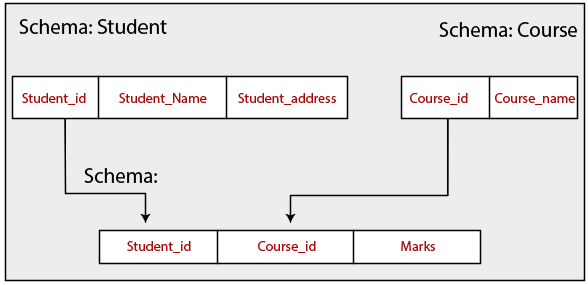
DBMS Schema

Subschema

  • A subschema is the sub-level or subset of the schema having the same features that a schema has.
  • This type of schema allows a user to view only that part of the database in which he is interested.
  • A language called the SDL (Subschema Definition Language) is used to specify a subschema in a database management system (DBMS).
  • For example: Suppose an employee table in a database where the programmer can access all fields of this table, but the user can access only two or three fields of it. Subschema describes both views of the database.

Instances

  • The data or information stored in the database at a particular moment is called an instance of the database.
  • An instance can also be called as a current state or database state.
  • The database schema defines the variables in tables that belong to a specific database; the values or records of these variables at a particular moment are called the instance of the database. 
  • Many instances can be constructed to correspond to a specific database schema.
  • Every time we insert, modify, or delete the value of data item in a record, one state of data changes into another state.

For Example:
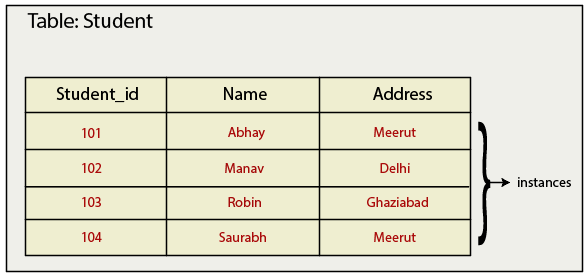
DBMS Schema 1

Related Topics

Network model in DBMS

Network model: The many-to-many relationship between the database constraints is represented hierarchically by the Network Model in DBMS. It is a straightforward and straightforward database model. Due to the Network Model...

4 minutes read.

B-Tree Insertion in DBMS

A B-tree is a special type of m-way tree, commonly used for disk access. A B-tree of order m can have at most m-1 keys and m descendants. B-trees are...

4 minutes read.

Applications of DBMS

There are various fields where a database management system is used. Following are some applications which make use of the database management system: 1. Railway Reservation System: In the railway reservation...

7 minutes read.

Serializability in DBMS

Serializability in DBMS Serializability is the concept in a transaction that helps to identify which non-serial schedule is correct and will maintain the database consistency. It relates to the isolation property of transaction in...

3 minutes read.

Conversion of ER Diagram into Relational Model

After designing the Entity-Relationship diagram, you need to convert it into tables in the relational model. Because the relational model can be easily implemented by the Relational DBMS like Oracle, MySQL, etc....

2 minutes read.

ER Diagram for Company Database in DBMS

What is ER Diagram? An ER diagram (short for Entity Relationship Diagram), also known as an ERD, is a diagram that shows the relationships of a set of entities stored in...

7 minutes read.

ER Diagram for School Management System in DBMS

What is ER Diagram? An ERD, or entity relationship diagram, is a diagram that depicts the connections between a group of entities contained in a database. In other words, ER diagrams...

6 minutes read.

DBMS Keys: Primary, Super, Candidate, Foreign

In database management system, keys play an important role which is used for identifying unique records by the combination of one or more fields in the database table. Keys also allows you to...

3 minutes read.

DBMS Examples

Introduction to DBMS A database management system (DBMS) is a software application that is designed to manage and organize data stored in a database. It is responsible for storing, retrieving, and...

4 minutes read.

ER Model: Entity Relationship Diagram (ERD) with Examples

ER model stands for Entity-Relationship Model. It is a high-level data model diagram which defines the conceptual view of the database. It is a blueprint or design of a database that will...

2 minutes read.

Secondary Key in DBMS

What are Keys? Keys in DBMS are the attributes or set of attributes that uniquely identify a row in a set of relations. A table (relation) can have a column or...

3 minutes read.

Concurrent Execution of Transaction

In the transaction process, a system usually allows executing more than one transaction simultaneously. This process is called a concurrent execution. Advantages of concurrent execution of a transaction Decrease waiting time or...

4 minutes read.

Difference between Relational and Non-Relational Databases

Databases have become an integral part of our lives, from powering big websites like Amazon and Netflix to everyday tasks like remembering our passwords. With such an indispensable role in...

7 minutes read.

Characteristics of DBMS

Introduction to DBMS: A database management system (DBMS) is a software application that is designed to manage and organize data stored in a database. It is responsible for storing, retrieving, and...

3 minutes read.

Query processing in DBMS

Operations on DBMSs are made much simpler, more organized, and methodical with SQL. These are not only simpler for people to comprehend, but after gaining a basic comprehension of them, they...

4 minutes read.

What is Non-Relational Database

Databases can be sorted as either relational or non-relational. Non-relational data sets are now and again alluded to as "NoSQL," which represents Not Only SQL. The principal difference between these...

4 minutes read.

States of Transaction in DBMS

Transaction States A transaction passes through many different states in its life cycle. These states are known as transaction states. A transaction can be in one of the following states in the database: Active statePartially...

3 minutes read.

Founder of DBMS

The first database management system was built to automate the business of the General Electric Company. It was built by a small group of programmers. The Integrated Data Store IDS...

4 minutes read.

DBMS Schedule

A schedule is a process of combining the multiple transactions into one and executing the operations of these transactions in a predefined order. A schedule can have multiple transactions in it, each transaction...

2 minutes read.

Concurrency Control Protocols

Concurrency Control Protocols Concurrency control protocols ensure the atomicity, serializability and isolation of the concurrent transactions. The Concurrency control protocols can be broadly classified into the following categories: Lock Based ProtocolTimestamp protocol Lock Based Protocol In this protocol,...

5 minutes read.