
Fundamentals Of Distributed DBMS
Fundamentals of DDBMS
Here we are going to talk about the Fundamentals of DDBMS.
But first, we need to know about Distributed databases to understand the Distributed Database Management System.
Distributed Database:
It is a database, but it is not restricted to only one system, but rather a several databases that could be geographically distributed from place to place worldwide.

The location of the Distributed Database System is spread out on various sites, which don't share any physical components. It is required because of numerous user access to particular databases.
A distributed DBMS manages to merge all the databases and show it as a single resource to the users.
In simple words, it is a collection of multiple databases connected via a computer network and serves as a single database.
Features
- As we know, the distributed database is a collection of numerous databases, So these databases are logically interrelated.
Sometimes these databases are represented as a single logical database.
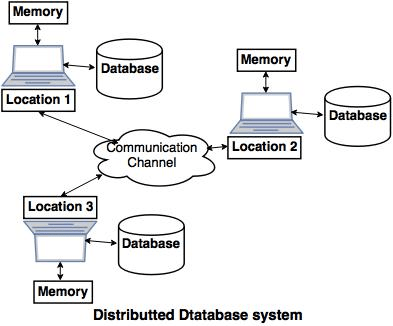
- Data is stored on multiple sites across the globe. Any DBMS can manage data depending on the system's choice and independent of other places.
- in the collection of databases, the processors in the sites are connected through a network.
- They are not multiprocessor configured.
- It is not any file system which is loosely connected.
A distributed database consolidates transaction processing, although it is not the same as the transaction processing system we find in other database systems.
Types of Distributed DBMS:
Distributed DBMS can be classified into two:
1. Homogeneous Database:

As the homogeneous name database means the same database, all the databases stored on various sites are identical or similar in this distributed database.
The Operating System, Database Management System, and all the data structures used are all the same at every site in a homogeneous database.
2. Heterogeneous Database:

In this distributed database system, different sites can use different database management systems, operating systems and other software that might lead to problems.
These problems may occur in query processing and transactions.
It might also cause unawareness of the site, which uses different schemas from others.
There can be a lot of types of data models in the database.
So, it leads to another operation, translation, which helps different sites communicate.
Distributed Database Management System:
It is a type of centralized software system that manages the distributed databases in such a way that they are a single database.
This management of distributed databases makes the operations happening in the database transparent.
In the Distributed Database Management System(DDBMS), the smaller fragment databases are merged to form a single central database that users can access as one.
Each fragment can independently process the user request to the local data.
Features:
- it can create, retrieve, update and delete distributed databases.
- Database is being synchronized periodically, and access mechanism is being
- Mandatory data update in all the distribution is done if data is being modified anywhere.
- It is used in the application field, where several users continuously and regularly
- it can handle heterogeneous database platforms.
- The distributed database systems maintain data confidentiality and data integrity of the databases.
Factors Encouraging DDBMS
The following are the reason for the encouragement of Distributed DBMS:
Distributed Nature of Organizational Units- Nowadays, organizations divide themselves into units that are physically distributed over the globe. Every department requires its own set of data. So, the organization has to divide its database into parts, but in contrast, it also has to keep united.
Sharing of Data: Many organizational units must keep sharing their data and resources, which constantly demands replication or unification of the database.
Support of Both OLTP and OLAP: Online Transaction Processing(OLTP) and Online Analytical Processing(OLAP) work on different systems but should have the same data. This problem is solved with Distributed Databases as it synchronizes databases and various systems to form a unified database.
Data Recovery: The data recovery in DDBMS is made through one of its techniques, which is a replication of data throughout different sites. Data can be accessed from other sites while the disrupted site is reconstructed. Failure in the database is not possible in this system.
Support for Multiple Application Software: DDBMS helps uniform functionality over the different platforms while using the same data. It is commonly used by organizations with various platforms for their applications.
Advantages of Distributed Databases
Advantages of DDBMS:
- Modular Development In centralized database systems, if the system needs to be expanded to new locations or additional units, the action necessitates significant effort and disrupts the current operation.
- More Reliable, The entire system of centralized databases comes to a standstill in the event of database failures. However, with distributed systems, if a component fails, the system may still function at a less efficient level. DDBMS is hence more dependable.
- Better Response If data is disseminated effectively, user requests may be satisfied from local data, resulting in a faster response time. On the other hand, centralized solutions require that all inquiries be processed through a single computer, which lengthens the response time.
- Lower Communication Cost In distributed database systems, communication costs for data manipulation can be reduced if data is kept close to where it is most often needed. In centralized systems, it is not possible to do this.
Adversities of Distributed Databases
- Need for complex and expensive software- Software that is sophisticated and usually expensive is needed by DDBMS in charge of coordinating data between the various sites and guaranteeing data transparency.
- Processing overhead -Even straightforward procedures may involve numerous connections and extra computations to guarantee data consistency between the locations.
- Data integrity- problems emerge from the necessity to update data across dozens of sites.