
Scan Conversion in Computer Graphics

“When we represent regular objects in the form of discrete pixels, it is called Scan Conversion.” Every graphics system must transform the primitives into a collection of pixels. The scan conversion is also called “Rasterization.” Each pixel in the graphical system has two states either on or off.

“The Scan Converting rate is a technique that is used in video processing. In this technique, we can change the horizontal and vertical frequency for many different purposes.” We use a scan converter to perform scan conversions. We can define a line by its starting and ending points. On the other hand, we can define a circle by its radius, circle equation, and center point.

Methods of Scan Conversion

We can perform scan conversion by using two methods.

  • Analog Method
  • Digital Method
  • Analog Method: It is the best method for analog videos. A large number of delay cells perform the analog method. The Analog approach is also known as “Non-retentive, memory-less, or real-time method.”
  • Digital Method: Digital method is also known as a “retentive or buffered method.” In the digital method, there is a concept of n1and n2 speed. We can save (Store) the picture in line or frame buffer with n1 speed. The image can be read with n2 speed.    

Some Examples of scan converted objects

 We can apply the conversion to the following objects.

  • Line
  • Point
  • Polygon
  • Rectangle
  • Filled Region
  • Arc
  • Character
  • Sector
  • Ellipse

Pixel

“We can define a pixel as a rectangular dot centered at an integral position on an integral grid.” It is a real point that is addressable. The pixel is also called “picture element (Pel).”

A pixel includes its own:

  • Intensity – The intensity of a pixel defines the brightness of the image that appears on the screen.
  • Name or Address- The name or address of a pixel defines the position of the pixel.

We can define the size of any image with a total number of horizontal pixels and the total number of vertical pixels.

For Example- (512 x 512, 640 x 480, or 1024 x 768).

We can measure the ratio of an image’s width to its height in unit length or number of pixels, is known as the aspect ratio of the image.

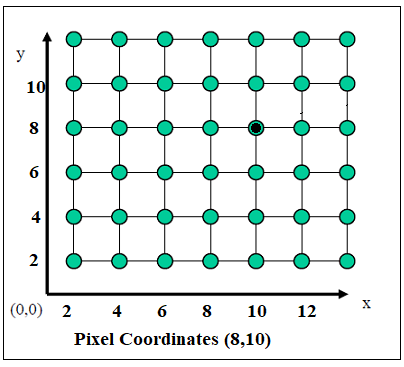
For example- A Pixel having a coordinate (8,10).
Scan Conversion

Advantages of Scan Conversion

  1. The scan conversion technique is used for various purposes, such as videoProjectors,TV, HDTV, Video capture card, LCD monitor, etc.
  2. The Scan Conversion technique has wide applications.
  3. We can efficiently perform scan conversion using high speed integrated circuits.

Disadvantages of Scan Conversion

  1. We can only apply scan conversion with LSI and VLSI integrated circuit.
  2. Int the digital scan conversion, the analog video signal has changed into digital data.

Related Topics

Midpoint Circle Drawing Algorithm in Computer Graphics

The midpoint circle drawing algorithm helps us to calculate the complete perimeter points of a circle for the first octant. We can quickly find and calculate the points of other...

12 minutes read.

2D Transformation in Computer Graphics

Some visuals are transformed into some other graphics by implementing several of the principles known as transformation. There are multiple kinds of transformation, including translation, scaling, rotation, shearing, etc. Whenever...

2 minutes read.

Scan Conversion of a Circle Computer Graphics

A circle is an eight-way symmetric shape. All quadrants of a circle are the same. There are two octants in each quadrant of a circle. If we know the value of any...

3 minutes read.

2D Scaling

In scaling, we can expend or compress the size of any object. We can apply scaling on the object by multiplying the original coordinates with scaling factors. The term scaling factor...

2 minutes read.

History of Computer Graphics

History of Computer Graphics Computer Graphics (CG) was first developed as a visualization tool. Computer graphics were basically introduced for scientists and engineers in government and corporate research centers, i.e., Bell Labs and Boeing...

4 minutes read.

Transformation

Introduction The term Transformation is generally referred to as converting a graphic into another graphic by applying some rules or algorithms. Sometimes an image or picture can be a combination of lines, rectangle,...

2 minutes read.

Applications of Computer Graphics

Applications of Computer Graphics Some applications of computer graphics are mentioned below- Graphical User Interface (GUI): It is a way of interacting with a computer using the icon, ...

2 minutes read.

Input Devices in Computer Graphics

An Input device is the piece of computer hardware equipment used to give input to the computer. The input can be in the form of graphics, text, sound, audio, video,...

7 minutes read.

3d Scaling

The 2D and 3D scaling are similar, but the key difference is that the 3D plane also includes the z-axis along with the x and y-axis. In scaling, we can expend...

2 minutes read.

Computer Graphics Tutorial

Introduction to Computer Graphics Computer graphics is commonly seen as a computer science branch that deals with the computerized image fusion theory and technology. As simple as a triangle outline, a...

6 minutes read.

Polygon Clipping in Computer Graphics

“A Polygon can be described as the enclosed collection or group of the lines.” In a polygon, all lines are connected. Lines can be a combination of edges and vertices,...

4 minutes read.

Anti-aliasing in Computer Graphics

Anti-aliasing in Computer Graphics “Anti-aliasing is a method for eliminating the aliasing effect used in computer graphics. In a 2-dimensional object, the ambient occlusion impact is the existence of sharp edges...

7 minutes read.

2D Rotation

The Rotation of any object depends upon the two points. Rotation Point: It is also called the Pivot point. Rotation Angle: It is denoted by Theta (). We can rotate an object in...

1 minute read.

2D Shearing

We can denote shearing with ‘SHx’ and ‘SHy.’ These ‘SHx’ and ‘SHy’ are called “Shearing factor.” We can perform shearing on the object in two ways- Shearing along x-axis: In this, we...

2 minutes read.

Types of Computer Graphics

Types of Computer Graphics The computer graphics contains two types. They are- Raster (Bitmap) graphicsVector graphics Many individuals are likely to consider pictures on computers (or phones, tablets, or some other electronic gadget...

5 minutes read.

3D Rotation

The 3D rotation is different from 2D rotation. In 3D Rotation we also have to define the angle of Rotation with the axis of Rotation. For Example- Let us assume, The initial...

2 minutes read.

3D Shearing

We can denote shearing with ‘SHx,’ ‘SHy,’ and ‘SHz.’ These ‘SHx,’ ‘SHy,’ ‘SHz’ are called “Shearing factor.” The basic difference between 2D and 3D Shearing is that the 3D plane also...

1 minute read.

Color Models in Computer Graphics

"Color model is a 3D color coordinate system to produce all range of color through the primary color set." There are millions of colors used in computer graphics. The light...

3 minutes read.

Animation in Computer Graphics

The word Animation is extracted from a Latin language, "Anima," which means "Soul." TheAnimation is a technology that allows any image object, an entity to walk, talk, or do some...

3 minutes read.

Line Drawing Algorithm in Computer Graphics

“The Line drawing algorithm is a graphical algorithm which is used to represent the line segment on discrete graphical media, i.e., printer and pixel-based media.” A line contains two points....

3 minutes read.