
×

Nested loop in C

Definition of Nested Loop

A nested loop is generally used when we want to run a loop statement inside another loop statement. This kind of loop is also known as a “loop inside the loop”.

Diagrammatical presentation of Nested loop Code with the help of flow chart 
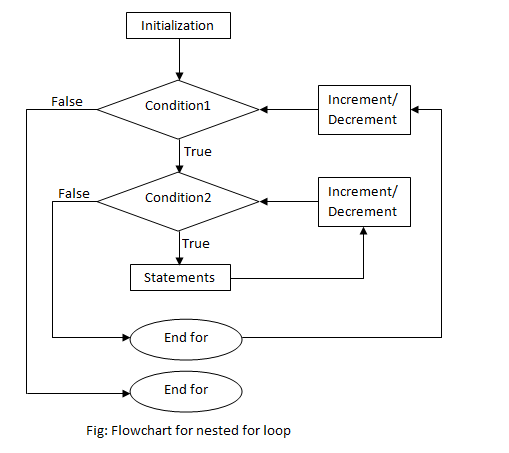
Nested loop in C

Explanation of the above Flow chart:

  1. As you can see, firstly, we provide an initialization statement.
  2. Then, the control evaluates the value of the first condition and checks whether the termination condition is true or false.
  3. If the value is false, the control will terminate the entire loop and only perform the basic command. But, if the value is true, it will continue to check the second condition.
  4. If it finds that the second condition is false, it will terminate the code of the second condition, and the control will move to the primary command and perform the loop. And if the value of the second condition is true, it will execute the code and check the termination condition, and it will continue to do so until the value becomes false.
  5. Along with this, some increment or decrement statements are also implemented after every statement execution.
  6. When the second condition terminates, the control goes back to the first condition, checks again, and repeats the entire execution process.
  7. The control will check and execute the termination condition multiple times.
  8. And it performs the condition given at the end and produces the output for displaying on the screen.

Now, let’s see the syntax of the nested loop in all loops of C.

Syntax Used For Initiating “Nested For Loop”:

for (initialization; termination condition; increment/decrement statement) {
      // program line of the first loop
   }
   // program line of the second loop
}

Syntax Used for Initiating “Nested While Loop”:

while(condition) 
{
// condition must be provided 
   while(condition) 
   { 
      // program line of the first loop
   }
   // program line of the second loop
}

Syntax Used for Initiating “Nested Do-While Loop”:

do
{
   do
   {     
      // program line of the first loop
   }
while(condition); //condition is given here
   // program line of the second loop
}
while(condition);

Syntax Used for Initiating “Nested Mixed (Do-While, While, For) Loop”:

do
{ while(condition) // condition should be provided
{   
 for (initialization; termination condition; increment/decrement condition) 
{  // program line of the first loop
 }
  // program line of the first while loop
 }
 // program line of second do-while loop
}
while(condition);

Example 01: Program of Nested for loop:

#include <stdio.h>
#include <stdlib.h> /* it involves memory 
  allocation, process control, conversions */
#define ROW 3 // rows declaration
#define COL 3 // columns declaration
// Driver program code
int main ()
{
    int i, j;
    // Declaration of the matrix
    int matrix [ROW][COL] = 
{
{11, 12, 13},
{14, 15, 16},
{17, 18, 19} 
};
        printf("the provided matrix is \n");
        // loops implementation
        for (i = 0; i < ROW; i++) // increment statement
   {
        for (j = 0; j < COL; j++) // increment statement
            printf("%d ", matrix[i][j]);
            printf("\n");
   }
    return 0;
}

Output:

the provided matrix is 
11 12 13 
14 15 16 
17 18 19 

Example 02: Program of nested while with for loop:

/* program in c to find out every prime factor
of a specific number with the help of nested loop */
#include <math.h> // library to include mathematical operations 
#include <stdio.h> 
// program line to display every possible prime factor of a provided number n
void prime factors (int n)
{
   // divisibility check 
   while (n % 2 == 0) 
   {
      printf("%d ", 2);
      n = n / 2;	
   }
   /* n must be odd So that one element can be we can be skipped
    (Note: i = i +2) */
   for (int i = 3; i <= sqrt(n); i = i + 2) 
   {
      // when n is divisible by i then display i and divide n
      while (n % i == 0) {
         printf("%d ", i);
         n = n / i;
      }
   }
   /* This test expression is defined to deal with the cases like 
    n is a prime number greater than 2 */
   if (n > 2)
      printf("%d ", n);
}
int main ()
{
   int n = 1578;
   primeFactors(n);
   return 0;
}

Output:

2 3 263

Related Topics

Pointer to pointer in C

A pointer to another pointer is another type of multiple indirections and a chain of many pointers. Generally, a pointer consists of the address of the variable. Once a pointer to...

4 minutes read.

Positioning of file in C

Positioning() function in c The fseek() function is utilized to change the document position of the stream . The fully extent of value from the source should be one of the...

3 minutes read.

Why does sizeof(x++) not Increment x in C

Sizeof() is a much-involved operator in C or C++. It is an incorporated time unary administrator which can be utilized to figure the size of its operand. The consequence of...

5 minutes read.

Consumer billing system in C

Introduction : Billing has always been taught to do perfectly, we know today's world is full of products, and We all are using multiple products. We are buying and selling various...

9 minutes read.

Variable in C

Variable is an identifier that holds data in memory. It is used to identify input data in a program. The value of the variable can change at the time of...

2 minutes read.

Find occurrence of substring in C using function

Introduction: In this article, we discuss finding the occurrence of a substring in C using function. This software takes strings and substrings as input and counts the occurrences of substrings within...

3 minutes read.

For loop in C Programming

In the C programming language, the for loop is used to repeatedly iterate over a set of instructions or a section of code. It is frequently used to traverse array-based...

3 minutes read.

Ferror() in c

Ferror():  In C, the ferror() function checks assuming there is a blunder in the given stream. The ferror() function is utilized to check for the document blunder on given stream. A return...

4 minutes read.

Storage class in C

Storage class in C defines the scope, the visibility, and the lifetime of variables and functions. In other words, storage classes are used to describe the features of variables and...

3 minutes read.

Structure in C

Why Structure came into the picture? In the actual world, we deal with entities that are collections of objects rather than tiny bits of data like integers, characters, floats, etc. So,...

4 minutes read.

User Defined Functions in C

C Functions: A function is defined as a block of code that is used to perform some specific task. In functions, we use flower brackets ({}) which contain the set of programming...

5 minutes read.

C Decision control statement

Decision Making C conditional statements are used to specify one or more conditions. The statements will be executed if the condition becomes true otherwise alternative statement will be executed if the...

3 minutes read.

Binomial Coefficient Program in C

What is Binomial coefficient? In the given set of n possibilities, the binomial coefficient(n,k) indicates the order of choosing 'K' results from those possibilities. Binomial coeeficient of posistive n and k...

3 minutes read.

Dos.h Header File in C Language

Dos.h is a header file in C. Interrupt handling, sound generation, date and time functions, and other tasks can be performed using the functions in this library. This is exclusive to...

4 minutes read.

Socket Programming in C

Socket programming is a process that connects the two or more nodes on a networking communication with respective to each other. One of the sockets that determines the socket (I.e.,...

5 minutes read.

Merge and Merge sort with example in C

Assume we have two ordered Integer arrays, a[] and b[]. If we wish to combine them into another ordered array, such as c[], we can use the following straightforward technique. Compare...

3 minutes read.

Const vs Volatile in C

Introduction Qualifiers are nothing but keywords which are used to modify the properties of a variable. Const and Volatile keywords are qualifiers in C. The Const qualifier is applied to the...

4 minutes read.

First Fit Program in C

This is one of the easiest ways to allocate memory. The main goal is to divide the memory into several fixed sizes. In C, there is only one process for...

3 minutes read.

String Handling functions in C

String :- The String is the collection of characters. Every String ends with the null character, and the String is enclosed in the double quotations .ie, "javaTpoint". If we see any...

5 minutes read.

memcmp() in C

Introduction: In this article we are discuss about memcmp() function in C. This function permits the person to evaluate the bytes of the two characters, as mentioned above. Depending on...

4 minutes read.