
×

Execution flow of C program

There are various steps of the execution of the C program that is given below. The following step of the execution
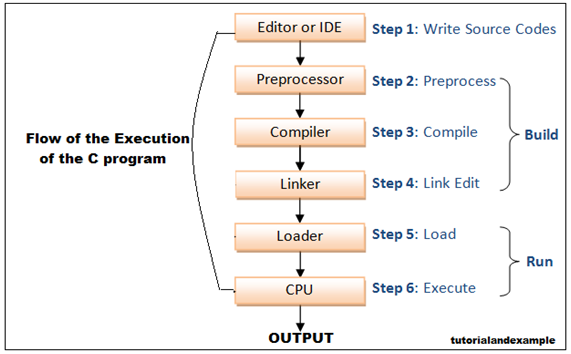
  1. Write source codes
  2. Preprocess
  3. Compile
  4. Link edit
  5. Load
  6. Execute

Editor or IDE: This is the first step while writing the source codes of the program, there must require any editor or IDE (like notepad and notepad++ etc) where we can write own source code and save it by using source codes (.c) and headers ( .h). Preprocessor: In this section, the source code includes the file and replaces the symbols and send to the next section compiler. Compiler: In this section, the compiler compiles the source code of the program and creates the object codes (.obj and .o)and sends to the linker. Linker: In this section, the linker links the object codes into static libraries (.dll and .so) and creates the executable code (.exe). Loader: In this section, the loader loads the executable code by using shared libraries (.dll and .so)file and send to the CPU for execution according to user input and return output.


Related Topics

Isalnum() function in C

Introduction: The isalnum () is a function used in C programming language. This function checks the passing number or argument is an alphanumeric number or not. The alphanumeric number consists of the...

3 minutes read.

Call Back Function in Embedded C

Callback function are one the most remarkable systems in C. A callback function is any code that is passed as a contention to another code, so this is the last...

3 minutes read.

Random function in C

Random function in C In the C programming language, the rand() is a function used for Pseudo Random Number Generator (PRNG). The random number generated by the rand() function is not...

4 minutes read.

Type Casting in C

Type casting is a way to convert a variable from one data type to another data type.Syntax: (type) expression;     Example: #include <stdio.h> int main() { int a,b; float sum; printf("Example of Type Casting\n"); printf("Enter any integer nos:"); scanf("%d",&a,&b); sum=a+b; printf("Sum: %f",sum); return 0; } Output Example...

1 minute read.

Conditional Operator in C

In C programming language, the conditional operator (also known as the ternary operator) is a shorthand way of writing an if-else statement. The syntax of conditional operator in C is...

3 minutes read.

Structure in C

Why Structure came into the picture? In the actual world, we deal with entities that are collections of objects rather than tiny bits of data like integers, characters, floats, etc. So,...

4 minutes read.

C String Manipulation programs without using Library Functions

C string manipulation programs without using Library Functions The string is the character list, and typically we operate with library functions to read and print the entire string, but here you...

6 minutes read.

Static in C

Static is a keyword that is used in the C programming language. It can be used both as variables and as functions. In other words, it can be declared both...

3 minutes read.

Garbage in C

Garbage in C The C programming language is a perfect fit for embedded systems as it provides low level control, structured programming, and portability. On the contrary, it does not provide...

3 minutes read.

Pre-increment and Post-increment in C

The rich set of operators is supported by the c language. In c there are several operators used. The mathematical operations in the programming language are done with the operators...

4 minutes read.

Example of Iteration in C

The iterations in the C language are the statements which are executed number of times until a certain condition is reached. These iterations are regarded as “Loops” in C language....

3 minutes read.

Volatile in C

Introduction A volatile keyword is a qualifier in C. Qualifiers are nothing but keywords which are used to modify the properties of a variable. Qualifiers are of two types: 1) Const The const type...

3 minutes read.

Sum of N numbers in C using For loop

Before we move on the program of sum of N numbers, first we have to know about the For Loop statement. The syntax of ‘for’ loop in C programming language is...

3 minutes read.

How to Merge Array in C?

Introduction Merging arrays is a common task for many developers but might be difficult for beginners of C programming. Fortunately, our guide will show you how to quickly merge arrays in...

6 minutes read.

Write a program that produces different results in C and C++

In this tutorial, we'll explore several programs that, depending on whether they are developed using C or C++ compilers, will produce varying outputs. There are numerous similar programs, but we will just...

2 minutes read.

If Statement in C

Decision Control Statements We frequently desire one set of instructions to be carried out in one circumstance while another set of instructions to be carried out in a completely different circumstance....

3 minutes read.

String in C

String is a collection of character or group of characters. In array, string of character is terminated by a null value “\0” and enclose between double quote. We can declare...

2 minutes read.

C Data type

Data Types in C with Examples Data types are used to define the type of data that a variable can store to perform a specific operation.ANSI C provides three types of...

2 minutes read.

Limitations of Inline Function in C

The compiler is unable to conduct inlining in two instances. It just accepts the inline definitions and produces space for the function in the same way it does for a...

3 minutes read.

Error handling in C

Error handling in C: The C programming standard does not provide direct convenience for handling the errors. However, being a system programming language, it definitely will give access to handling...

4 minutes read.