
×

Food Allergy VS Food Intolerance

Difference Between Food Allergy and Food Intolerance

A food allergy arises when the body's immune system, which normally fights diseases, sees food as an invasion. When the immune system reacts to anything, it releases chemicals like histamine into the body, which causes an allergic reaction. Hives, vomiting, stomach discomfort, throat tightness, hoarseness, coughing, breathing issues, and a decrease in blood pressure are all possible reactions.

When the body is unable to properly digest the food ingested, or when a particular meal irritates the digestive tract, it is called food intolerance. Nausea, gas, cramps, abdominal discomfort, diarrhea, irritability, and headaches are all signs of food intolerance.

A person with a food allergy is always at risk of a life-threatening reaction, even if previous reactions were minimal. Anaphylaxis might occur if even a small portion of the meal is consumed. As a result, anybody with a food allergy must avoid the offending item(s) completely and keep emergency injectable epinephrine on hand at all times.

The body's reaction is what distinguishes a food allergy from an intolerance. Your immune system triggers a response when you have a food allergy. If you have a food sensitivity or intolerance, your digestive system reacts.

“Gas, bloating, diarrhea, constipation, cramps, and nausea” are all signs of food intolerance.

“Hives, swelling, itching, anaphylaxis, and dizziness” are all signs of a food allergy.

Food Allergies

A food-allergy is an immune system response to a specific food. It occurs when the body misinterprets a dietary element — generally a protein — as dangerous and responds with an immune system (antibodies) to combat it. When the antibodies are fighting an "invading" dietary protein, an allergic response ensues.

An immunoglobulin E (IgE)-mediated response is the most prevalent. Allergy antibodies are known as IgEs. When substances, such as histamine from mast cells, are released, they produce an instant response.

Your immune system protects your body from intruders such as bacteria, fungi, and the common cold virus. A food allergy occurs when your immune system perceives a protein in your food as an invader and responds by producing antibodies to fight it.

Severity of Food Allergies

Food allergies, contrasting to food intolerances or sensitivities, can be deadly. In certain situations, simply swallowing or touching a little quantity of the allergen might trigger a severe reaction.

Symptoms of Food Allergy

Food allergies can cause hives, swelling, and itching on the skin, as well as anaphylaxis (difficulty breathing, wheezing, disorientation, and death) and stomach problems.

Food Allergy VS Food Intolerance

Causes of Food Allergy

Ninety (90%) percent of allergic reactions are caused by Shellfish, eggs, milk, fish, peanuts, wheat, tree nuts, and soybeans.

Food Intolerance

0A food intolerance, on the other hand, is an immune system-independent reaction to a meal. Reactions might be instantaneous or take 10-20 hours to show after eating.

In your digestive tract, a food causes an intolerance. This occurs when your body is unable to properly break it dow0n or when your body reacts to a meal that you are allergic to. Lactose intolerance, for example, is a condition in which your body is unable to digest lactose, a sugar found in dairy products. Neither of these scenarios includes the immune system.

Causes of Food Intolerances

You may be sensitive or intolerant to a certain food for a range of reasons.

  • Sulfites, MSG, and artificial colors are examples of food additives or preservatives that might cause allergic reactions.
  • Pharmacological dynamics such as caffeine sensitivity or other medications
  • Sensitivity to sugars found naturally in foods like onions, broccoli, and Brussels sprouts.

Symptoms of Food Intolerances

Food intolerances can appear in a number of ways. Symptoms of food intolerance might be vague or even mimic those of other diseases.
Food Allergy VS Food Intolerance

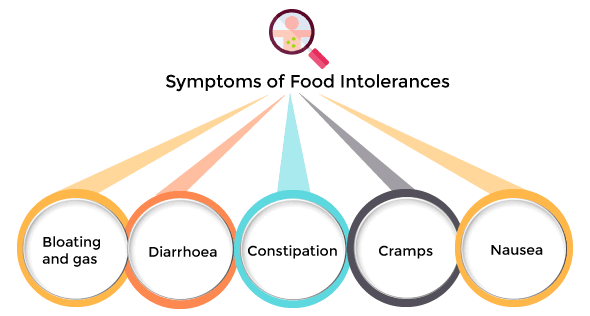
The symptoms of intolerance, on the other hand, are all connected to the digestive system. The following are some examples:

  • Bloating and gas
  • Diarrhea
  • Constipation
  • Nausea

Key Differences between Food Allergy and Food Intolerance

Food Allergy VS Food Intolerance
Food Allergy Food Intolerance
Where Reaction Takes Place Immune System Mostly related to digestive system
Severity of Reaction It can be life threatening Mild to restrained discomfort
Symptoms Multiple body systems ; skin, respiratory , heart and gastro-intestinal Gastro-intestinal
Reaction-time Usually immediate(within few seconds to 30-60 min after food intake) Maybe delayed(From 30 min to 3-4 days)
Are symptoms critical or chronic? Typically acute, hardly chronic Frequently chronic, occasionally acute
Affected Population as a Percentage of Total Population 1-2% Estimated 20-30%
Mechanisms of Immunity IgE WBC antibodies, IgG (and subclasses) IgM C3, C4

Related Topics

Difference between SDN and NFV

1. Software Defined Networking (SDN) The aim of the SDN design is to enhance overall network performance, and by providing a dynamic and programmatically effective network setup, networks may become nimble...

3 minutes read.

Difference between Threat and Attack

Threats and attacks are two crucial occurrences in terms of security. From the perspective of network security, it is crucial to comprehend the distinctions between the two. A persistent risk to...

3 minutes read.

Difference between Vision and Mission

Difference between Vision and Mission These words are really important for every organisation. Now a day, in fast-paced environment, every organisation must have a clear or pinned statement which is attractive. There...

6 minutes read.

Anxiety vs Depression

Difference between Anxiety and Depression The terms anxiety and depression are used by people very casually, but these terms have a very serious outcome. Both explain an emotion of a person....

8 minutes read.

Difference between Procedural and Declarative Knowledge

The information can be presented in a variety of forms to the computer's inference in order to address issues related to the rule. So, in this article, we'll talk about...

2 minutes read.

Difference between Spark DataFrame and Pandas DataFrame

Spark and Pandas are the libraries of the Python. Both Spark and Pandas are used in the Data Science, and Data Analytics. Basically, a DataFrame can be defined as a...

3 minutes read.

Difference between India and Australia

Difference between India and Australia India India is a large country in Asia Continent. A Portuguese explorer VascodeGama was the first European who reach India. He reached Calicut (India) in July 1497...

5 minutes read.

Difference between FTP and TFTP

File transfer protocols like FTP and TFTP are both used to move data between systems on a TCP/IP network. Both TFTP and FTP deliver data in clear text and are...

3 minutes read.

Difference between Associative Mapping and Direct Mapping in Cache

This article gives the brief explanation about the Associative and Direct mapping techniques. We will get a brief understanding about associative and direct mapping after going through this article. What is...

3 minutes read.

Difference between Traditional and Modern Concepts of Marketing

Traditional Concepts of Marketing The conventional view of marketing places all its emphasis on products, with the goal of producing and selling more goods to increase profits. Profit is the focus...

3 minutes read.

Difference between ERP and SAP Software

There are different businesses running in the world. Not only large businesses, the small businesses are also need a lot of planning to run in a smooth manner. All the...

3 minutes read.

Difference between Molecules and Compounds

Molecule A molecule is a group of two or more atoms that are joined together, showing the smallest identifiable unit where the pure substance can hold its compositions chemical properties. The...

3 minutes read.

Difference between TV and Computer Display

These two are hardware products that have screens that show graphics, pictures, and movies. Despite having the same capability, their applications are widely diverse. We shall examine the distinction between...

3 minutes read.

Difference between Bezier Curve and B-Spline Curve

Nowadays, we all see that the use of graphics is increased. Graphics is used in all the websites, applications and also games. Ever wondered how such smooth curves are created...

3 minutes read.

Difference between E-Commerce and E-Business with an Example

Nowadays, no one is interested in going to the market to buy and sell their products. Now people just place an order through the internet, and their product is directly...

3 minutes read.

Difference between EBS and EFS

The Amazon web service provides a storage management system. There are two types of the storage management system. These are AWS EFS (Elastic File System) and AWS EBS (Elastic Block...

4 minutes read.

Food Allergy VS Food Intolerance

Difference Between Food Allergy and Food Intolerance A food allergy arises when the body's immune system, which normally fights diseases, sees food as an invasion. When the immune system reacts to...

3 minutes read.

Difference Between CC and BCC

Now a day, there are so many medium of communication. But In olden times it was not easy to talk to people sitting far away from you. There was no...

7 minutes read.

Difference between Memory Mapped IO and IO Mapped IO with reference to 8085 Microprocessor

The microprocessor is unable to act independently; therefore, it must be connected to memory, additional peripherals, or IO devices. Interfacing is the term for this connecting. There are two methods to...

3 minutes read.

Difference between GPS and GPRS

GPS (Global Positioning System) A locating system based on satellites is called GPS (Global Positioning System). Satellites are used by the GPS network to pinpoint an object's exact location on the...

3 minutes read.