
×

Unix Operating System

Unix Operating System

Unix Operating System is a multiuser, portable, time-sharing, and multitasking operating system that was developed in 1969. Unix operating system was developed by a group of AT & T Laboratory employees Dennis Ritchie, Joe Ossanna, Douglas Mcllroy, and Ken Thompson at Bell Labs.  The first language that was used to developed a Unix operating system was Assembly Language and then the Unix operating system was developed by using the C language in 1973.

There are several types of Unix operating system which are present in the market such as AIX, BSD, Solaris, and HP Unix. Unix operating system is known as multiuser system because multiple users can use it simultaneously.

Unix operating system is a multitasking environment because in this, we can run number of programs simultaneously.

Unix operating system is mainly made up of three parts such as Kernel, Shell, and File.

Features of Unix Operating System

There are various features of Unix operating System:

  1. Open Source
  2. Multitasking capability
  3. Multi user capability
  4. Security
  5. Portability
  6. Communication
  1. Open Source: - The Unix operating system is an open source code. So anyone can modify the code of the Unix operating system as per the requirements.
  2. Multitasking Capability: - The Unix operating system is a multitasking operating system because in Unix operating system, multiple programs can be run simultaneously. And this feature increases the utilization of the CPU resources. In Unix operating system, we can type a program in a program editor and concurrently we can also run some other commands.
  3. Multiuser Capability: - The Unix operating system is a multiuser operating system because it allows multiple users to use a system simultaneously.
  4. Security: - The Unix operating system is a highly secured operating system because Unix use different provisions to protect the data. Every Unix user is happy to work with the Unix operating system because it provides a virus-free environment to the user.

There are two security levels provided by the Unix operating system:

  1. File Level Security: - File level security is managed or, controlled by the owner of the file.
  2. System Level Security: - System level security is managed or controlled by the system administrator.
  3. Portability: - Portability is the wonderful feature of the Unix operating system. In the Unix operating system, the term portability means that Unix is able to port to every type of operating system. Unix operating system is portable because it is written in C language and the C language is also a portable language.
  4. Communication: - The Unix operating system provides a tremendous communication among the users. The communication can be of any kind means the communication can be within network of the one main computer or in between the network of two or more computer.

In the Unix operating system, we can easily exchange data, programs and mail via networks.

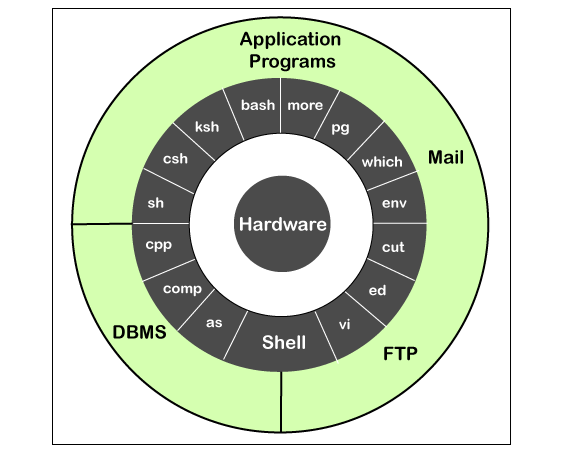
Architecture of Unix Operating System

The operating system is mainly made up of four components:

  1. Kernel
  2. Shell
  3. Files and Directories
  4. Commands and Utilities
  1. Kernel: - Kernel is the main component of the operating system. It is like the heart of the operating system. The main task of the kernel is to interact with the hardware and various types of task such as File management, Memory management, and Task management.
  2. Shell: - Another component used to implement a Unix operating system is Shell. Shell is the essential component of the Unix operating system. The shell is a command line interpreter. When the user types the command, the shell interprets it and then shell call that program which need a user. There are various types of standard syntax shell used for the commands such as Korn Shell, C Shell, and Bourne Shell.
  3. Commands and Utilities: - Another component of the Unix operating system is commands and utilities. There are different types of command and utilities which is used to develop the Unix operating system such as grep, mv, cp, and cat.
  4. Files and Directories: - In Unix operating system, files are used to organize the data. Then we organize the files into the directories. Again, organize the directories into a Tree-structure.
Unix Operating System

Related Topics

Bit Vector in Operating System

What is Bit vector? Bit vector is one of the most important methods used in the free space management of operating system. Free space management which is used by the operating...

3 minutes read.

Disk Scheduling Algorithms

Disk Scheduling Algorithms Disk scheduling algorithms are the algorithms that are used for scheduling a disk. Generally, the scheduling refers to a time-table for completing any task or a job. With the help...

2 minutes read.

Inter Process Communication in Operating System

Inter-Process Communication or IPC refers to the methods and techniques that allow processes (programs or tasks) to communicate with each other within a computer system. This is typically done through...

3 minutes read.

Unix Operating System

Unix Operating System Unix Operating System is a multiuser, portable, time-sharing, and multitasking operating system that was developed in 1969. Unix operating system was developed by a group of AT &...

3 minutes read.

Process Management in OS

A Program will not do anything unless a CPU executes its instructions. An executing program is called a process. The Process requires computer resources to complete its task. More than...

3 minutes read.

Directory Structure in Operating System

Directory Structure in Operating System What is a Directory A Directory is the collection of the correlated files on the disk. In simple words, a directory is like a container which contains...

8 minutes read.

Dining Philosophers Problem in Operating System

Edsger Wybe Dijkstra was a well-known Dutch scientist. He was the first person ever to present the Dining Philosophers Problem in the stream of Computer Science. The dining philosophers problem...

5 minutes read.

Simple Structure in Operating System

An operating system is a piece of software that lets the user applications talk to the hardware of the system. Because it is such a complicated structure, the operating system...

3 minutes read.

Interested Variable Mechanism

Interested Variable Mechanism It is a must to provide progress to the process synchronization mechanism. In variable mechanism, if there is a process that doesn’t need to enter into the critical section, then due...

5 minutes read.

CPU Scheduling in OS

What is Scheduling? Scheduling is the process that is used to share the computing resources such as memory, processor time, and bandwidth to the different processes, data flows, threads, and applications that need...

5 minutes read.

Deadlock Prevention in Operating System

Deadlock Prevention The conditions which we used for deadlock prevention are: Mutual ExclusionHold and WaitNo PreemptionCircular Wait 1. Mutual Exclusion: - From the resource point of view, the mutual exclusion means that simultaneously more...

4 minutes read.

Difference between Rotational Latency and Disk Assess Time in Disk Scheduling

Disk scheduling is used by operating systems to arrange the arrival of I/O requests to the disc. Disk scheduling is necessary because several I/O requests may occur from various processes,...

4 minutes read.

Virtual Memory in Operating System

What is Virtual Memory Virtual Memory is a storage scheme in which the users have an illusion that users have a significant amount of Main Memory. We can perform this by taking a...

3 minutes read.

Multiprogramming Operating System

You will discover more about the multiprogramming operating system in this post, including how it functions and its benefits and drawbacks. Each process needs several types of system time, including CPU...

4 minutes read.

DOS Operating System

What is DOS Operating System? An operating system that runs from a hard disk drive is known as the DOS (Disk Operating System).In other words, DOS (Disk Operating System) is defined...

7 minutes read.

Paging and Segmentation in OS

What is Paging in OS? Paging is a storage technique used for memory management. In paging, the (OS) Operating System retrieves the processes from the secondary memory into the main memory,...

6 minutes read.

Booting Process in Operating System

What is Booting? Booting is defined as the term which says that the process of loading the operating system into the memory. The process of booting begins when we switch on...

4 minutes read.

Contiguous Memory Allocation in Operating System

Memory is a place where data, facts, figures, and information are stored for temporary or permanent access the data in future, which is also considered as the storage place. Allocation of...

4 minutes read.

Trap vs Interrupt in Operating System

What is Trap in Operating System? A trap is a synchronous interrupt used to perform functionality when an error occurs in a user process. A trap in an operating system can...

4 minutes read.

Difference between Multi-programming and Multitasking

Difference between Multiprogramming and Multitasking         Multiprogramming  Multitasking In Multiprogramming, at the same time, we can run the multiple processes concurrently on one...

2 minutes read.