
×

Process-to-Process Delivery

Process-to-Process Delivery: A transport-layer protocol's first task is to perform process-to-process delivery. A process is an entity of the application layer which uses the services of the transport layer. Two processes can be communicated between the client/server relationships.
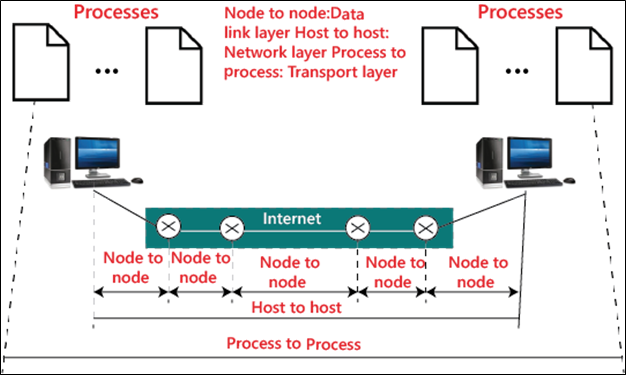
Process-to-Process Delivery

Client/Server Paradigm

There are many ways to obtain the process-to-process communication, and the most common way is through the client/server paradigm. A process is called a client on the local-host. Usually, the remote host is needed services on the processes, that is called server. The same name applies to both processes (client and server). IP address and port number combination are called socket address, and that address defines a process and a host.

Multiplexing and Demultiplexing

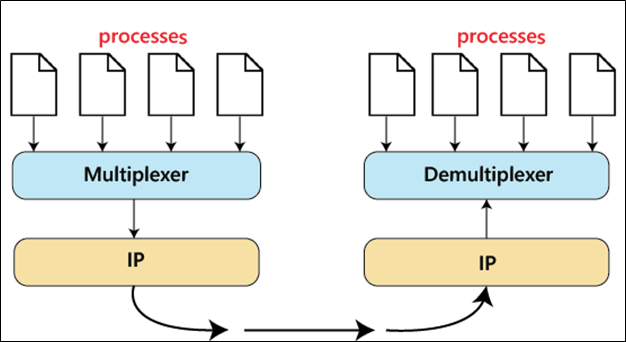
Multiplexing: At the sender site, multiple processes can occur, and those processes are required to send packets. It is a technique that combines multiple processes into one process.

Demultiplexing: At the receiver site, it is a technique that separates many processes.
Process-to-Process Delivery

UDP (User Datagram Protocol)

UDP was developed by David P Reed in 1980. It is a connection-less and unreliable protocol. This means when the data transfer occurs; this protocol does not establish the connection between the sender and receiver. The receiver does not send any acknowledgment of the receiving data. It sends the data directly. In the UDP, the data packet is called datagram. UDP does not guarantee your data that will reach its destination or not. It does not require that the data reach the receiver in the same order in which the sender has sent the data.

Transmission Control Protocol

TCP stands for Transmission Control Protocol. It was introduced in 1974. It is a connection-oriented and reliable protocol. It establishes a connection between the source and destination device before starting the communication. It detects whether the destination device has received the data sent from the source device or not. If the data received is not in the proper format, it sends the data again. TCP is highly reliable because it uses a handshake and traffic control mechanism. In TCP protocol, data is received in the same sequencer in which the sender sends the data. We use the TCP protocol services in our daily life, such as HTTP, HTTPS, Telnet, FTP, SMTP, etc.

Difference between UDP and TCP

UDPTCP
UDP stands for User Datagram Protocol.TCP stands for Transmission Control Protocol.
UDP sends the data directly to the destination device.TCP establishes a connection between the devices before transmitting the data.
It is a connection-less protocol.It is a connection-oriented protocol.
  UDP is faster than the TCP protocol.  TCP is slower than the UDP protocol.
It is an unreliable protocol.It is a reliable protocol.
It has not a sequence number of each byte.It has a sequence number of each byte.

Related Topics

APIPA: Automatic Private IP Addressing

What is APIPA? APIPA stands for Automatic Private IP Addressing. It is a word used by Microsoft to describe address auto configuration, which enables a Local Area Network (LAN) computer to...

3 minutes read.

Basic Networking Devices

Introduction Physical components, or network devices, allow hardware on a computer network to link and convey with one another. Network equipment such as switches, routers, gateways, hubs, repeaters, bridges, and routers...

6 minutes read.

Controlled Access Protocols in Computer Networks

In this tutorial, we will discuss Controlled Access Protocols in Computer Networks. Introduction On a shared platform, it is a strategy to minimise data frame collision. As in controlled access technique, every...

7 minutes read.

Session Layer and Presentation Layer

Session Layer and Presentation Layer Session Layer The fifth layer is the Session layer in the OSI model, which controls connections between many computers. It manages, establishes, and terminates the session connection...

2 minutes read.

Classification of Routing Algorithms

Introduction Before going to the classification of routing algorithms, we must find out what routing is. So, routing can be defined as the process of establishing the paths that the data...

3 minutes read.

What is Computer Network?

 A computer network is a collection of interconnected devices, such as computers, servers, routers, and switches, that are connected together to share resources and exchange data. These devices use a...

6 minutes read.

Disadvantages of Computer Network

What is Computer Network? A computer network is a collection of interconnected devices that can communicate and exchange data with each other. Networks allow devices to share resources such as printers...

3 minutes read.

Computer Network Switching

Switching Many numbers of connected devices are called the network. Whenever a company has multiple devices, there has a problem of how to connected them to make the one to one...

5 minutes read.

Method of Joining and Fusion of Fiber Optic Cable

What is Fiber Optics Cable? Fiber optics cable transforms the information at a light pulse. We can transfer voice, data, and video through the fiber optics cable. The fiber optics cable...

3 minutes read.

Supernetting in Network Layer

Introduction Supernetting is one of the main topics in data communication networks or computer networks. The network aggregation goes by many names, such as supernetting, route aggregation, summarization, and so on....

6 minutes read.

What is Framing in a Computer Network?

In the stream of bits, the data is stored by transmitting the bit by the connection of two devices through cable. This type of connection for data transmission is called...

6 minutes read.

Cryptography in Computer Network

Cryptography: Cryptography is derived from the Greek word, which means "Hidden Secrets." In other words, it is an art in which we can protect our data and information. Through cryptography,...

2 minutes read.

Working of ARP

The majority of computer programmes and applications send and receive messages using logical addresses (IP addresses), but the actual communication takes place over physical addresses (MAC addresses), which is found...

4 minutes read.

Hamming Code Example

What is Hamming Code? Hamming code is an error-detecting and error-correcting code used in computer data storage and transmission to detect and correct errors caused by noise, interference, or data corruption....

4 minutes read.

Computer Network Topology: Bus, Star, Ring, Tree and Hybrid

Network Topology: The Computer network topology refers to the layout of connected devices on a network. The network topology is the combination by which computer or network devices interconnected to...

4 minutes read.

Digital Transmission

Line Coding Digital signal is converted in the digital data that process is known as the Line Coding. That data is stored in the computer in the form of text, audio,...

4 minutes read.

Data Link Control

Data Link Control Data-link control is the main function of the data link layer. It deals with the configuration and coordination for connection between two neighboring nodes: node-to-node communication. The task...

10 minutes read.

TCP/IP model in Computer Network

An essential foundation for computer networking is the TCP/IP model. It stands for Transmission Control Protocol and Internet Protocol which are the two major Internet protocols. This model outlines the...

6 minutes read.

Stream Control Transmission Protocol

Stream Control Transmission Protocol: SCTP stands for Stream Control Transmission Protocol. SCTP was developed by the Internet Engineering Task Force (IETF). It is a reliable message-oriented protocol of the transport...

3 minutes read.

TCP vs UDP

Transmission Control Protocol (TCP) and User Datagram Protocol are the two most popular Internet protocols (IPs). TCP is a connection-oriented protocol, which means that once a connection has been made,...

4 minutes read.