
×

Types of Computer Network: LAN, MAN, WAN and PAN

PAN: Personal Area Network

PAN stands for Personal Area Network. It is designed for a very short distance (1 to10 m), such as a single room. This type of network can also be connected wirelessly to the Internet. The best example of PAN Networks is a Mobile hotspot and Bluetooth. The figure is shown below.
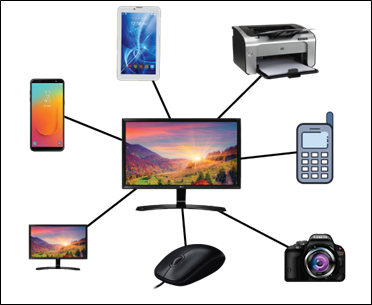
PAN: Personal Area Network

Advantages of PAN Network

  1. It reduces hardware costs.
  2. It connects the devices very quickly.
  3. It is very secure.

Disadvantages of PAN Network

  1. In PAN Network, Transmission speed is very slow to moderate.
  2. PAN networks have a limited range.

LAN: Local Area Network

LAN stands for Local Area Network. LAN is a privately-owned network. It is designed for a small range of areas such as buildings, offices, and factories. LANs are widely used to share resources like printers, data, etc. It's simple to design and solve problems. The figure is shown below.
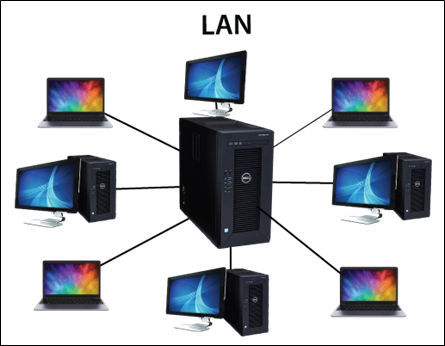
LAN: Local Area Network

Workstations and personal computers are connected via LANs. It can use different types of topologies, such as Star, Tree, Bus, Ring, etc.

Advantages of LAN Network

  1. It provides higher security.
  2. It is cost efficient.
  3. It is easily transferred to data and messages.
  4. It provides high data transfer rates.

Disadvantages of LAN Network

  1. The Power must be ON to make the LAN work efficient.
  2. Security is not always 100% ensured.
  3. It is more time consuming to set up the network.

MAN: Metropolitan Area Network

MAN stands for Metropolitan Area Network. MAN is an extended version of the LAN network. It is designed for extending over the geographic area (typically a city or towns). This type of network is larger than the LAN network and smaller than the WAN network. It uses similar technology as LAN. The single private company and public company is mainly operating the MAN Network. The best example of MAN networks is the Television network. The figure is shown below.
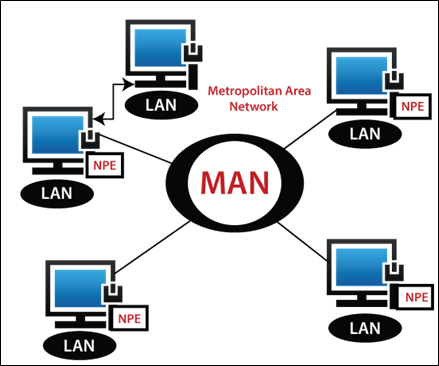
MAN: Metropolitan Area Network

Advantages of MAN Network

  1. MAN Network covers a larger range of areas than the LAN network, such as an entire city or town.
  2. The double bus used in MAN network helps it possible to transmit data in both directions together.

Disadvantages of MAN Network

  1. More cable required for a set up a MAN network from one location to another.
  2. It isn't very easy to manage the system securely.

WAN: Wide Area Network

WAN stands for Wide Area Network. It is designed for extending over the geographical area, such as cover the states or countries. It is very complex to design and maintain. The medium of communication used by the WAN is a PSTN (Public Switched Telephone Network) or satellite link. The best example of WAN networks is the Internet. The figure is shown below.
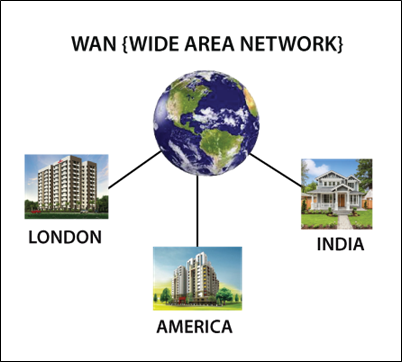
WAN: Wide Area Network

Advantages of WAN Network

  1. It covers a larger geographical area, such as countries.
  2. It is used to send rapid messages at anywhere and anytime.
  3. It allows you to connect workstations to share resources and software.

Disadvantages of WAN Network

  1. It is costly.
  2. Low security (Unsafe from hackers or other outside threats)
  3. Manage and Maintain the WAN network is a very complex task.
  4. It requires investing in a good firewall system to avoid interference from hackers.

Related Topics

Types of Computer Network: LAN, MAN, WAN and PAN

PAN: Personal Area Network PAN stands for Personal Area Network. It is designed for a very short distance (1 to10 m), such as a single room. This type of network can...

3 minutes read.

Unicast Routing Protocol

Unicast Routing Protocol: Unicast is a point to point communication arrangement that only occurs between the sender and receiver. Routing Information Protocol RIP is an open standard protocol that can work with...

3 minutes read.

Decoding in Communication Process

The use of codes is necessary for all forms of communication. The sender, transmitter, and receiver are the three major components of more conventional communication paradigms. The sender is in...

4 minutes read.

Transmission Media

Transmission Media: The physical layer directly controls transmission media. A transmission medium is a way which transmits the data from one place to another. It carries the data from source...

5 minutes read.

Data link layer in OSI model

This article will help you in getting a good understanding of the topic called the Data link layer in the OSI model. It is the second bottom most layer in the...

3 minutes read.

Mesh Topology Diagram in Computer Network

Topology in simple terms can be defined asthe arrangement of a computer network, which is further divided into logical and physical arrangements. Logical arrangement refers to how the data flow...

4 minutes read.

Domain Name System in Computer Network

Domain Name System Domain Name System is also called DNS. DNS was introduced by Paul Mockapetris and Jon Postel in 1983. DNS is an internet service that converts Domain names to...

2 minutes read.

Error Correction and Error Detection

Error Correction and Error Detection Error correction and error detection techniques are work on the data-link layer. The data link layer ensures the frames are sent from the sender to the...

16 minutes read.

User Datagram Protocol

User Datagram Protocol: UDP stands for the User Datagram Protocol. UDP was developed by David P Reed in 1980. It is a connection-less and unreliable protocol. In this protocol, when...

2 minutes read.

Computer Network Tutorial

What is Data Communication and Computer Network? Data Communication is the process of exchanging digital data between two or more computers that act as source and receiver through wireless media or...

7 minutes read.

Analog Transmission

Digital to Analog Transmission The data is sent one device to another via analog carrier, and firstly it is converted into the analog signals. It modifies the analog signals to represent...

3 minutes read.

Network Layer in OSI Model

This article will help you in getting a good understanding of the Network Layer in the OSI model. The network layer is the third layer of the OSI Model from the...

4 minutes read.

Advantages and Disadvantages of MAN

Before we move to advantages and disadvantages of MAN, first we discuss about what is MAN and what are its examples. A network that encircles a city or a sizable university...

3 minutes read.

Advantages and Disadvantages of Fibre Optics Cable

What is Fibre Optics Cable? A fibre optics cable is made of plastic or fibre, which is used to transmit the data. In fibre optics cable, the data is sent along...

3 minutes read.

Aloha

Aloha Norman Abramson and his colleagues were developed aloha at the University of Hawaii in the 1970s. ALOHA is a Multiple Access Protocol which is used for random access in the...

3 minutes read.

Hamming Code Example

What is Hamming Code? Hamming code is an error-detecting and error-correcting code used in computer data storage and transmission to detect and correct errors caused by noise, interference, or data corruption....

4 minutes read.

Process-to-Process Delivery

Process-to-Process Delivery: A transport-layer protocol's first task is to perform process-to-process delivery. A process is an entity of the application layer which uses the services of the transport layer. Two...

2 minutes read.

TCP vs UDP

Transmission Control Protocol (TCP) and User Datagram Protocol are the two most popular Internet protocols (IPs). TCP is a connection-oriented protocol, which means that once a connection has been made,...

4 minutes read.

Data Link Layer Protocols

 Data Link Layer Protocols Bluetooth Low EnergyZ-WaveZigBee Smart EnergyLoRaWANWirelessHARTLTE-A  1. Bluetooth Low Energy Bluetooth Low Energy or Bluetooth is a short-range communication protocol with the physical layer and medium access control layer. It is widely used in IoT...

3 minutes read.

Stream Control Transmission Protocol

Stream Control Transmission Protocol: SCTP stands for Stream Control Transmission Protocol. SCTP was developed by the Internet Engineering Task Force (IETF). It is a reliable message-oriented protocol of the transport...

3 minutes read.