C Math Library
C Math Library
The <math.h> header defines various mathematical functions and one macro. Many functions are available in this library to take double as an argument and then return double as a result. As explained in the previous tutorial, here are more functions that can be used in <math.h> library
- double exp (double number)
The exp() returns the value of e raised to the power of the given number.
E.g.:
 #include <stdio.h>
 #include <conio.h>
 #include <math.h>
 int main()
 {
 double x = 12.0, result;
 result = exp(x);
 printf (“The exponential value of 12 is = %.2lf”, x, result);
 return 0;
 }
Output

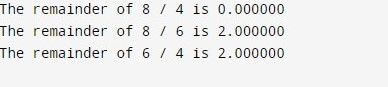
- double fmod (double number 1, double number 2)
It returns the remainder of the number 1 divided by the number 2. It works as a modulus function.
E.g.:
 #include <stdio.h>
 #include <conio.h>
 #include <math.h>
 int main ()
 {
 int a, b, c;
 a = 8;
 b = 6;
 c = 4;
 printf("The remainder of 8 / 4 is %lf \n", fmod(a, c));
 printf("The remainder of 8 / 6 is %lf \n", fmod(a, b));
 printf("The remainder of 6 / 4 is %lf \n", fmod(b, c));
 return(0);
 }
Output
- double acos (double number)
The acos() returns the arc cosine of the number given in radians.
E.g.:
 #include <stdio.h>
 #include <math.h>
 int main()
 {
 const double PI =  3.1415926;
 double x, result;
 x =  -0.5;
 result = acos(x);
 printf("the inverse of cos(-0.5) = %.2lf in radians\n", result);
 /* converting radians to degree */
 result = acos(x)*180/PI;
 printf("The inverse of cos(-0.5) = %.2lf in degrees\n", result);
 /* paramter not in range*/
 x = 1.2;
 result = acos(x);
 printf("Inverse of cos(1.2) = %.2lf", result);
 return 0;
 }
Output

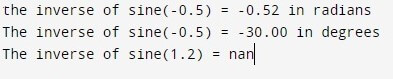
- double asin (double number)
The asin() returns the arc sine of the number given in radians.
E.g.:
 #include <stdio.h>
 #include <math.h>
 int main()
 {
 const double PI =  3.1415926;
 double x, result;
 x =  -0.5;
 result = asin(x);
 printf("the inverse of sine(-0.5) = %.2lf in radians\n", result);
 /* converting radians to degree */
 result = asin(x)*180/PI;
 printf("The inverse of sine(-0.5) = %.2lf in degrees\n", result);
 /* paramter not in range*/
 x = 1.2;
 result = asin(x);
 printf("The inverse of sine(1.2) = %.2lf", result);
 return 0;
 }
Output
- double atan (double number)
The atan() returns the arc tangent of the number given in radians.
E.g.:
 #include <stdio.h>
 #include <math.h>
 #define PI 3.141592654
 int main()
 {
 double num = 1.0, result;
 result = atan(num);
 printf("The inverse of tan(1.0) = %.2f in radians \n", result);
 // Converting radians to degrees
 result = (result * 180) / PI;
 printf("the Inverse of tan(1.0) = %.2f in degrees \n", result);
 return 0;
 }
Output

- double cos (double number)
The cos() returns the cosine of the number in radian.
E.g.:
 #include <stdio.h>
 #include <math.h>
 #define PI 3.14159265
 int main ()
 {
 double x, ret, val;
 x = 60.0;
 val = PI / 180.0;
 ret = cos( x*val );
 printf("The cosine of %lf is %lf degrees\n", x, ret);
 x = 90.0;
 val = PI / 180.0;
 ret = cos( x*val );
 printf("The cosine of %lf is %lf degrees\n", x, ret);
 return 0;
 }
Output

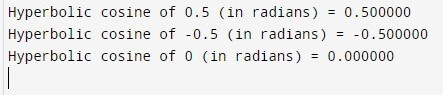
- double cosh (double number)
It returns the hyperbolic cosine of the value of the number.
E.g.:
 #include <stdio.h>
 #include <math.h>
 int main ()
 {
 double x, result;
 x = 0.5;
 result = cosh(x);
 printf("Hyperbolic cosine of 0.5 (in radians) = %lf\n", x, result);
 x = -0.5;
 result = cosh(x);
 printf("Hyperbolic cosine of -0.5 (in radians) = %lf\n", x, result);
 x = 0;
 result = cosh(x);
 printf("Hyperbolic cosine of 0 (in radians) = %lf\n", x, result);
 return 0;
 }
Output
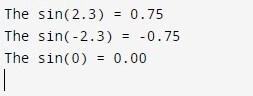
- double sin (double number)
It returns the sine of the number in radian.
E.g.:
 #include <stdio.h>
 #include <math.h>
 int main()
 {
 double x;
 double result;
 x = 2.3;
 result = sin(x);
 printf("The sin(2.3) = %.2lf \n", result);
 x = -2.3;
 result = sin(x);
 printf("The sin(-2.3) = %.2lf \n", result);
 x = 0;
 result = sin(x);
 printf("The sin(0) = %.2lf \n", result);
 return 0;
 }
Output
- double sinh (double number)
It returns the hyperbolic sine of the value of the number.
E.g.:
 #include <stdio.h>
 #include <math.h>
 #define PI 3.141592654
 int main()
 {
 double angle = 2.50, result;
 result = sinh(angle);
 printf("Sine hyperbolic of 2.50 (in radians) = %.2lf", angle, result);
 return 0;
 }
Output

- double tanh (double number)
It returns the hyperbolic tangent of the value of the number.
E.g.:
 #include <stdio.h>
 #include <math.h>
 int main ()
 {
 double x, result;
 x = 0.5;
 result = tanh(x);
 printf("The hyperbolic tangent of 0.5 is %lf degrees", result);
 return(0);
 }
Output

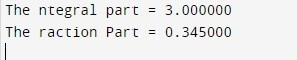
- double modf (double number, double *integer)
It returned those value which will be the fraction component and sets the integer to the integer component.
E.g.:
 #include<stdio.h>
 #include<math.h>
 int main ()
 {
 double x, fractpart, intpart;
 x = 3.345;
 fractpart = modf(x, &intpart);
 printf("The integral part = %lf\n", intpart);
 printf("The fraction Part = %lf \n", fractpart);
 return(0);
 }
Output