Return array from function in C
Return array from function in C
C programming does not require the return to a function of a whole array as an argument. However, you can return a pointer to an array without the need for an index by determining the name of the array.
If you want to return a single-dimensional array from a function, a function returning a pointer should be declared as in the following example:
int * myFunction()
 {
    …..
    …..
    …..
 }
The second thing to remember is that C does not support returning the address of a local variable outside of the function, so you will have to define it as a static variable.
Now, consider the function below that will generate 20 numbers randomly and return them using an array.
#include <stdio.h>
 /* function to generate and return random numbers */
 int * getRandom( ) {
    static int  k[20];
    int p;
    /* set the seed */
    srand( (unsigned)time( NULL ) );
    for ( p = 0; p < 20; ++p) {
       k[p] = rand();
       printf( "k[%d] = %d\n", p, k[p]);
    }
    return k;
 }
 /* main function to call above defined function */
 int main () {
    /* a pointer to an int */
    int *s;
    int i;
    s = getRandom();
    for ( i = 0; i < 10; i++ ) {
       printf( "*(s + %d) : %d\n", i, *(s + i));
    }
    return 0;
 }
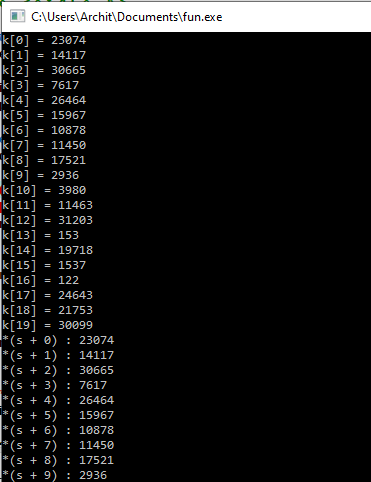
Output:
Using Dynamically Allocated Array
Dynamically allocated memory (allocated using new or malloc ()) remains their memory until delete or free) (is removed. So we can build a dynamically allocated array and will be able to delete it once we get out of use.
#include <stdio.h>
 int* function(int *array)
 {
     arr[1] = 20;
     arr[2] = 40;
     return array;
 }
 int main()
 {
     int arr[100];
     int* ptr = function(arr);
     printf("%d %d", ptr[1], ptr[2]);
     return 0;
 }
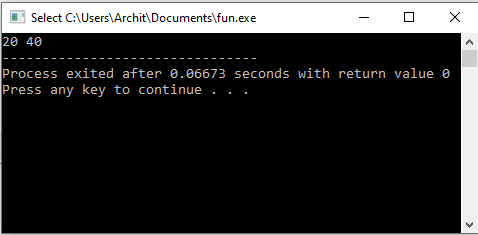
Output:
Using struct:
We can wrap a structure/class list and return a struct/class instance. The explanation for this work is that there are deep copies of array members of structures. A deep copy occurs when the returned instance is copied to main in the program below.
#include <stdio.h>
 struct arrayWrap {
     int array[100];
 };
 struct arrayWrap function()
 {
     struct arrayWrap m;
     m.array[1] = 25;
     m.array[2] = 49;
     return m;
 }
 int main()
 {
     struct arrayWrap m = function();
     printf("%d %d", m.array[1], m.array[2]);
     return 0;
 }
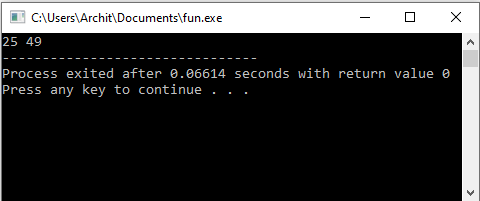
Output:
Using static array:
A static variable's lifetime is throughout the program. So, we can always build and return a static local array.
#include <stdio.h>
 int* function()
 {
     static int array[200];
     /* Some operations on array[] */
     array[4] = 50;
     array[9] = 80;
     return array;
 }
 int main()
 {
     int* ptr = function();
     printf("%d %d", ptr[4], ptr[9]);
     return 0;
 }
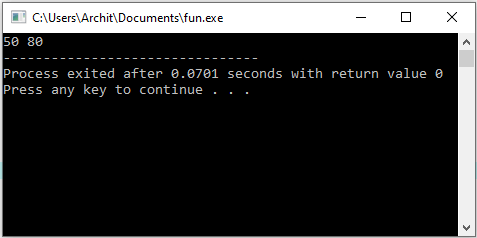
Output: