Star Program in C Language
Star Program in C
Star patterns are a sequence of * or any other character used to construct any pattern or any like-square geometric form, triangle, hollow square, pyramid, rhombus, etc. Many programmers worldwide highly recommend pattern issues to improve the skill of critical thought. For a beginner programmer, you should practice these patterns to get good hands-on the logical thinking and software flow control. In this exercise, a list of beginners and advanced Star patterns programmers are made to learn.
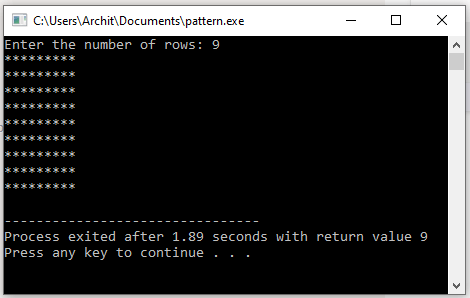
Program to print square star pattern
#include <stdio.h>
 int main()
 {
     int k, m, s;
     /* Input number of rows from user */
     printf("Enter the number of rows: ");
     scanf("%d", &s);
     /* Iterate through N rows */
     for(k=1; k<=s; k++)
     {
         /* Iterate over columns */
         for(m=1; m<=s; m++)
         {
             /* Print star for each column */
             printf("*");
         }
         /* Move to the next line/row */
         printf("\n");
     }
 }
Output:
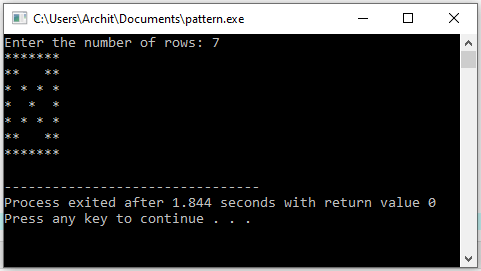
Write a C-program to use loops to print a hollow square star pattern with diagonal. How to print a hollow square star pattern in the C system with diagonals. The logic for printing in C programming hollow square star pattern with diagonal.
Program to print Hollow Square with diagonal.
#include <stdio.h>
 int main()
 {
     int s, t, K;
     /* Input number of rows from user */
     printf("Enter the number of rows: ");
     scanf("%d", &K);
     /* Iterate over each row */
     for(s=1; s<=K; s++)
     {
         /* Iterate over each column */
         for(t=1; t<=K; t++)
         {
             /*
              * Print star for,
              * first row (s==1) or
              * last row (s==K or
              * first column (t==1) or
              * last column (t==K) or
              * row equal to column (s==t) or
              * column equal to N-row (t==K-s+1)
              */
             if(s==1 || s==K || t==1 || t==K || s==t || t==(K - s + 1))
             {
                 printf("*");
             }
             else
             {
                 printf(" ");
             }
         }
         /* Move to the next line */
         printf("\n");
     }
     return 0;
 }
Output:
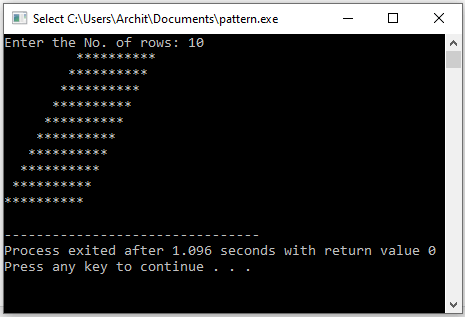
Program to print rhombus star pattern
#include <stdio.h>
 int main()
 {
     int t,k, rows;
     /* Input number of rows from user */
     printf("Enter the No. of rows: ");
     scanf("%d", &rows);
     for(t=1; t<=rows; t++)
     {
         /* Print trailing spaces */
         for(k=1; k<=rows - t; k++)
         {
             printf(" ");
         }
         /* Print stars after spaces */
         for(k=1; k<=rows; k++)
         {
             printf("*");
         }
         /* Move to the next line */
         printf("\n");
     }
     return 0;
 }
Output:
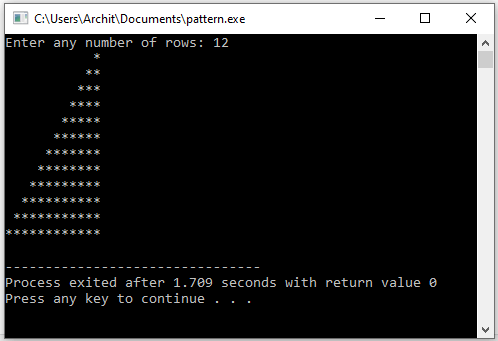
Program to print mirrored right triangle star pattern.
#include <stdio.h>
 int main()
 {
     int k,l, rows;
     /* Input rows from user */
     printf("Enter any number of rows: ");
     scanf("%d", &rows);
     /* Iterate through rows */
     for(k=1; k<=rows; k++)
     {
         /* Print spaces in decreasing order of row */
         for(l=k; l<rows; l++)
         {
             printf(" ");
         }
         /* Print star in increasing order or row */
         for(l=1; l<=k; l++)
         {
             printf("*");
         }
         /* Move to next line */
         printf("\n");
     }
     return 0;
 }
Output:
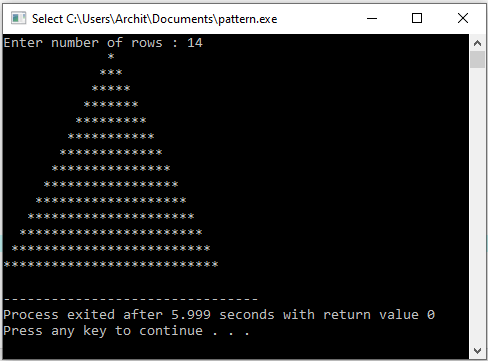
Program to print pyramid star pattern series
#include <stdio.h>
 int main()
 {
     int w, s, rows;
     /* Input number of rows to print */
     printf("Enter number of rows : ");
     scanf("%d", &rows);
     /* Iterate through rows */
     for(w=1; w<=rows; w++)
     {
         /* Print leading spaces */
         for(s=w; s<rows; s++)
         {
             printf(" ");
         }
         /* Print star */
         for(s=1; s<=(2*w-1); s++)
         {
             printf("*");
         }
         /* Move to next line */
         printf("\n");
     }
     return 0;
 }
Output:
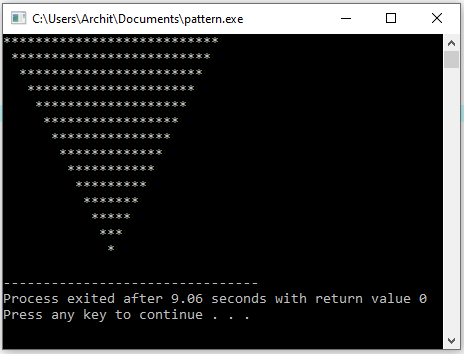
Program to print reverse pyramid star pattern
#include <stdio.h>
 int main()
 {
     int p,n, rows;
     /* Input rows to print from user */
     printf("Enter number of rows : ");
     scanf("%d", &rows);
     for(p=1; p<=rows; p++)
     {
         /* Print leading spaces */
         for(n=1; n<p; n++)
         {
             printf(" ");
         }
         /* Print stars */
         for(n=1; n<=(rows*2 -(2*p-1)); n++)
         {
             printf("*");
         }
         /* Move to next line */
         printf("\n");
     }
     return 0;
 }
Output:
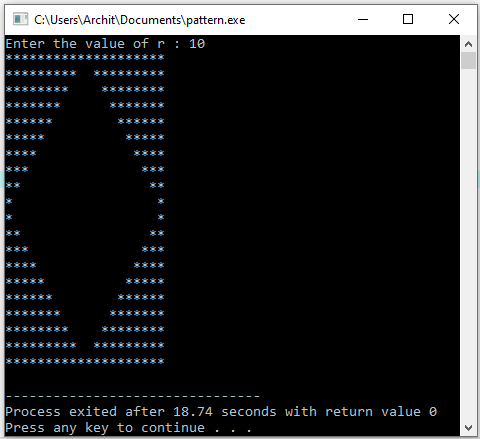
Program to print a hollow diamond star pattern.
#include <stdio.h>
 int main()
 {
     int h, t, r;
     printf("Enter the value of r : ");
     scanf("%d", &r);
     // Loop to print upper half of the pattern
     for(h=1; h<=r; h++)
     {
         for(t=h; t<=r; t++)
         {
             printf("*");
         }
         for(t=1; t<=(2*h-2); t++)
         {
             printf(" ");
         }
         for(t=h; t<=r; t++)
         {
             printf("*");
         }
         printf("\n");
     }
     // Loop to print lower half of the pattern
     for(h=1; h<=r; h++)
     {
         for(t=1; t<=h; t++)
         {
             printf("*");
         }
         for(t=(2*h-2); t<(2*r-2); t++)
         {
             printf(" ");
         }
         for(t=1; t<=h; t++)
         {
             printf("*");
         }
         printf("\n");
     }
     return 0;
 }
Output:
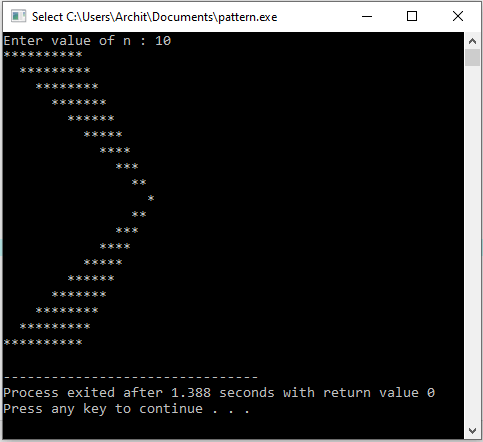
Program to print the right arrow star pattern.
#include <stdio.h>
 int main()
 {
     int s, t, n;
     // Input number of rows from user
     printf("Enter value of n : ");
     scanf("%d", &n);
     // Print the upper part of the arrow
     for(s=1; s<n; s++)
     {
         // Print trailing (2*rownumber-2) spaces
         for(t=1; t<=(2*s-2); t++)
         {
             printf(" ");
         }
         // Print inverted right triangle star pattern
         for(t=s; t<=n; t++)
         {
             printf("*");
         }
         printf("\n");
     }
     // Print lower part of the arrow
     for(s=1; s<=n; s++)
     {
         // Print trailing (2*n - 2*rownumber) spaces
         for(t=1; t<=(2*n - 2*s); t++)
         {
             printf(" ");
         }
         // Print simple right triangle star pattern
         for(t=1; t<=s; t++)
         {
             printf("*");
         }
         printf("\n");
     }
     return 0;
 }
Output: