
×

CSS Clip

CSS Clip

The Clip property in CSS describes the element’s visible area. It applies over the elements which are absolutely positioned (position: absolute ;). Generally, it is used when an image is more significant than the existing element.

It permits us to portray a rectangle described as any four coordinates to clip the element, which is absolutely positioned.

Syntax:

clip: auto | shape | initial | inherit;  

Property values

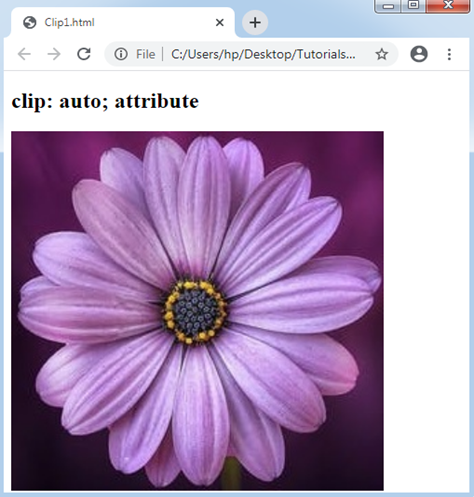
auto: This property value is used as a default value, which displays the elements as they are. Using this value, no clipping will be defined.

Example:

<!DOCTYPE html>
<html>
<head>
<style>
.auto
{
 position: absolute;
 width: 400px;
 height: 400px;
 clip: auto;
}
</style>
</head>
<body>
<h2> clip: auto; attribute </h2>
<img src= "Flower3.png" class= "auto">
</body>
</html>

Output:
CSS Clip

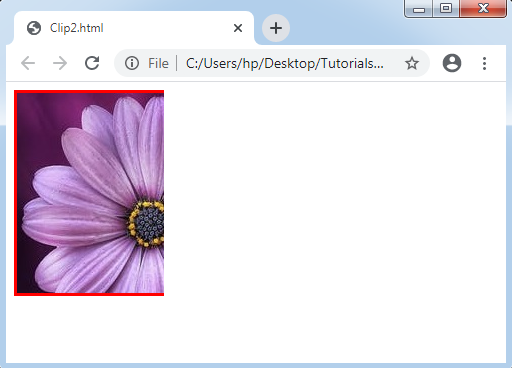
Shape: This property value is applied for clipping the elements. Any element’s defined area can be clipped using this value. Its authentic value is like this-rect(top, right, bottom, left);

Example:

<!DOCTYPE html>
<html>
<head>
<style type= "text/css">
div
{
  background: url(flower3.png); 
  clip: rect(0px, 150px, 250px, 0px); 
  border:3px solid red; 
  height:200px; 
  width: 250px; 
  position: absolute; 
}
</style>
</head>
<body>
<div></div>
</body>
</html>

Output:
CSS Clip

Related Topics

CSS Overlay

CSS Overlay: It measures to cover-up something’s surface along with a coating. CSS overlay sets anything over the top area of other things. It creates a web-page more attractive. The...

8 minutes read.

CSS Radio Button

Radio Button A radio button has been defined as an element of HTML. It can support us to take any input from the user. But it is challenging to design a...

4 minutes read.

Radial-gradient() CSS function

Radial-gradient() CSS function It defines a CSS in-built function, which produces a smooth transition among multiple colors. It is used to set any radial-gradient that is same as a background-image. This...

4 minutes read.

What is CSS used for

What is CSS used for? CSS stands for Cascading Style Sheet. CSS is a stylesheet language for web pages. It specifies how a document created in a markup language looks and...

4 minutes read.

CSS Outline

CSS Outline: This CSS property is quite similar to the border property of CSS. It eases us to design an additional border around the element to obtain visual attention. The...

4 minutes read.

CSS Math Functions

The CSS math functions permit numerical articulations. These CSS math functions can particularly be utilized in maybe unforeseen ways, for example, inside angles and shading the functions and in the...

3 minutes read.

CSS Tutorial

CSS refers to the Cascading Style Sheet. CSS is a form of a programming language. In other words, CSS is a language of the style sheet that is utilised for...

9 minutes read.

CSS Flex-Box

Introduction The flex-box property of CSS stands for Flexible Box Layout Module. It is specifically used to design a flexible responsive layout. Flex-box is a one dimensional layout model, i.e. it works...

6 minutes read.

CSS Masking

CSS Masking The CSS mask property is applied to hide a component with the use of the masking or clipping an image at any specific point. The masking depicts the use...

3 minutes read.

CSS Padding

CSS Padding: The padding property in CSS is addressed to describe the space among the element border and the element content.This property is quite different from the margin property of...

2 minutes read.

CSS User Interface

Introduction User Interface can be defined as series of visual elements like screens, buttons, forms that help the user interact with the software application or hardware device. CSS User Interface allows the...

6 minutes read.

How to use google fonts in CSS

Fonts: - Fonts are used to make our website look more beautiful. Choosing appropriate font according to the web design or layout is also important. Many typefaces are accessible in...

4 minutes read.

CSS Text-Overflow

Introduction: The text-overflow property of CSS is used to format the text which is overflowing the boundaries of the container. This property helps user to clip the text, to display the...

5 minutes read.

CSS Pagination

CSS Pagination The pagination in CSS is an advantageous approach for indexing of a website’s distinct pages over the homepage. When our site contains multiple pages, we must insert a few...

13 minutes read.

CSS Variables

CSS Variables These variables of CSS are applied to add the custom property values to our various web-pages. The custom properties are often called as CSS variables or cascading variables. Various...

4 minutes read.

Hover condition for a:before and a:after in CSS

In CSS, :after and :before are used to add content after and before the element. The CSS pseudo-class is used to add some styling effect to the webpage. We can change...

4 minutes read.

CSS Vertical Align

Vertical Align The vertical align CSS property describes the cell box of the table and an inline alignment vertically. This property is a self-explanatory and an essential property in CSS. But,...

2 minutes read.

CSS Units

CSS Units In CSS, there are so many units available to show the length’s measurement. A single unit of CSS is applied to examine the size of the property, which the...

5 minutes read.

CSS Navigation bar

CSS Navigation bar: A navigation system or navigation bar comes upon GUI that can help many visitors to access the information. A Navigation bar is a UI component on the...

11 minutes read.

CSS Page-break-before Attribute

Page-break-before Attribute As its name implies, the page-break-before property is applied to include page break before any element, at the time of printing any document. It adds the page break before...

5 minutes read.