
×

CSS Syntax

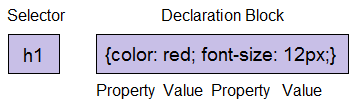
The CSS syntax contains the selector and the declaration block, which will be clearer with the following example:
CSS Syntax

Selector: A CSS selector specifies the HTML tag we wish to style. A selector can be any element such as <title>, and <h1>.

Declaration Block: This block can consist of more than one declaration that is isolated by the semicolon. Here, there are two types of declarations for the example as mentioned above:

  • Color: red;
  • Font-size: 12px;

 All the declarations include the property name and the value that are isolated by the colon.

Property: It is a part of the HTML element’s attributes. A property could be any color or border.

Value: CSS properties are required to be assigned by some values. Thus, values are provided to the properties of CSS. Value “red” is given to the color property in the example, as mentioned above.

Selector{Property1: value1; Property1: value1;   ………;}

Example:

<!DOCTYPE>
<html>
<head>
<title> CSS Syntax</title>
<style>
p {
color: green;
text-align: left;
}
</style>
</head>
 
<body>
<p> CSS Syntax </p>
<p> This is an example of CSS Syntax. </p>
</body>
</html>
Explanation of above Example:

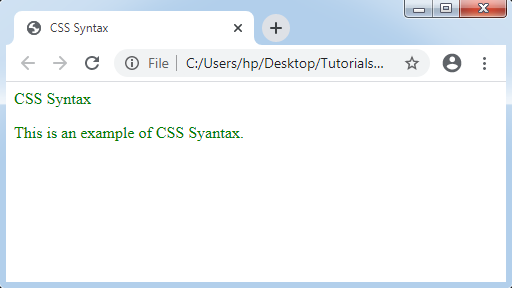
  • P is the selector.
  • Color is the property.
  • The value of the property is green.
  • Another property is text-align.
  • The value of the property is left.

Related Topics

CSS Form

You can create attractive HTML form by using CSS. Style input Fields The Input Field width properties are used to determine the width of the input field. Let us see an example of CSS style...

2 minutes read.

Cascading Style Sheet

CSS refers to the Cascading Style Sheet. CSS is a form of a programming language. In other words, CSS is a language of the style sheet that is utilised for...

7 minutes read.

CSS Background-blend-mode

Background-blend-mode The background-blend-mode property sets a blend mode of the component’s every background layer (color/image). It illustrates how the element background image blends well with the element background color. We can...

9 minutes read.

CSS Lists

CSS Lists: Several properties are available in CSS that are used to manage the lists. Lists are distributed as ordered and unordered kind of lists. The ordered lists provide the...

7 minutes read.

CSS 3D Transform

Introduction To understand 3D transformation property of transform you need to first understand the difference between 2D and 3D transform. 2D transform is a CSS effect which transforms the elements according to...

6 minutes read.

CSS Box-shadow

CSS Box-shadow This property is referred to include effects as shadow-like around an element’s frame. Syntax box-shadow: h-offset v-offset blur spread color |inset|inherit|none; Property values Following are the various property values which can be used...

3 minutes read.

CSS Pseudo-elements

Pseudo-elements The pseudo-classes in CSS can be represented as any keyword which is connected to the selector that represents any selected element’s unique state. On the other hand, pseudo-elements can be...

6 minutes read.

Difference between CSS Grid and CSS Flexbox

The way that information is arranged on a website reveals a lot about you or your company. Organizational abilities are just as important as having the right materials. The design...

3 minutes read.

CSS translate() Function

Translate() CSS function This function in CSS is a CSS in-built function. It relocates the element in the horizontal direction or in the vertical direction. It can move the items from...

2 minutes read.

CSS Sticky

CSS Sticky The position property in CSS is applied to set an element’s position. This property is also applied to position an element behind the other element. It is useful for...

1 minute read.

CSS Specificity

CSS Specificity: If one or more conflicting rules of CSS express a similar element, a browser will pursue a few rules to examine the specific one. Specificity can be specified...

3 minutes read.

CSS Text-Transform Property

Text-Transform in CSS The text-transform property permits us to alter the text case. It controls the capitalization of the text. This property is employed to design the text appearance in every...

3 minutes read.

CSS Functions

CSS functions are used for different CSS properties. Every front-end developer should have knowledge of all CSS functions. It makes the coding easier. FunctionsExplanationattr().It returns the value of an attribute of...

5 minutes read.

CSS Transition

CSS Transition The transitions in CSS are influenced, included to modify the component from one design to another, without the use of the JavaScript or Flash. We should describe two of the...

2 minutes read.

CSS Arrow

CSS Arrow The arrow of CSS is applied to insert an array with the tooltip. It can make a tooltip as any speech bubble. Also, this arrow can be illustrated in...

4 minutes read.

How to get rid/remove of bullet pioints in CSS

We include a list of items on the web pages that were sometimes numbered and sometimes bulleted in various styles. In HTML, there are two kinds of lists: ordered and unordered...

3 minutes read.

What is CSS

CSS stands for Cascading Style Sheet. It gives an additional style to the HTML document. A cascading style sheet is a language that is designed to define the document formatting...

3 minutes read.

CSS Units

CSS Units In CSS, there are so many units available to show the length’s measurement. A single unit of CSS is applied to examine the size of the property, which the...

5 minutes read.

Combine Background Image with Gradient Overlay

With the help of CSS gradient, we can display smooth and straightforward transitions between two or more colours. We can add the background images by combining the gradient property with...

2 minutes read.

CSS Syntax

The CSS syntax contains the selector and the declaration block, which will be clearer with the following example: Selector: A CSS selector specifies the HTML tag we wish to style. A selector can be...

2 minutes read.