CSS Dropdowns
Dropdowns are one of the maximum crucial parts of an interactive internet site. CSS is a kind used to design the drop-down menus. A drop-down essentially is a group of lists below an unordered list. <ul> as it is popularly recognized in HTML international, sort of contrary to popular belief. Nested list (<li>) tags below the <ul> tag used to create drop-down shape.
To carry out the outcomes, we can use CSS for the additives particularly present inside the shape in a big way.
Example
Let’s consider a coding example.
Consider the below code:
<!DOCTYPE html>
<html>
    <head>
        <title>Dropdown property</title>
    </head>
    <body>
        <nav>
            <ul>
                <li class="Level-1">
                <a href="">Dropdown-list</a>
                <ul>
                    <li><a href="">Li 1</a></li>
                    <li><a href="">Li 2</a></li>
                    <li><a href="">Li 3</a></li>
                    <li><a href="">Li 4</a></li>
                </ul>
                </li>
            </ul>
        </nav>
    </body>
</html>
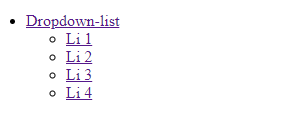
Output:
Types of CSS Dropdowns
The CSS Dropdowns are classified as:
- Basic Dropdown
- Dropdown-menu
- Right-aligned Dropdown
- Dropdown Navbar
Basic Dropdown
Example
Let’s consider a coding example.
<!DOCTYPE html>
<html>
<head>
<style>
.dropdown {
position: relative;
display: inline-block;
}


.dropdown-content {
display: none;
position: absolute;
background-color: white ;
min-width: 170px;
box-shadow: 0px 9px 16px 0px black;
padding: 13px 18px;
z-index: 1;
}


.dropdown:hover .dropdown-content {
display: block;
}


</style>
</head>
<body>
<h2>Hoverable Dropdown Here</h2>
<p>Circulate the mouse over the text below to open the dropdown content.</p>
<div class="dropdown">
<span>Hover Mouse Over Me</span>
<div class="dropdown-content">
<p>Hello All..!!</p>
</div>
</div>
</body>
</html>
Output:
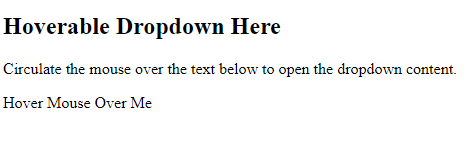
If we hover the mouse (Hover Mouse Over Me) then the below output is shown:
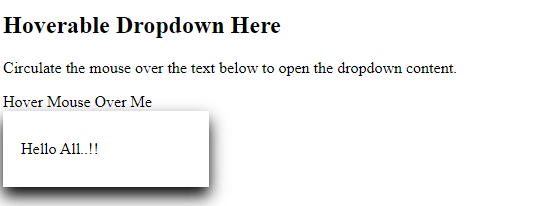
Explanation:
HTML- Use any element to open the dropdown content material, e.g. A <span>, or a <button> element.
Use a container element (like <div>) to create the dropdown content material and upload something you want inner of it.
Wrap a <div> element across the elements to put the dropdown content efficaciously with CSS.
CSS- The .Dropdown class makes use of position: relative, which is wanted when we need the dropdown content material to be positioned right under the dropdown button (using position: absolute).
The .Dropdown-content material magnificence holds the real dropdown content. It's far hidden by default and might be displayed on hover (see underneath). Word the min-width is ready to 160px. Feel free to trade this.
Rather than using a border, we've got used the CSS field-shadow belongings to make the dropdown menu appear to be a "card".
The :hover selector is used to revealing the dropdown menu when the consumer moves the mouse over the dropdown button.
Dropdown-menu
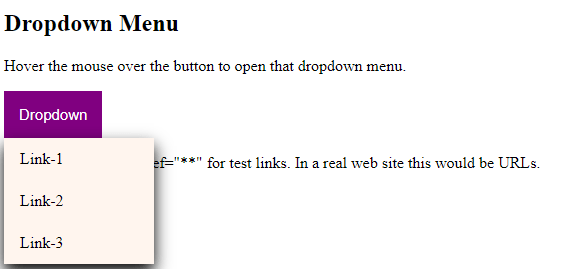
Create a dropdown menu that allows the consumer to select an alternative from a listing. In this case, just like the preceding one, it depicts that we add links in the dropdown box and fashion them to in shape a styled dropdown button:
Example
Code:
<!DOCTYPE html>
<html>
<head>
<style>
.dropbtn {
  background-color: purple;
  color: white;
  padding: 15px;
  font-size: 15px;
  border: none;
  cursor: pointer;
}


.dropdown {
  position: relative;
  display: inline-block;
}


.dropdown-content {
  display: none;
  position: absolute;
  background-color: seashell;
  min-width: 150px;
  box-shadow: 0px 8px 16px 0px black;
  z-index: 1;
}


.dropdown-content a {
  color: black;
  padding: 12px 16px;
  text-decoration: none;
  display: block;
}


.dropdown-content a:hover {background-color: white}


.dropdown:hover .dropdown-content {
  display: block;
}


.dropdown:hover .dropbtn {
  background-color: purple;
}
</style>
</head>
<body>


<h2>Dropdown Menu</h2>
<p>Hover the mouse over the button to open that dropdown menu.</p>


<div class="dropdown">
  <button class="dropbtn">Dropdown</button>
  <div class="dropdown-content">
  <a href="**">Link-1</a>
  <a href="**">Link-2</a>
  <a href="**">Link-3</a>
  </div>
</div>


<p><strong>Remember:</strong> We use href="**" for test links. In a web site this would be URLs.</p>


</body>
</html>
Output:
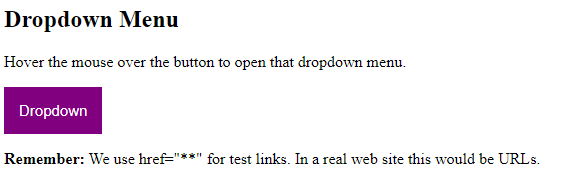
If we hover the mouse(Dropdown) then below output is shown:
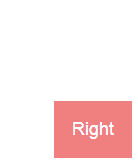
Right-aligned Dropdown
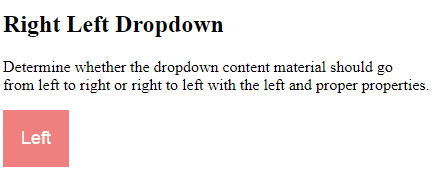
If you need the dropdown menu to move from right to left, instead of left to right, upload right: 0;
Example
Code:
<!DOCTYPE html>
<html>
<head>
<style>
.dropbtn {
  background-color: lightcoral;
  color: white;
  padding: 18px;
  font-size: 18px;
  border: none;
  cursor: pointer;
}


.dropdown {
  position: relative;
  display: inline-block;
}


.dropdown-content {
  display: none;
  position: absolute;
  right: 0;
  background-color: white;
  min-width: 150px;
  box-shadow: 0px 8px 16px 0px black;
  z-index: 1;
}


.dropdown-content a {
  color: black;
  padding: 11px 15px;
  text-decoration: none;
  display: block;
}


.dropdown-content a:hover {background-color: white;}


.dropdown:hover .dropdown-content {
  display: block;
}


.dropdown:hover .dropbtn {
  background-color: lightcoral;
}
</style>
</head>
<body>


<h2>Right Left Dropdown</h2>
<p>Determine whether the dropdown content material should go from left to right or right to left with the left and proper properties.</p>


<div class="dropdown" style="float:left;">
  <button class="dropbtn">Left</button>
  <div class="dropdown-content" style="left:0;">
  <a href="**">Product1</a>
  <a href="**">Product2</a>
  <a href="**">Product3</a>
  </div>
</div>


<div class="dropdown" style="float:right;">
  <button class="dropbtn">Right</button>
  <div class="dropdown-content">
  <a href="**">Product1</a>
  <a href="**">Product2</a>
  <a href="**">Product3</a>
  </div>
</div>


</body>
</html>
Output:
Dropdown Navbar
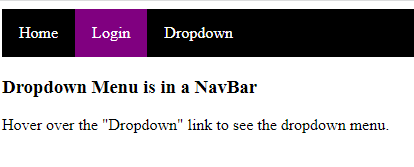
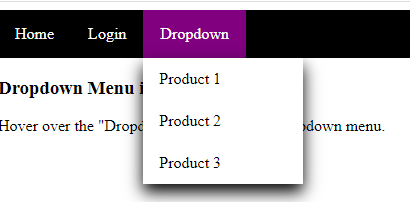
Dropdown menu is added in Navbar.
Example
Code:
<!DOCTYPE html>
<html>
<head>
<style>
ul {
  list-style-type: none;
  margin: 0;
  padding: 0;
  overflow: hidden;
  background-color: black;
}


li {
  float: left;
}


li a, .dropbtn {
  display: inline-block;
  color: white;
  text-align: center;
  padding: 15px 17px;
  text-decoration: none;
}


li a:hover, .dropdown:hover .dropbtn {
  background-color: purple;
}


li.dropdown {
  display: inline-block;
}


.dropdown-content {
  display: none;
  position: absolute;
  background-color: white;
  min-width: 160px;
  box-shadow: 0px 8px 16px 0px black;
  z-index: 1;
}


.dropdown-content a {
  color: black;
  padding: 12px 16px;
  text-decoration: none;
  display: block;
  text-align: left;
}


.dropdown-content a:hover {background-color: white;}


.dropdown:hover .dropdown-content {
  display: block;
}
</style>
</head>
<body>


<ul>
  <li><a href="#Home">Home</a></li>
  <li><a href="#Login">Login</a></li>
  <li class="dropdown">
    <a href="javascript:void(0)" class="dropbtn">Dropdown</a>
    <div class="dropdown-content">
      <a href="**">Product 1</a>
      <a href="**">Product 2</a>
      <a href="**">Product 3</a>
    </div>
  </li>
</ul>


<h3>Dropdown Menu is in a NavBar</h3>
<p>Hover over the "Dropdown" link to see the dropdown menu.</p>
</body>
</html>
Output: