
What is Deadlock in OS?
Deadlock in Operating System
In an Operating System, a process uses various resources, and the resources are used in the following manner:
- Request the Resource
- Use the Resource
- Release the Resource
In the Operating System, Deadlock is a condition where two or more than two processes need to use some resources to finish its execution and that resources are held by some another process.
In other words, Deadlock is defined as a situation in which the processes are in the blocked state. As each process is holding a resource and waiting for another resource, which is held by some other process.
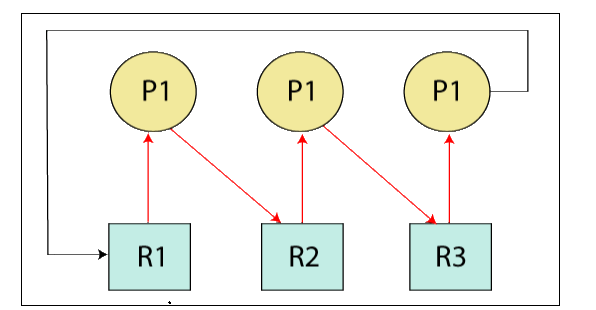
Now we take an example to understand the concept of Deadlock. Suppose we have three processes P1, P2, and P3, and we have three resources R1, R2, and R3. The resource R1 is allocated to the Process P1, resource R2 is allocated to the Process P2, and the resource R3 is allocated to the Process P3.
After some time, the process P1 request for resource R2, which is allocated to Process P2. So, in this situation, P1 stops its execution because, without R2 resources, P1 cannot finish its execution. The process P2 wants to use the resource R3, but the P3 process is held with R3. So in this way, P2 also stops its execution. Now, the P3 process also requests for R1 resources, which is held by the process P1, so P3 halts its execution.
In this condition, a cyclic situation will make among the processes, and no process will progress, and all the processes will be in the waiting state. So, in this situation, the computer will not be responsive, and all the processes will be blocked.
Difference between Deadlock and Starvation
| Deadlock | Starvation |
| In a Deadlock, processes wait for each other to release its resources, and no process gets executed. | In Starvation, the processes which are having high priority get executed, and the processes having low priority get blocked. |
| The conditions which are required for Deadlock are Mutual Exclusion, Hold and Wait, No Preemption, and Circular Wait. | In Starvation, we assign priorities to the processes. |
| In a Deadlock, resources are blocked by the processes. | In Starvation, the processes which are having high priority utilize resources continuously. |
| Deadlock is also called Circular wait | Starvation is also called lived lock |
| With the help of necessary conditions, a deadlock can be prevented. | With the help of aging, Starvation can be prevented. |
| In a deadlock, for ending, external intervention is needed. | In Starvation, for ending, no external intervention is needed. |
Advantages of Deadlock
The advantages of Deadlock are:
- Deadlock is suitable for those processes that perform a single burst of activity.
- In Deadlock, Preemption is not required.
- Deadlock is one of the efficient methods which we use for those resources where the state of resources can be saved and restored.
- Deadlock is feasible to enforce through compile-time checks.
- In Deadlock, run-time computation is not required because we can solve the problem in system design.
Disadvantages of Deadlock
- It is a must to know the future resources required for the process.
- Essential preemption losses.
- It preempts the resources more than the requirement.
- Deadlock takes more time for process initiation.
How to Avoid Deadlock
We can avoid Deadlock by preventing four conditions:
- Mutual Exclusion
- Hold and Wait
- No Preemption
- Circular Wait
- Mutual Exclusion: - Mutual Exclusion means at the same time, more than two processes can use the same resources, and resources can be shared in mutual exclusion way.
- Hold and Wait: - Hold and Wait means we must take care that one process is not holding one or more resources and also concurrently waiting for other resources.
- No Preemption: - With the help of preemption of the process's resource allocations, we can also avoid Deadlock.
- Circular Wait: -We can also avoid Deadlock by preventing the number of processes from the circular wait. We can prevent circular wait by numbering the resources and the process requests for resources only in the ascending or descending order.
Handling Deadlock
The points which we discussed above are useful for deadlock prevention. But we also consider some points for handling deadlock if Deadlock has occurred.
We can use some essential strategies to remove Deadlock if it has occurred:
- Preemption
- Rollback
- Kill one or more Processes
Preemption: - By taking the resource back from the process and provide that resource to other process is helpful to solve the problem of Deadlock, but sometimes there may be a possibility of problems.
Rollback: - In some cases, where there may be a chance of Deadlock then the system prepares a record of all process states, and if a deadlock has occurred then we can easily roll back to the last checkpoint and then restart, but we allocate resources differently so that the Deadlock can never occur again. So, with the help of rollback, we can handle Deadlock.
Kill one or more processes: - Kill one or more processes is one of the easiest strategies for deadlock handling.
What is Livelock?
Livelock is a type of Deadlock. Livelock is just like a deadlock. Livelock means a condition where two or more processes switch their state frequently for the alteration in the processes without performing any beneficial task. It is the same as Deadlock, where progress is not made. But, in livelock, the process is not blocked or waiting.