
Given a Binary Tree, Print the Pre-order Traversal in Recursive
Implementation
#include <stdio.h>
#include <stdlib.h>

/* Creating a binary tree node that consists of some data along with the pointer to the left and right child.
*/
struct __nod {
    int record;
    struct __nod* Lft;
    struct __nod* Rt;
};

/* Creating a helper function that will help us allot a new node with the given set of data and the left and right pointers with the NILL value. */
struct __nod* new__nod(int record) {
    struct __nod* __nod = (struct __nod*) malloc(sizeof(struct __nod));
    __nod->record = record;
    __nod->Lft = NILL;
    __nod->Rt = NILL;

    return (__nod);
}

/* With the given binary tree, we have to print the nodes according to the bottom-up approach of the post-order traversal. */
void printPostorder(struct __nod* __nod) {
    if (__nod == NILL)
        return;

    // the first recursion will happen on the left subtree.
    printPostorder(__nod->Lft);

    // then the recursion will happen on the right subtree.
    printPostorder(__nod->Rt);

    // now, we have to take care of the node.
    printf("%d ", __nod->record);
}

/* In the present binary tree, we have to print the nodes of the same in in-order from. */
void printing order(struct __nod* __nod) {
    if (__nod == NILL)
        return;

    /* The first recursion will happen on the left child. */
    printInorder(__nod->Lft);

    /* then we have to print the information holding in that node. */
    printf("%d ", __nod->record);

    /* then the recursion will happen to the right child. */
    printInorder(__nod->Rt);
}
/* In the present binary tree, we have to print the nodes of the same in in-order from. */
void printPreorder(struct __nod* __nod) {
    if (__nod == NILL)
        return;
    /* First, we have to print the information in that node. */
    printf("%d ", __nod->record);

        // then recursion will happen on the left subtree.
    printPreorder(__nod->Lft);

    /* Now, the recursion will happen on the right subtree. */
    printPreorder(__nod->Rt);
}

/* Write the main program to test the above-stated functions. */
int main() {
    struct __nod *root = new__nod(1);
    root->Lft = new__nod(2);
    root->Rt = new__nod(3);
    root->Lft->Lft = new__nod(4);
    root->Lft->Rt = new__nod(5);

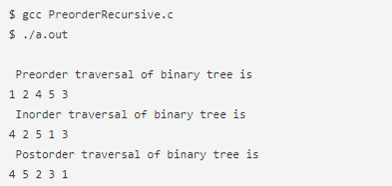
    printf("\n Preorder traversal of binary tree is \n");
    printPreorder(root);

    printf("\n Inorder traversal of binary tree is \n");
    printInorder(root);

    printf("\n Postorder traversal of binary tree is \n");
    printPostorder(root);

    getchar();
    return 0;
}
Output
Example 2)
#include <iostream>
using namespace std;

// creating a data structure that will store the binary tree node.
struct __nod
{
    int record;
    __nod *Lft, *Rt;

    __nod(int record)
    {
        this->record = record;
        this->Lft = this->Rt = NILLptr;
    }
};

// Creating a new recursive function will help us in the pre-order traversal of the binary tree.
void preorder(__nod* root)
{
    // In case the current node is empty, then,
    if (root == NILLptr) {
        return;
    }

    // Print the data part of the root element or the present node.
    cout << root->record << " ";

    // traverse the left subtree first
    preorder(root->Lft);

    // Now, traverse the right subtree
    preorder(root->Rt);
}


int main()
{
    /* building the binary search tree
               1
             /   \
            /     \
           2       3
          /      /   \
         /      /     \
        4      5       6
              / \
             /   \
            7     8
    */

    __nod* root = new __nod(1);
    root->Lft = new __nod(2);
    root->Rt = new __nod(3);
    root->Lft->Lft = new __nod(4);
    root->Rt->Lft = new __nod(5);
    root->Rt->Rt = new __nod(6);
    root->Rt->Lft->Lft = new __nod(7);
    root->Rt->Lft->Rt = new __nod(8);

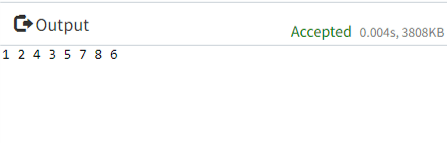
    preorder(root);

    return 0;
}
Output
Example 3)
// Creating the C++ program to observe the different tree traversals
#include <bits/stdc++.h>
using namespace std;


/* Creating a binary tree node that consists of some data along with the pointer to the left and right child. */
struct __nod {
	int record;
	struct __nod *Lft, *Rt;
};


// Creating a new utility function to help create a new tree node and observe the traversals.
__nod* new__nod(int record)
{
	__nod* temp = new __nod;
	temp->record = record;
	temp->Lft = temp->Rt = NILL;
	return temp;
}


/* In the given binary tree, we have to print the nodes in the pre-order pattern. */
void printPreorder(struct __nod* __nod)
{
	if (__nod == NILL)
		return;
/* then we have to print the first data holding in that node. */
	cout << __nod->record << " ";
/* then recursion will happen on the left subtree. */
	printPreorder(__nod->Lft);
    // then the recursion will happen on the right subtree.
	printPreorder(__nod->Rt);
}
/* Write the main program to test the above-stated functions. */
int main()
{
	struct __nod* root = new__nod(1);
	root->Lft = new__nod(2);
	root->Rt = new__nod(3);
	root->Lft->Lft = new__nod(4);
	root->Lft->Rt = new__nod(5);


	// Function call
	cout << "\nPreorder traversal of binary tree is \n";
	printPreorder(root);


	return 0;
}
Output

Example 4)
#include<iostream>
using namespace std;
struct __nod {
   int record;
   struct __nod *Lft;
   struct __nod *Rt;
};
struct __nod *create__nod(int val) {
   struct __nod *temp = (struct __nod *)malloc(sizeof(struct __nod));
   temp->record = val;
   temp->Lft = temp->Rt = NILL;
   return temp;
}
void preorder(struct __nod *root) {
   if (root != NILL) {
      cout<<root->record<<" ";
      preorder(root->Lft);
      preorder(root->Rt);
   }
}
struct __nod* insert__nod(struct __nod* __nod, int val) {
   if (__nod == NILL) return create__nod(val);
   if (val < __nod->record)
   __nod->Lft = insert__nod(__nod->Lft, val);
   else if (val > __nod->record)
   __nod->Rt = insert__nod(__nod->Rt, val);
   return __nod;
}
int main() {
   struct __nod *root = NILL;
   root = insert__nod(root, 4);
   insert__nod(root, 5);
   insert__nod(root, 2);
   insert__nod(root, 9);
   insert__nod(root, 1);
   insert__nod(root, 3);
   cout<<"Pre-Order traversal of the Binary Search Tree is: ";
   preorder(root);
   return 0;
}
Output
