
×

Delete N nodes after M nodes of a linked list

Delete N nodes after M nodes of a linked list

In this problem, we have given a linked list and two integers M and N. We need to traverse the linked list in such a way that we retain M nodes of the linked list and delete N nodes of the linked list continually till the end of the linked list.

Examples:

Input:

M = 3, N = 2

Linked List: 2 ->4 ->6 ->8 ->10 ->12 ->14 ->16

Output:

Linked List: 2 -> 4 -> 6 -> 12 -> 14 -> 16

Input:

M = 1, N = 3

Linked List: 0 -> 12 -> 13 ->4 -> 15 ->6 -> 17 ->8 -> 19

Output:

Linked List: 0 -> 15 -> 19

Input:

M = 1, N = 1

Linked List: 1 ->2 ->3 ->4 ->5 ->6 ->7 ->8 ->9 ->10

Output:

Linked List: 1 ->3 ->5 ->7 ->9

Method:

This method will traverse the given linked list and skip the first m nodes and then delete the next n nodes. It performs this traversing for all the remaining nodes. Here, we need to handle all corner case or boundary conditions and maintain proper links between the nodes of the linked list.

C program to delete N nodes after M nodes of a linked list

 #include<stdio.h>
 #include<stdlib.h>
 // The structure of the node
 struct node
 {
 int info;
 struct node * next;
 };
 struct node * start = NULL;
 // For inserting the elements in the linked list
 void add(int item)
 {
 struct node * t, * p;
 t = (struct node * )malloc( sizeof( struct node ));
 if(start == NULL)
 {
 start = t;
 start -> info = item;
 start -> next = NULL;
 return;
 }
 else
 {
 struct node * p = start;
 while(p -> next != NULL)
 {
 p = p -> next;
 }
 p -> next = t;
 p = p -> next;
 p -> info = item;
 p -> next = NULL;
 }
 }
 // For delete N nodes after M nodes of the linked list
 voidskipMdeleteN(struct node  *head, int M, int N)
 {
 struct node *temp = head, *t;
 int count;
 while (temp)
     {
 for (count = 1; count<M && temp!= NULL; count++)
 temp = temp->next;
 if (temp == NULL)
 return;
          t = temp->next;
 for (count = 1; count<=N && t!= NULL; count++)
         {
 struct Node *temp = t;
             t = t->next;
 free(temp);
         }
 temp->next = t;
 temp = t;
     }
 }
 // To display the elements of the linked list
 void traverse(struct node * t)
 {
 if(t == NULL)
 {
             printf(" Linked list is empty\n");
                                     }
                                     while(t -> next != NULL)
                                     {
                         printf("%d  ->  ", t -> info);
                         t = t -> next;
                         }
                         printf("%d\n", t -> info);
 }
 // Driver Function
 int main()
 {
 int M,N;
 printf("Enter the M and N values:\n");
 scanf("%d%d",&M,&N);
 add(2);
 add(4);
 add(6);
 add(8);
 add(10);
 add(12);
 add(14);
 add(16);
 printf("Linked List before deletion:\n");
 traverse(start);
 skipMdeleteN (start,M,N);
 printf("Linked List after deletion\n");
 traverse(start);
 return 0;
 } 

Output:
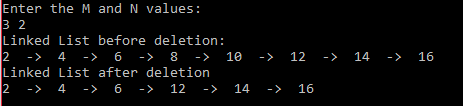
Delete N nodes after M nodes of a linked list

Time Complexity: The time complexity of the above method is O(n), where n is the total number of nodes in the linked list.


Related Topics

Equal Sum

Find an element in array such that the sum of left array is equal to the sum of right array You have been given an array of numbers. You have to...

4 minutes read.

Find Bridges in a Graph

You have been given a graph. You have to find out the bridges in that graph. Graph may be connected or disconnected. You have to print vertices of particular edge...

4 minutes read.

Tree in Data Structure

Tree A tree is a non-linear data structure by which hierarchical data is displayed. As we know that there are many trees in the forest, similarly the data structure also contains...

3 minutes read.

Stack Using Linked List

In the linked list implementation of the stack, we use a linked list as the primitive data structure to create the stack. It is called the dynamic implementation of the...

6 minutes read.

Find all possible words from board

We have been given a dictionary of words and a board of characters from which we can form strings. Now, we have to check if the string is present in...

5 minutes read.

Delete N nodes after M nodes of a linked list

Delete N nodes after M nodes of a linked list In this problem, we have given a linked list and two integers M and N. We need to traverse the linked...

3 minutes read.

Data Structures Tutorial

The data structure is a way of storing and organizing data in a computer system. So that we can use the data quickly, which means the information is stored and...

7 minutes read.

Convert Sorted List to Binary Search Tree

Implementation // creating the C++ implementation of the following approach: - #include <bits/stdc++.h> using namespace std; /* Create the link list node and see its implementation. */ class L__Nod { public: int record; L__Nod* next; }; /* constructing a new binary...

15 minutes read.

Data Structures Algorithms

What is an Algorithm? An algorithm is a sequence of steps used to complete a job or get a desired result. It is similar to programming building elements that let cell...

4 minutes read.

Common Operations on various Data Structures

Data structures are ways to organise data in computer memory for quick and effective use. The storage of data uses a variety of data-structures. It is also possible to define...

7 minutes read.

Delete nodes from the linked list which have a greater value on the right side

Delete nodes from the linked list which have a greater value on the right side In this problem, we have given a singly linked list, and we need to remove all...

3 minutes read.

B Tree vs B + Tree: Data Structure

Difference Between B Tree and B+ Tree What is B Tree? B-Tree is a self-balancing or special type of m-way tree. B-Trees are used mainly in disc access. If we want...

3 minutes read.

Queue Data Structure

Queue in DS: The queue is a non-primitive and linear data structure. It works on the principle of FIFO (First In First Out). That is, the element that is added...

4 minutes read.

What Is Dfs Algorithm in Data Structures

DFS stands for Depth First Search. Generally, it is a repetitive or decidable type of algorithm which is basically used in identifying all the vertices or nodes of a graph...

5 minutes read.

Asynchronous advantage actor-critic (A3C) Algorithm

The Asynchronous advantage actor-critic (A3C) Algorithm is one of the latest algorithms developed by the Artificial Intelligence division, Deep Mind at Google. It is used for the Deep Reinforcement Learning...

3 minutes read.

Quick Sort vs Merge Sort

In this article, we will take an overview of Quick Sort and Merge Sort and then discuss the differences between them. What is Quick Sort? Quick Sort – The idea behind the...

7 minutes read.

AVL Tree

AVL Tree AVL Tree is referred to as self-balanced or height-balanced binary search tree where the difference between heights of its left subtree and right subtree (Balance Factor) can't more than...

25 minutes read.

Tree vs Graph: Data Structure

Difference Between Tree and Graph What is Tree? A tree is a non-linear data structure and finite collection of elements called node. A tree, in which the data items are arranged in...

3 minutes read.

Bitonical Sort

Arranging an unordered collecttion of things into asignificant order. •Comparision Based Model: Bubble Sort, Selection Sort -->Non-Comparison Based. Model: Bucket Sort or on the other hand a Count Sort Bitonic Sort: Bitonic sort Algorithm was made...

5 minutes read.

Introduction to 1D-Arrays

One Dimensional Array Technical Definitions The simplest version of an Array is a One-Dimensional Array, in which the items are stored linearly and may be accessed individually by supplying the index value...

6 minutes read.