
Semi-Structured data
In this article, we will discuss the semi-structured data. Data can be defined as the distinct piece of information that is gathered and translated for some purpose. It can be available in different forms, such as bits and bytes stored in electronic memory, numbers or text on pieces of paper, or facts stored in a person's mind.
Data that are very large in size is called Big Data that is classified into three categories – Structured data, Semi-structured data, and unstructured data. Among these categories, here we will discuss the semi-structured data.
Semi-structured data is a type of structured data that does not hold the tabular structure of data models associated with relational databases or other types of data tables but still includes tags or other markers to separate semantic elements and enforce hierarchies of records and fields within the data.
In semi-structured data, entities of the same class may have different characteristics despite being grouped next to each other, and the order of the attributes is unimportant.
Since the rise of the internet, semi-structured data have become more common, as full-text documents and databases are no longer the only types of data. The sources of the semi-structured data are – Emails, Zipped files, web pages, XML and other markup languages, TCP/IP packets, etc.
Characteristics of Semi-structured data
Now, let's discuss the characteristics of the semi-structured data. The characteristics of semi-structured data are listed as follows –
- We cannot store semi-structured data in the form of rows and columns as in databases.
- The structure of semi-structured data is not well defined, so it cannot be easily used by computer programs.
- Data automation and management of semi-structured data is difficult as it does not contain enough metadata.
- In a group, the size and type of same attributes may differ.
- In the semi-structured data, entities in the same group may or may not have the same attributes or properties.
- In the semi-structured data, similar entities are grouped together and organized in a hierarchy.
Now, we discuss the benefits and limitations of the semi-structured data.
Advantages of semi-structured data
There are some of the benefits of semi-structured data that are listed as follows –
- In semi-structured data, the schema is flexible. It means that it can be easily changed.
- Semi-structured data support the users that do not express their need in SQL.
- Dealing with heterogeneous sources is easier in semi-structured data.
- In semi-structured data, the data is restricted by a fixed schema.
Disadvantages of semi-structured data
There are some of the limitations of semi-structured data that are listed as follows –
- Storage of semi-structured data is difficult due to the lacking of fixed or rigid schema.
- In comparison to structured data, queries in semi-structured data are less efficient.
Example of the semi-structured data
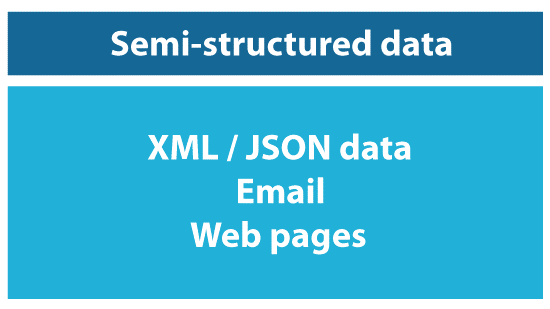
The examples of the semi-structured data are discussed as follows –
CSV
The three main languages used to interact or transfer data from a web server to a client are CSV, XML, and JSON (i.e., computer, Smartphone, etc.). CSV stands for "comma separated values", and data are expressed as Lucy, Jessica, and Anthony. It can be expressed in the same way as Excel files but with only one column.
HTML
HTML or "Hyper Text Markup Language" is a hierarchical language, and it is similar to XML but unlike XML. HTML is used to create websites and visualize information. The commentaries used to display text and images on a computer screen provide the semi-structure of HTML, but the text and images themselves are unstructured.
Web Pages
Web pages are designed to be easily accessible with tabs like Home, About Us, Blog, Contact, and so on, or links to other pages within the text, to help users find the information they need. Of course, this is all authored in HTML, but we don't see that on the computer monitor. And the text and data on each of these pages are unstructured.
Electronic Data Interchange (EDI)
EDI is the electronic computer-to-computer transmission of business documents such as purchase orders, invoices, and inventory documents previously transmitted on paper.
Email is arguably the most common type of semi-structured data since we all have it on a routine basis. Email messages comprise structured data such as name, email address, recipient, date, time, and so on, and are also organized into folders such as Inbox, Sent, Trash, and so on.
JSON
JSON stands for "JavaScript Object Notation". It is an open standard format, which is lightweight and text-based, designed explicitly for human-readable data interchange.
Now, let's see some of the issues and solutions to store the semi-structured data.
What are the problems faced to store the semi-structured data?
The storage of semi-structured data is difficult due to the reasons listed below –
- Unlike structured data, the cost of storing the semi-structured data is higher.
- In semi-structured data, designing of data structure is typical. It is because the distinction between the schema and data is not clear and uncertain.
- In semi-structured data, generally, the structure of data is irregular. Some data sources have an implicit data structure that makes the interpretation of data relationships complicated.
- Generally, the schema and data in semi-structured data are tightly coupled and dependent on each other.
What are the solutions to store semi-structured data?
The solutions to store semi-structured data are listed as follows –
- We can use Object Exchange Model (OEM) to exchange and store semi-structured data.
- RDBMS can also be used to store the semi-structured data. It can be done by mapping the data to relational schema and map it to a table.
- XML is broadly used to exchange and store the semi-structured data. Using XML, the user can define tags and attributes for storing the data in hierarchical form. In XML, data and schema are not tightly coupled.
How to extract information from semi-structured data?
Extracting information from semi-structured data is typical, as it is hard to tag and index. It is because semi-structured data have different structures due to the heterogeneous sources. Sometimes semi-structured data do not have any structure. The possible solutions to extract semi-structured data are listed as follows –
- We can use data mining tools to extract information from semi-structured data.
- We can use graph-based models such as Object Exchange Model (OEM) to index the semi-structured data. The searching and indexing of data stored in a graph-based model are easier.
- XML allows us to arrange the data in hierarchical order. It enables the indexing and searching of data.
So, that's all about the article. Here, we have discussed the semi-structured data along with its characteristics, benefits, limitations, and examples. We have also seen some of the important questions related to the semi-structured data. Hope the article will be helpful and informative to you.