
×

Timsort

TimSort Time Complexity

Timsort is a sorting algorithm that is quite efficient for real-world data. Timsort is created in 2001 by Tim Peters for the python programming language. Timsort is a hybrid stable sorting algorithm and it is the combination of Insertion Sort and Marge Sort. After it has been created, it is used in java’s Arrays.sort() as well as python’s sorted() and sort().

How it works

In Tim sort, we divide the Array or List into blocks. Then, after we use insertion sort to sort those blocks one by one and then, by the help of merge function of merge sort, we combine or merge those blocks. The concept behind is that the insertion sort performs well for small arrays.

Timsort time complexity comparison

Algorithm Time Complexity
 Best-CaseAverage-Case          Worst-Case
Tim SortO(n)O(n log( n ) )                   O(n log( n ) )
Quick SortO(n log( n ) )O(n log( n ) )                   O(n^2)
Merge SortO(n log( n ) )O(n log( n ) )                   O(n log( n ) )

Timsort program in C-language: -

 #include<stdio.h>
 #define BLOCK 32
 void insertion_Sort(int array[], int lt, int rgt)
 {
     int i=0;
     for ( i = lt + 1; i <= rgt; i++)
     {
         int temp_var = array[i];
         int j = i - 1;
         while (array[j] > temp_var && j >= lt)
         {
             array[j+1] = array[j];
             j--;
         }
         array[j+1] = temp_var;
     }
 }
 // merge function
 void merge(int array[], int l, int m, int r)
 {
     // we divide array into two part left and right array
     int len1 = m - l + 1, len2 = r - m,i=0;
     int lt[len1], rgt[len2];
     for ( i = 0; i < len1; i++)
         lt[i] = array[l + i];
     for ( i = 0; i < len2; i++)
         rgt[i] = array[m + 1 + i];
     i = 0;
     int j = 0;
     int k = l;
     // after that, we combine those two sub-arrays
     while (i < len1 && j < len2)
     {
         if (lt[i] <= rgt[j])
         {
             array[k] = lt[i];
             i++;
         }
         else
         {
             array[k] = rgt[j];
             j++;
         }
         k++;
     }
     // we copy remaining left array element
     while (i < len1)
     {
         array[k] = lt[i];
         k++;
         i++;
     }
     // we copy remaining right array element
     while (j < len2)
     {
         array[k] = rgt[j];
         k++;
         j++;
     }
 }
 int min(int a,int b)
 {
     if(a<b)
         return a;
     return b;
 }
 void tim_Sort(int array[], int n)
 {
     // Sort individual subarrays of size BLOCK
     int i=0,size=0,lt=0;
     for ( i = 0; i < n; i+=BLOCK)
         insertion_Sort(array, i, min((i+31), (n-1)));
     for (size = BLOCK; size < n; size = 2*size)
     {
         // After every merge, we increase lt by 2*size
         for ( lt = 0; lt < n; lt += 2*size)
         {
             int mid = lt + size - 1;
             int rgt = min((lt + 2*size - 1), (n-1));
             // merge sub array array[lt.....mid] & array[mid+1..A..rgt]
             merge(array, lt, mid, rgt);
         }
     }
 }
 // For printing the array
 void printArray(int array[], int n)
 {
     int i=0;
     for ( i = 0; i < n; i++)
         printf("%d  ", array[i]);
     printf("\n");
 }
 // Driver function
 int main()
 {
     int array[] = {5, 21, 7, 23, 19};
     int n = sizeof(array)/sizeof(array[0]);
     printf("Given Array is\n");
     printArray(array, n);
     tim_Sort(array, n);
     printf("After Sorting Array is\n");
     printArray(array, n);
     return 0;
 } 

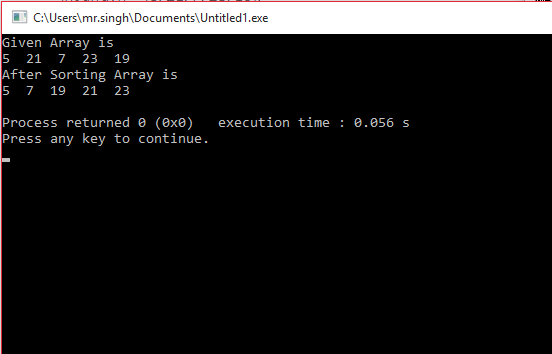
Output
TimSort Time Complexity

Related Topics

Number of visible boxes putting one inside another

You have given one array, which consists of values which represent the sizes of different boxes. We can put one box inside another if the size of the outside box...

3 minutes read.

Radix Sort

Radix Sort: The radix sort is a non-comparative integer sorting algorithm that sorts the elements by grouping the individual digits of the same location. It shares the same significant position...

4 minutes read.

Berkley’s Algorithm

Berkley’s Algorithm is mainly used in clock synchronization system. It is used in distributed systems. To implement this algorithm, we have to think that the network has no accurate time...

4 minutes read.

Rearrange a linked list into alternate fashion first and the last element

Rearrange a linked list into alternate fashion first and the last element This article will explain how to rearrange the linked list into alternate fashion first and the last element. Here,...

3 minutes read.

Stack vs Queue: Data Structure

 Difference Between Stack and Queue What is Stack? The LIFO principle applies on insertion and deletion operations of the stack which means last inserted element to the stack will remove first....

3 minutes read.

Deque in Data Structure

Deque A deque referred as “Double-Ended Queue”, is a linear collection of data items same like queue data structure. deque has two ends, front end and rear end, deque is the...

27 minutes read.

Partitioning a linked list around a given value

Partitioning a linked list around a given value In this problem, we are given a linked list and a value k. We need to partition the given linked list so that...

3 minutes read.

Bitonical Sort

Arranging an unordered collecttion of things into asignificant order. •Comparision Based Model: Bubble Sort, Selection Sort -->Non-Comparison Based. Model: Bucket Sort or on the other hand a Count Sort Bitonic Sort: Bitonic sort Algorithm was made...

5 minutes read.

Types of Linked list

Single linked list  A single linked list is a linked list in which all nodes are connected with each other in sequence. Each node of a singly linked list has two...

7 minutes read.

Data Structures Algorithms

What is an Algorithm? An algorithm is a sequence of steps used to complete a job or get a desired result. It is similar to programming building elements that let cell...

4 minutes read.

Binary Search Tree

Binary Search Tree: A binary search tree is a type of tree in which every node is organized in the sorted order. It is also called an ordered binary tree. Properties...

4 minutes read.

Serialize and Deserialize a Binary Tree

Implementation // Writing a C++ program to check the serialization and deserialization of binary tree.   #include <iosstream> /* A binary tree node contains a key and a pointer to the left and right...

4 minutes read.

A Full Binary Tree with n Nodes

Implementation // Writing the implementation of the above approach in C++ #include <bits/stdc++.h> using namespace std; // We are creating a class that will create a node and its left and right children.  struct __nod...

12 minutes read.

Stack vs Array

Difference between Array and Stack In this article, we are going to discuss the major differences between the stack and array data structures: Array – In the data structure, the array is...

3 minutes read.

Insertion sort

Insertion sort is a simple sorting technique. It is best suited for small data sets, but it does not suitable for large data sets. In this technique, we pick an...

4 minutes read.

Invert binary tree

Invert binary tree is a mirror image of a tree. It is pretty much the same compared to the only difference: its left and right children are swapped with the...

4 minutes read.

Introduction and Implementation of Bloom Filter

It often happens with many of us that when we create an account on some applications like Github, it shows us that the username already exists. You can add some...

4 minutes read.

Deletion Operation from A B Tree

This article will show the deletion operation through the b tree in C++ programming language. Implementation #include <iostream> using namespace std; class B_TreeNod {   int *kys;   int m;   BTreeNod **C;   int j;   bool leaf;  ...

5 minutes read.

Complete Binary tree

In this article, we will discuss the complete binary tree. But before start discussing the complete binary tree, we should first see a brief description of a binary tree. What is...

7 minutes read.

Detect and Remove Loop in a Linked List

Create a function called detectAndRemovetheLoop() that verifies whether a given Linked List has a loop, eliminates the loop if it does, and returns true if it does. It returns false...

6 minutes read.