
Palindrome Using While Loop in C++
A palindrome is a word, number, phrase, or other sequence of letters that reads the same backward as forward, such as 101 or MOM.
Like other programming languages, C++ also allows us to perform various operations. With the help of some examples, we'll explore how to verify the palindrome program in C++. Before we go into that, let's look at a palindrome. A palindrome is a result that gets the same value when the original value is reversed. Palindrome logic is as straightforward as it appears. For example, if you reverse MADAM, you'll get the same result: MADAM. That’s why, MADAM is a Palindrome value.
Here are some examples to see if they are palindromes or not:
- 242: It is a palindrome because the reverse is242.
- SOS: It's a palindrome because the reverse is SOS.
- 12341: This is not a palindrome because the reverse is 12341.
- java: It is not a palindrome because the reverse is avaj.
We can now tell whether the case, as mentioned earlier, is a palindrome or not. However, we solved the examples above orally. Let's look at how this verbal reasoning works in a computer language in C++. Before we move on the program, let's look at the algorithm to find the Palindrome.
The basic algorithm for testing Palindrome in a C++ program:
Step 1. Start
Step 2. Take input from the user.
Step 3. Save the value of the input into a temporary variable.
Step 4. Find the inverse of inserted value.
Step 5. Compare the values of both reverse and temporary variables.
Step 6. Print "it as a palindrome" if both values match.
Step 7. Print "it is not a palindrome" if both values do not match.
Step 8. Stop.
What is while Loop?
A while loop or while statement repeats all code of its body as long as a specific condition is satisfied. The loop ends if or when the condition no longer met.
The syntax of the while loop
while(condition)
                     {
                        statement(x);
                     }
Algorithm:
Step 1: Start.
Step 2: Read a number, num.
Step 3: Assign temp=num and rev=0.
Step 4: Compute r=num/10;
Rev= rev*10+r;
Num= num/10;
Step 5: If( rev== num ) print it is a palindrome.
Else print it is not a palindrome.
Step 6: End
Flowchart:
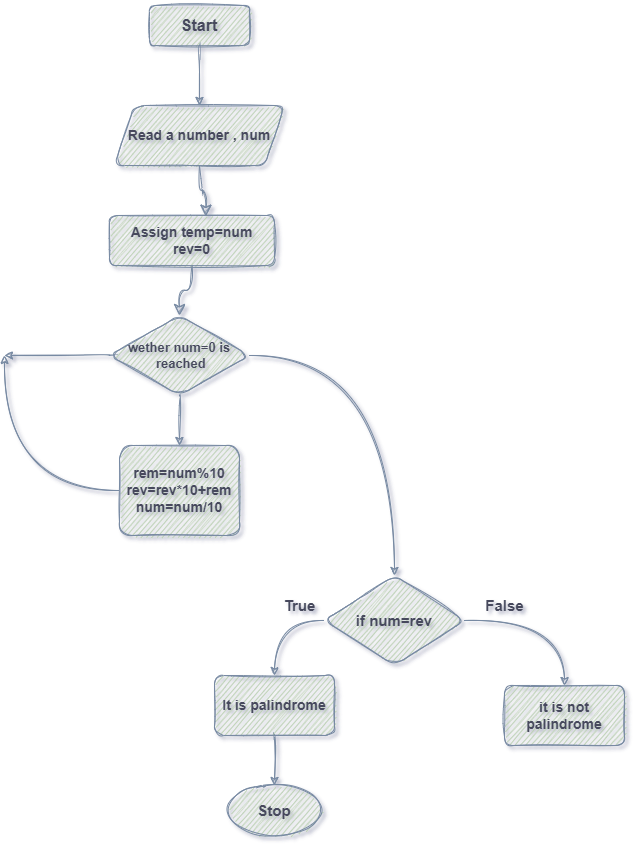
Program 1: Program to print whether the number is Palindrome or not.
#include<iostream>
using namespace std;
int main()
{
int r, rev= 0, i, temp;
int num=67876;
temp = num;           //store number to temp
i=num;
while(i>0)
         {
           r= i % 10;
          rev = rev * 10 +r;
          i = i/ 10;
       }
if(temp == rev)
       {
           cout << "number is palindrome";
      }
else
     {
             cout << "number is not a palindrome";
      }
return 0;
}
The output of the program:
Number is palindrome
Explanation:
In the above program, we assigned a value 67876 to integer variable num. The integer's value is saved in yet another temporary variable, “temp”.
Then, while loop is utilized, and the modulus operator is used to get the number's last digit; 1’s position is filled with the last digit, the 10's place with the second last, and so on.
After that, the last digit is deleted by dividing the number by 10. When the value is zero, the loop ends. The reverse number is then compared to the integer value of the temporary variable. The number is a palindrome if both values are equal. The number isn't a palindrome if both aren’t equal. But, in this case, the number is Palindrome.
Program 2: Program to check whether the number taken from the user is Palindrome or not.
#include<iostream>
using namespace std;
int main()
{
int num, r, rev= 0, i, temp;
cout << "Enter random number:";
      cin >> num;                        // takes value from user
      temp = num;                     //store number to temp
   i=num;
while(i>0)
         {
           r= i % 10;
          rev = rev * 10 +r;
          i = i/ 10;
       }
    if(temp == rev)
          {
           cout << "Given number is a palindrome";
          }
     else
       {
          cout << "Given number is not a palindrome";
       }
  return 0;
The output of the program:
Enter a random number: 121
    The given number is a palindrome.
Enter a random number: 1234
     Given number is not a palindrome.
Explanation:
The user must first enter the integer value and save it in a variable. The integer's value is subsequently saved in yet another temporary variable.
Then, while loop is utilized, and the modulus operator is used to get the number's last digit; 1’s position is filled with the last digit, the 10's place with the second last, and so on. After that, the last digit is deleted by dividing the number by 10.
When the value becomes zero, the loop ends. The reverse number is then compared to the integer value of the temporary variable. The number is a palindrome if both values are equal. The number isn't palindrome if both aren’t equal. But, in this case, the number is Palindrome.
Program 3: Program to check whether the given array is a palindrome:
Algorithm:
Step 1: Start the program
Step 2: Set the flag to unset, i.e., int flag = 0.
Step 3: Execute the Loop through the array until it reaches the size n/2.
Step 4: In a loop, determine if arr[i]! = arr[n-i-1] then set the
Flag to 1 and break.
Step 5: If the flag is set at the end of the loop, print "Not
Palindrome," otherwise print "Palindrome."
Step 6: End.
Program:
#include <iostream>
using namespace std;
 void palindrome(int arr[], int n)
{
    // Initialise flag to zero.
    int flag = 0;
    // Loop till array size n/2.
       Int i=0;
       While(i<=n/2&&n!=0)
     {
        // Check if first and last element are different
        // Then set flag to 1.
        if (arr[i] != arr[n - i - 1])
        {
            flag = 1;
            break;
        }
       i++;
    }
         // If flag is set then print Not Palindrome
        // else print Palindrome.
    if (flag == 1)
        cout << "Not Palindrome";
    else
        cout << "Palindrome";
}
       // Driver program.
int main()
{
    int arr[] = { 1, 2, 3, 2, 1 };
    int n = sizeof(arr) / sizeof(arr[0]);
    palindrome(arr, n);
    return 0;
}
Output:
Given array is a palindrome
What is reverse() function?
Reverse() function is a predefined function in the Standard Template Library. It reverses the order of the elements in the range [first, last]. The time complexity is 0(n).
Algorithm:
Step 1: Start.
Step 2: Read str from the user.
Step 3: Assign str= temp.
Step 4: Use the reverse(str.begin(),str.end()).
Step 5: If( temp==str)
Print it is a palindrome
Else
Print it is not a palindrome.
Step 6: Stop.
Program of Palindrome using Reverse() function:
#include<bits/stdc++.h>
using namespace std;
int main()
{
   string str;
   cout<<"Enter String:";
   getline(cin,str);
   string temp=str;
   reverse(str.begin(),str.end());
   if(temp==str)
      {
           cout<<"it is a palindrome"<<endl;
      }
  else
      {
           cout<< "it is not a palindrome" <<endl;
      }
return 0;
}
The output of the program
Enter String: 12321
            It is a palindrome.
 Enter String: Shyam
            It is not a palindrome.
Explanation
In this program, a string called "rev" is the inverse of the series "str" entered by the user. Then we compared them to see if they're identical or not. And, if both are identical, then the input string/number is palindrome. If the reversed string is not the same as the input string, the input string is not palindrome.