
×

How to check the version of the Python Interpreter?

As we all know what an interpreter is, and how important it is. We should also be aware of the fact that it is important to have knowledge of the version of the Python interpreter we are using, as many functions do not run on older versions, hence it should be up to date to use the latest features of Python smoothly.

Python is widely used in source coding and computer programming in many industries. It executes the interactive commands received by it.

How to check the version of Python?

Some methods used to check the version of Python are:

  • Python -V command
  • Python_version() function
  • sys.version method

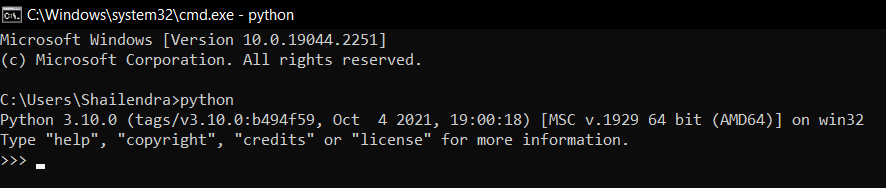
Before checking the version of the Python interpreter, it is necessary that your device should have installed it. To check it, execute the following command in the command prompt:

Python

If the terminal shown below appears then you have it installed on your device, and if you see any kind of error then first install Python from its official website.
How to check the version of the Python Interpreter

Method 1: Using the “Python -V” command

It is one of the most commonly used commands to check the version of the Python interpreter. This is an inbuilt Python command.

The following steps are followed to check the version of the Python interpreter:

  1. First, open the command prompt.
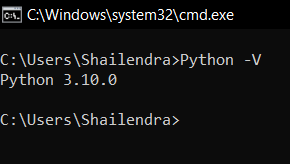
  2. Then, execute the following command in it, and after pressing enter you will receive the current version of the Python interpreter:
Python -V

Output:
How to check the version of the Python Interpreter

Method 2: Using the “Python_version()” function:

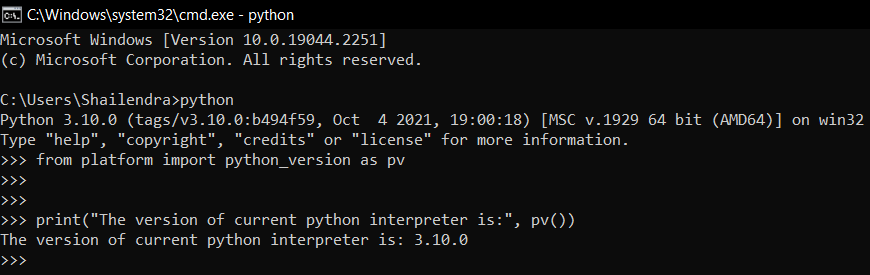
This is one of the methods to check the version of the Python interpreter. To use this function, the platform library has to be imported. This function can be used in both, the terminal and in IDLE.

The following steps are followed to check the version of the Python interpreter:

  1. First, open the command prompt or the IDLE.
  2. Then, if you opened the command prompt, type Python and press enter.
  3. Finally, at last, execute the following command in the terminal or IDLE:
fromplatform importPython_versionas pv
print("The version of current Python interpreter is:",pv())

Output:
How to check the version of the Python Interpreter

Method 3: Using the “sys.version” method:

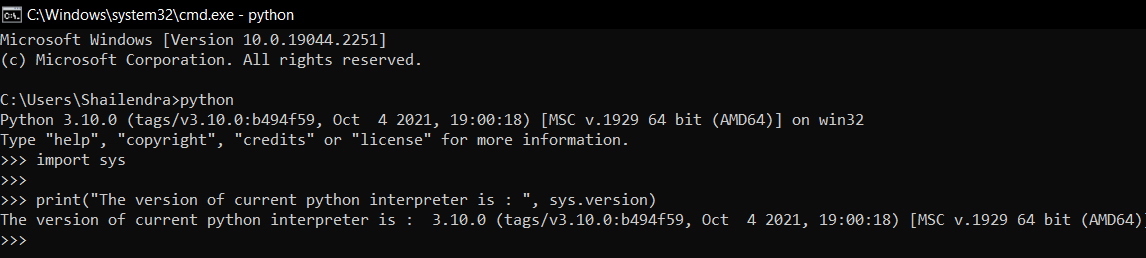
It is the last method to check the version of the Python interpreter, of the three we mentioned before. To use this method, the user has to import the sys library. Just like the “Python_version()” function, it can be used in both, the terminal and in IDLE.

The following steps are followed to check the version of the Python interpreter:

  1. First, open the command prompt or the IDLE.
  2. Then, if you opened the command prompt, type Python and press enter.
  3. Finally, at last, execute the following command in the terminal or IDLE:
importsys
print("The version of current Python interpreter is : ",sys.version)

Output:
How to check the version of the Python Interpreter

Note: This method does surely give some additional details along with the version of Python interpreter.


Related Topics

Latest Project Ideas using Python 2024

Python is one of the well-known languages for programming in the contemporary domain of computer science. The demand to adopt Python for IT purposes is steadily increasing because of its...

7 minutes read.

Poolmanager in Python

Python: Python is an interactive and more accessible language than any other programming language. The python programming language uses a variety of libraries to perform the operations in a faster way....

4 minutes read.

Python Skyline

Python Programming Language: Python is an interactive and more accessible language than any other programming language. The python programming language uses a variety of libraries to perform the operations in a...

3 minutes read.

*Args and **Kwargs in Python

Let’s know about ** (dual star / asterisk) and * (star / asterisk) are operators in Python. These stars are used in Python for parameters. Args and kwargs are special...

3 minutes read.

Python Infinity

Introduction We will discover how to define an infinite number in Python in this tutorial. Infinity, as we all know, is a value that cannot be defined and can either be...

5 minutes read.

Static Variables in Python

What is a Static Variable? The variable that remains with a constant value throughout the program or throughout the class is known as a " Static Variable ". Static variables are...

3 minutes read.

How to upgrade PIP in python

We use the PIP command in our command prompt to install any package. PIP is used to install published Python packages in the PyPI (Python package index) or other indices....

3 minutes read.

Type casting in Python

Introduction Type Casting is defined as the method of converting the variables/values data type into a certain data type for matching the operation needed to be performed by the users. This...

4 minutes read.

How to check if the dictionary is empty in Python?

What is a dictionary in Python? A directory is a collection of data but data is not ordered. Unlike other data types, it does not hold a single value as its...

3 minutes read.

Socket Programming in Python

Socket Programming in Python In this tutorial, we will discuss network programming using Python programming language. We will explore all basic concept of network with Python script. Network Services in Python Python has...

9 minutes read.

Python Simple Interest

Python is an Object-Oriented high-level language. Python has an English-like syntax, which is very easy to read and write codes. Python is an interpreted language which means that it uses...

3 minutes read.

Cross Entropy in Python

Introduction Cross-entropy loss is frequently combined with the softmax function. Determine the total entropy among the distributions or the cross-entropy, which is the difference between two probability distributions. For the purpose...

5 minutes read.

Python String rjust() method

Python String rjust() method The string.rjust() method in Python returns a right-justified string of a given minimum width where the padding is done using the specified fillchar (default is a space). It returns...

2 minutes read.

Python Variables, Constants and Literals

Python is today's most valuable, easy-to-implement and sought-out programming language. Nowadays, developers want to focus on implementing the program rather than spending time with complex programs. So, for this reason,...

17 minutes read.

How to Iterate a List in Python

As we know, a List is one of the four unique data structures available in Python; in this article, we will deep dive into understanding iterating through a list and...

3 minutes read.

Difference Between Python and Scala

What is Python? Python is a high-level general-purpose interpreted programing language. It is used for multi general-purpose work such as language construct as well as its object-oriented approach aims to help...

4 minutes read.

Python String capitalize() method

Python String capitalize() method The string.capitalize() method in Python returns a copy of the string with only its first character capitalized. Syntax string.capitalize() Parameter NA Return This function returns a string where the first character is upper...

1 minute read.

Linear Regression using Sklearn with Example

This article will examine Python's global, local and non-local variables and show you how to use them to write code without problems. Let's quickly review what a variable in Python is...

8 minutes read.

Python String rstrip() method

Python String rstrip() method The string.rstrip() method in Python returns a copy of the string with trailing characters removed. Syntax string.rstrip([chars]) Parameter chars:  This argument represents a string specifying the set of characters to be...

1 minute read.

How to set up a proxy using selenium in python

What is Proxy? A proxy acts as a middleman between user requests and server responses. The main purposes of proxies are to protect user privacy and encapsulate data between various interactive...

3 minutes read.