
×

Python for Data Analysis

Data analysis uses various techniques to read, illustrate, manipulate and evaluate a particular data. You can have access to the data and keep the data updated regularly. You can append new values or suspend the values from the data. There are six basic steps in data analysis which are:

  • Specify data requirements
  • Collect or prepare data
  • Process and clean
  • Analyze
  • Share
  • Report

For every process, there is a tool to work with.

In Python, we can use various packages for data analysis like NumPy for numerical data analysis, Pandas for Tabular data, Matplotlib for visualizing data, and Exploratory analysis.

NumPy for numerical analyzing

NumPy is also called numerical Python. NumPy is one of the open-source libraries of Python. We primarily use NumPy for arrays and some main functions in linear algebra, matrices, and statistics.

In data analysis, we use NumPy arrays, a table of elements. As it is an array, it will only store similar data types. The dimensions of the array are taken as the rank of the array.

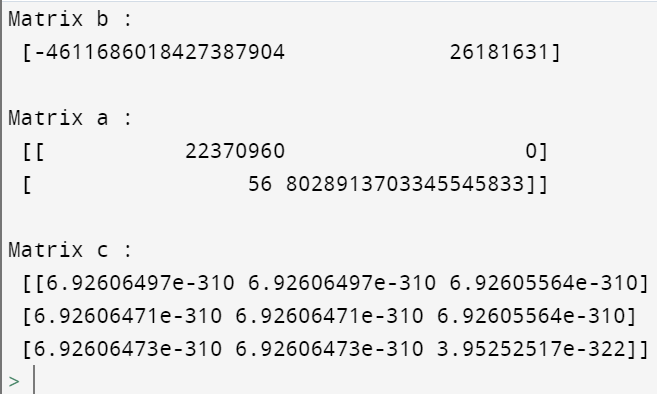
To create a NumPy array, we use the below code:

Code

import numpy as np
   
B = np.empty(2, dtype = int)
print("Matrix b : \n", B)
   
A = np.empty([2, 2], dtype = int)
print("\nMatrix a : \n", A)
   
C = np.empty([3, 3])
print("\nMatrix c : \n", C)

Output:
Python for Data Analysis

Further, you can do many airthematic operations on NumPy arrays like

  • Addition: you can add two arrays using add function. Defining (a+b)
  • Subtraction: you can subtract two arrays using a sub-function. Defining (a-b)
  • Multiplication: you can multiply two arrays using the mul function. Defining (a*b)
  • Division: you can divide one array from another using the div function. Defining (a/b)

You will also try array indexing, array slicing, and array broadcasting.

Pandas for tabular data:

Pandas is one of the best libraries in Python used to work with data sets containing functions for analyzing, cleaning, exploring, and manipulating the given data. The definition of "Pandas" has a reference in "Panel Data" and "Python Data Analysis" and was created by Wes McKinney in 2008.

Python with Pandas is used in many fields, including academic and commercial, finance, economics, Statistics, analytics, etc.

We import pandas using the following command:

import pandas as pd

Pandas help in writing less amount code every time a method is called. In pandas for data manipulations, we get two data structures which are:

  • Series: This is a one-dimensional labeled array used to hold data of any type. This Series acts like a column in an excel sheet.

The command we use for this function is Series().

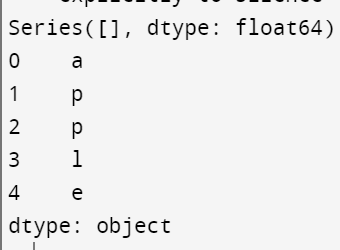
Example code:

import pandas as pd
import numpy as np
# Creating an empty series
A = pd.Series()
print(A)
# simple array
data = np.array(['a', 'p', 'p', 'l', 'e'])
A = pd.Series(data)
print(A)

output:
Python for Data Analysis
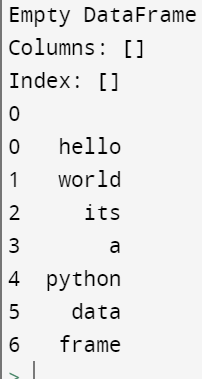
  • Data frame:  this is a two- dimensional size, mutable. This data is aligned in a tabular form consisting of rows and columns. This will be created using the function Datafram(). Let us look at an example code

Code:

import pandas as pd
  
# Calling the DataFrame method
df = pd.DataFrame()
print(df)
  
# list of strings
A = ['hello', 'world', 'its', 'a',
            'python', 'data', 'frame']
  
# Calling DataFrame constructor on the list
df = pd.DataFrame(A)
print(df)

Output:
Python for Data Analysis

Further, you can make some operations in data frames like

  • Filtering: this is used to subset rows or columns of a data frame. This can be used by the function data frame.filter().
  • Sorting: This is used to sort the data frame in either ascending or descending order. The syntax of this is sort_values().
  • Groupby: this is used to categorize the data. This will be used in real-life projects.
  • Concatenating: used to concatenate the data frames. Syntax of this is concat().

Matplotlib for visualizing data

Matplotlib is Python's best visualization library for developing 2D plots of an array. This library is built on NumPy. We can create several plots like line graphs, bar graphs, scatter plots, and histograms.

Pyplot is a matplotlib module that gives an interface. All functions of pyplot are used to create figures, decorate a plot with, creating plotting areas.

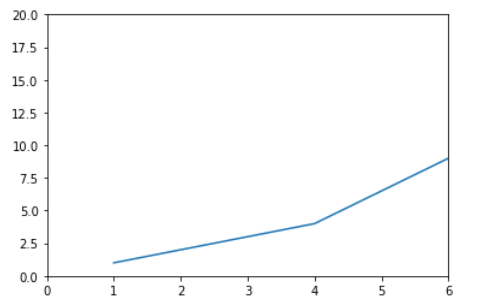
Let us look at an example code for plotting

Code:

# python program to execute pyplot module
import matplotlib.pyplot as plt
  
  
plt.plot([1, 4, 6, 8], [1, 4, 9, 16])
plt.axis([0, 6, 0, 20])
plt.show()

Output:
Python for Data Analysis

You can also create many more graphs like pie charts, bar graphs, histograms, scatterplots, box plots, and correlation heat maps.

Exploratory Data analysis

EDA- this is one of the techniques to analyze the data using a few visual techniques. With this method, we will get detailed information on the statistical summary of the data. With this, we will be able to manipulate the duplicate values and a few patterns.


Related Topics

Palindrome In Python

What is Palindrome? A Palindrome can be defined as the number or a string that resides unchanged when it is reversed. Example: 14341 Output: Yes, this is a Palindrome number Example: RACECAR Output: Yes, this...

2 minutes read.

After Python, What Should I Learn

Python is a programming language used to create websites, software, and other projects. It is easy to code and easy to learn. After learning Python, there are many different directions...

4 minutes read.

Python Set union() method

Python Set union() method The set.union() method in Python returns a set that contains all items from the original set and all items from the specified sets. Syntax set.union(set1, set2...) Parameter set1- This parameter represents the first set...

2 minutes read.

Artificial intelligence mini projects with source code in Python

Project Name: Movie recommendation system A recommendation provides customers with relevant information related to their searches. Before the recommendation system, the most common method of purchasing was to rely on the...

4 minutes read.

How to create a DataFrames in Python

How to create a DataFrames in Python Data Frame is a data structure in which data is stored in tabular form. They can also be referred as two-dimensional collection of data. Various...

5 minutes read.

Yield Statement In Python

The generators are defined by using the yield statement in Python. Generally, it converts a normal Python function into a generator.  The yield statement hauls the function and returns back the...

2 minutes read.

How to declare array in python

How to declare array in python? Arrays are a great way of storing our numeric values into a variable in continuous locations. For declaring an array in C language, we used...

4 minutes read.

Rank Based Percentile GUI Calculator using PyQt5 in Python

PyQt5: PyQt5 is one of several solutions that Python offers for creating GUI applications. Cross-platform GUI toolkit PyQt5 is a collection of Python interfaces for Qt version 5. With the capabilities...

3 minutes read.

EDA in Python

The EDA is the exploratory data analysis; the data scientists mainly use the EDA to understand the main features of the data quickly, the variables in python and the relationship...

6 minutes read.

Python If-else statement

In real life, there are situations where we have to make decisions for a particular circumstance and based on those decisions, and we plan our next move. The same thing...

4 minutes read.

Convert List to Array in Python

What is List in Python? In Python, a list is a built-in data structure that stores a collection of items. The items in a list can be of any data type,...

3 minutes read.

How to Take Input in Python

How To Take Input In Python Python has various in-built functions that help in code redundancy. Let's discuss the usage of some functions- ascii() – it returns a readable representation of objects.format()...

4 minutes read.

Assertion Errors and Attribute Errors in Python

Assertion Error in Python In Python, the assert condition is used to continue the execution if the given statement displays true. If the assert statement displays false, it raises Assertion Error...

3 minutes read.

Python Multithreading

In python, we can implement multithreading. In this tutorial, we will understand the basics of implementing multithreading in a python programming language. Multithreading is just like multiprocessing. We use it...

4 minutes read.

Permutations in Python

Recursion Basic idea: for numbers of length N. N-1 items are chosen at random between 0 and then generate permutations using the remaining N-1 elements in a recursive fashion. Once you've done...

4 minutes read.

Write a String in Python

Python is an object-oriented high-level programming language. Python has dynamic semantics and has high-level built-in data structures which support dynamic typing and dynamic binding. Python provides rapid development. It has...

5 minutes read.

Check if the directory exists in Python

To prevent any error, while loading or editing a file, we first have to check that the directory or the file exists or not. This is also done to prevent...

5 minutes read.

Working with files in Python

Python is an object-oriented high-level programming language. Python has dynamic semantics and has high-level built-in data structures which support dynamic typing and dynamic binding. Python provides rapid development. It has an...

5 minutes read.

What is the re.sub() function in Python

There. sub () function is used to return a string by replacing the occurrences of a specific character or pattern with a replacement string. To use this function, import the...

3 minutes read.

Python Assert

Python Assert Python provides an assert statement which is used to check the logical expression. If the given logical expression is true, then it precedes for the next line; otherwise, it raises an...

2 minutes read.