
Python Stack
Python Stack: The work Stack is defined as arranging a pile of objects or items on top of another. It is the same method of allocating memory in the stack data structure. The Stack is used to store the data elements in a similar style as a pile of plates are arranged one over the other in the kitchen and dinner parties. Thus, this data structure helps to function at one end known as the top of the Stack. The user can remove elements from the top or add elements to the top of the Stack.
Stack in Python
The Stack in Python is an abstract structure that is comprised of a set of homogeneous elements. This container of elements can be removed and added according to the LIFO (Last-In-First-Out) principle. The Stack is a generally used abstract data type that is comprised of two distinct operations: Push and Pop. Both the operations push and pop are conducted on the topmost element recently added to the Stack.
In Python Stack, the Push operation is used to add or insert a data element or object to the Stack, whereas the Pop operation is used to remove or eliminate a data element or object from the top of the Stack. Stack's concept is being used in many programming languages (such as C++, Python, Perl and many more) and memory organization in Computer systems.
How stack work in Python
A Stack in Python is a linear format of data structure that represents a sequence of elements or objects. The Stack is comprised of a constrained bottom, and every operation is conducted on the topmost element. Whenever the push operation is carried out, an element is added to the Stack incrementing the top value by one. When the pop operation is taken into action, the topmost element is removed or eliminated, and the topmost value is decremented by one. The Stack Pointer is a pointer that points to the topmost position of the Stack.
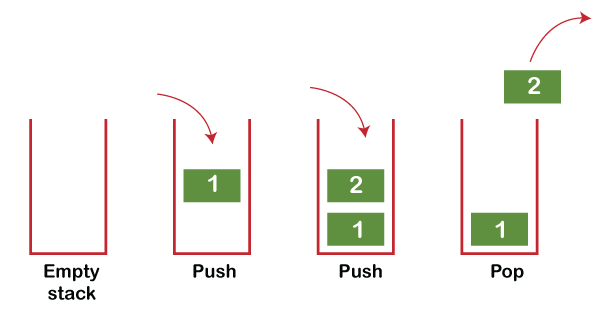
A Stack in Python may have a vibrant implementation where the size is changeable or may have a fixed size. If, in case, the stack has a bound capacity and we try adding an element or object to an already full stack can cause an Overflow exception in the stack. Moreover, if we try a pop operation on an already empty stack to remove an element, it is called Underflow.
Understanding Some Stack Operations in Python
Having a limited number of operations in Stack, it is considered a restricted data structure. However, certain implementations provide some advanced operations to Stack apart from the push and pop operations. Some of them are briefly described below:
- Push: The Push operation is used to add or insert an element to the stack. However, once the stack is full, it causes a condition of Overflow.
- Pull: The Pull operation is used to remove or eliminate an element from the stack. However, once the stack is empty, it causes a condition of Underflow.
- Peek: The Peek operation is used to view the topmost element in the stack.
- Swap: The Swap operation is used for swapping the two topmost elements in the stack.
- Duplicate: The Duplicate operation is used to copy the topmost element's value into the variable and insert it back into the stack.
- Rotate: The Rotate operation is used for rotating the topmost data elements or object in the stack as stated by a number.
The Concept of Stack is implemented in Software with the help of linked lists and arrays, where the top position is tracked using a header pointer or variable, respectively. Various built-in features to support the stack implementation are provided by many programming languages.
The implementation of Hardware Stacks provides the function to allocate the memory and access with a fixed size and origin. The Stack registers help in storing the value of the Stack Pointer.
Push Operation in Python Stack
As we have discussed earlier, the Push operation is the process of inserting a new element or object into the stack. There is a series of steps following by the Push operation.
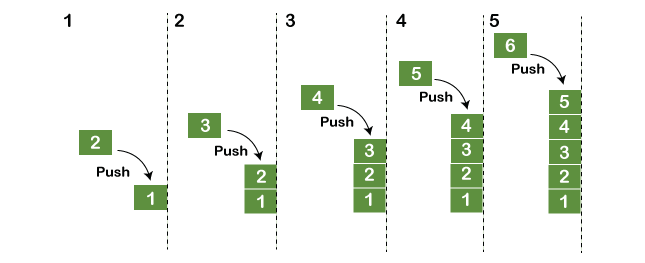
The Steps for Push Operation
- Firstly, it checks for the space available in the Stack
- It returns an error if the Stack is full and quit.
- However, it increments the top to point subsequent void space if the Stack is not occupied.
- It inserts the data element to the stack location that is pointed in the previous step.
- Once the process is completed, it prints a success message.
Pop Operation in Python Stack
As we have also discussed earlier, the Pop operation is a process to access the content and removing it from the Stack. It is a point to understand, the data element is not removed or eliminated with pop() operation in an Array Implementation; but it decrements the top to a lower position in the Stack pointing to the next value. In contrast, the pop() operation removes the data element deallocating the memory space in a Linked-list implementation. Let’s understand the series of steps followed in Pop Operation.
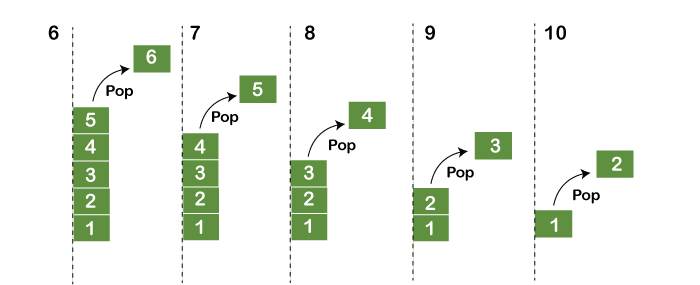
The Steps for Pop Operations
- First of all, it checks if the stack is empty or not.
- It produces an error if the stack is appeared to be empty and quit.
- However, if the stack is not empty, it accesses the stack's data element, pointing at the top.
- Then, it decreases the value of the topmost element by one.
- Once the process is completed, it prints a success message.
Stack Implementation in Python
There are a lot of options available in Python to implement a Stack. This can be done with the help of tuples, lists, or third-party packages or modules. However, few fundamental Python Stack implementations will be able to fulfill most of the user’s requirements.
Some of the Python Stack implementations are shown below:
- list
- queue.LifoQueue
- collections.deque
Some functions associated to Stack
| S. No. | Function | Description |
| 1 | empty() | The empty() function is used to return whether the Stack is empty or not – Time Complexity: O(1) |
| 2 | top() | The top() function is used to return a reference to the Stack’s topmost element – Time Complexity: O(1) |
| 3 | pop() | The pop() function is used to remove the topmost data element or object of the Stack – Time Complexity: O(1) |
| 4 | push(h) | The push() function is used to insert the data element ‘h’ at the top of the Stack – Time Complexity: O(1) |
| 5 | size() | The size() function is used to return the stack size – Time Complexity: O(1) |
Stack Implementation using List
As we have already discussed, the list methods can add or remove the data element from the end of the list. Thus, we will be using these methods for implementing the Stack in Python.
We will use the following list methods:
- append(x): The append(x) method is used to append or insert the 'x' element at the end of the list.
- pop(): The pop() method is used to remove or eliminate the list's last data element.
The list is a built-in data structure that is likely to be used frequently in the programs and can also serve Stack's purpose. We can use the append() method instead of using the push() method to insert or add a new data element to the top of the Stack, and the pop() method would help in removing the data elements in the LIFO manner.
Let's see a program illustrating the use of list stack as follows.
# Using the list as a Stack
# Declaring a list named as "my_stack"
my_stack = [20, 40, 60, 80]
print("The Elements of the Stack: ")
print(my_stack)
# Using the push operation
my_stack.append(100)
my_stack.append(120)
print("The Data Elements after the PUSH Operation...")
print(my_stack)
# Using the pop operation
print(my_stack.pop(), "is removed/popped...")
print(my_stack.pop(), "is removed/popped...")
print(my_stack.pop(), "is removed/popped...")
print("The Data elements after the POP operation...")
print(my_stack)
The Output of above program should look as shown below:
The Elements of the Stack:
[20, 40, 60, 80]
The Data Elements after the PUSH Operation...
[20, 40, 60, 80, 100, 120]
120 is removed/popped...
100 is removed/popped...
80 is removed/popped...
The Data elements after the POP operation...
[20, 40, 60]
Stack Implementation using Classes
Using the collections.deque Class
The deque class is used to implement a double-ended queue supporting the insertion and elimination of data elements from either end in Time Complexity: O(1) (non-amortized).
The deque class is used as a queue but can also serve a great purpose as stacks as the deques help support the addition and removal of data elements from both ends equally.
The deque objects in Python are implemented as the doubly-linked lists that provide the proper as well as consistent performance in insertion and removal of data elements. However, they also give a poor O(n) performance because of their random access to the data elements in the middle of the stack.
But if we are looking for a linked-list implementation for the Stack data structure, the collections.deque comes out to be a good selection in Python’s standard library with better performance characteristics.
Let’s see an example illustrating the stack implementation using collections.deque class.
# Using the collections.deque class as a Stack (LIFO)
>>> from collections import deque
>>> my_stack = deque()
>>> my_stack.append('apple')
>>> my_stack.append('banana')
>>> my_stack.append('mango')
>>> my_stack
deque(['apple', 'banana', 'mango'])
>>> my_stack.pop()
'mango'
>>> my_stack.pop()
'banana'
>>> my_stack.pop()
'apple'
>>> my_stack.pop()
Traceback (most recent call last):
  File "<stdin>", line 1, in <module>
IndexError: pop from an empty deque
Using queue.LifoQueue Class
The queue.LifoQueue Class provides a synchronized Stack implementation in the standard library of Python. It also provides locking semantics that helps support multiple synchronous producers and consumers.
The queue module comprises few other classes that help implement multi-consumer, multi-producer queues and in parallel computing.
The locking semantics can be helpful or incur unwanted overhead depending on the use case. In such a case, it is advised to use list or deque instead of LifoQueue as a general-purpose stack.
Let’s see an example illustrating the use of the queue.LifoQueue Class for stack implementation
# Using the queue.LifoQueue class as a Stack
>>> from queue import LifoQueue
>>> my_stack = LifoQueue()
>>> my_stack.put('apple')
>>> my_stack.put('banana')
>>> my_stack.put('mango')
>>> my_stack
<queue.LifoQueue object at 0x000002DB13438550>
>>> my_stack.get()
'mango'
>>> my_stack.get()
'banana'
>>> my_stack.get()
'apple'
>>> my_stack.get_nowait()
Traceback (most recent call last):
  File "<stdin>", line 1, in <module>
  File "C:\Users\SUHAIL KHAN\AppData\Local\Programs\Python\Python39\lib\queue.py", line 199, in get_nowait
    return self.get(block=False)
  File "C:\Users\SUHAIL KHAN\AppData\Local\Programs\Python\Python39\lib\queue.py", line 168, in get
    raise Empty
_queue.Empty
>>> my_stack.get()
# Blocks / waits forever...
Parsing the Python Stack
We must traverse a string to implement the prior algorithm and break it into the operands and operators.
Python offers a split method used in the string object and the re (abbreviated for the regular expression) module. The split method used in the string splits the string into a list with a single character known as a delimiter. Here’s an example for the same:
>>> "This is an example".split(" ")
['This', 'is', 'an', 'example']
In the above snippet of code, the space character acts as the delimiter, splitting the string.
Another method can be using the re module. The re module in Python provides the function called re.split. It is a more powerful alternative and allows the users to provide a regular expression instead of a delimiter. This regular expression helps in specifying a set of strings.
Let’s take an example, where we have a set of all alphabetical letters as [A-z] and a set of all numbers as [0-9]. We will use ^ Operator that works as negator for a set. Thus, we have a set [^0-9] that is a set of everything but the number and can be used as the splitter for postfix expressions:
>>> import re
>>> re.split("([^0-9])", "345+678*/")
['345', '+', '678', '*', '', '/', '']
As we can observe that the list in the output consists of the operands 345 and 678 and the operators * and /. The list also consists of two void strings that are inserted after each operator.
Some Applications of Python Stack
Stacks are said to the backbone of Data Structures. Stacks are used for implementing many algorithms and applications.
Some of the significant applications of Python Stacks are as follows:
- It is used in Language Processing:
- It helps in spacing for parameters and local variables internally.
- It also helps in implementing the compiler's syntax check to match braces.
- It also helps support recursion.
- It also helps in expression evaluation, such as prefix or postfix in compilers.
- It is used in the Text editor for the "undo" mechanism.
- It also helps in Backtracking (for example, finding paths, playing games, exhaustive searching and many more).
- It is also used in many algorithms such as tree traversals, Tower of Hanoi, histogram problem, and other graphs algorithms such as Topological Sorting and many more.
- It also serves a great purpose in memory management, providing a run-time environment for nested language features and many more.
Conclusion
In the end, we would like to conclude that Python Stack is a simple data structure that helps the user storing and retrieving the data in a sequential style. The stacks have a lot of use in real-life cases. Having a good knowledge of Stacks would allow the users to solve many data storage problems efficiently.
Python Stack has also appeared as a significant data structure that helps realize the solutions for many programming problems. Moreover, it is even more necessary to understand the running time evaluations and these data structure’s working mechanisms.