
×

Java Try Keyword

The try block in Java is used to run essential code, such as connection closure, among other things. Whether an exception is resolved or not, the Java try block has always been run. Even the Prior execution or printing statements of the program is given we cannot know whether an exception happens or not to implement necessary statements are not.

The try-catch block is executed after the try block is implemented or executed.

Block Flow Chart:
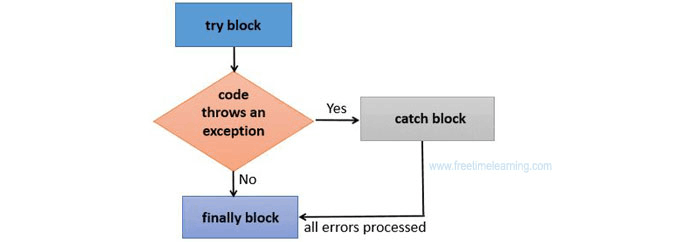
Java Try Keyword

In the same manner that Java's final is a reserved keyword, try is also a reserved keyword that cannot be used as an identifier. Try, keyword ensures that a part of code will be run even if an exception is thrown when used in combination with a try/catch block. The control of the program to its source before the try and catch blocks are executed then last block will be executed.

Note: The JVM will implement or execute the finally block before terminating or stopping the application (if any), if we don’t handle the exception.

Usage of Try Block in Java

In Java programming language, "cleanup" code, such as terminating a file or a connection, can be inserted in the finally block. As part of programming specifications, we interface with databases by creating connections, using input and output streams, and resources inside a try block. It is advisable to use the finally block together with try-catch blocks as a good programmer to ensure the safety of resources and to make sure that there is no resource leak as part of our software.

The try block is where you can print the essential statements.

Usage of Try Java keyword

Let's understand and examine the various scenarios in which the Java finally block can be applied and implemented.

Case 1: In the absence of an exception

Let's look at the example below, where the Java program doesn't raise any exceptions and the finally, block is executed following the try block.

TestFinallyBlock.java


class Fnl_Block {    
  public static void main (String s []) {    
  try {    
// any exception is not thrown in the above code
   int ja=25/5;
   System.out.println(ja);
  }    
//executed without regard to exception happened or not
  catch (NullPointerException e) {  
System.out.println(e);
}    
 finally {  
System.out.println("Ececution of the finally block is always done.");
}    


System.out.println("remaining of the code...");
  }    
}    

Output:

Java try block

Case 2: A catch block is not used when an exception occurs.

In this case, the catch block is unable to handle the exception when the code throws exception statements. Excepting this, the program terminates improperly or irregularly after the try block is executed after the running of try block.

public class Fnl_block_1{    
      public static void main (String s []) {   
      try {    
        System.out.println("inner of try block");


        //The code below raises the divide-by-zero exception.
       int ja=25/0;
       System.out.println(ja);
      }    
//cannot handle exception of the arithmetic type
//can only accept exceptions of the Null Pointer type.
      catch (Null_Pointer_Exptn e) {  
        System.out.println(e);
      }   
//checking whether an exception has occurred is executed or not.
      finally {  
        System.out.println("Execution of the finally block is always done");
      }    


      System.out.println("remaining of the code...");
      }    
    }    

Output:

Java try block

Case 3: When a catch block is used to handle an exception that arises

Example:

Let's look at the example below, where the catch block handles an exception that the Java code throws. After the block of try-catch, the try block is then run. Additionally, the remaining code runs normally as well.

public class Fnl_Block_2{    
      public static void main (String s []) {
      try {    
        System.out.println("Inner side of try block");


        //below code throws divide by zero exception  
       int ja=25/0;
       System.out.println(ja);
} //handles the Arithmetic Exception 
            // Divide by zero


      catch (Arithmetic_Exception e) {  
        System.out.println("Exception handled");
        System.out.println(e);
      }   


      //regardless of whether an exception has occurred, /executes
      finally {  
        System.out.println("Execution of the final block is always done");
      }    


      System.out.println("remaining of the codeexecuted...");
      }    
    }  

Output:

Java try block

Rule: There may be zero or more catch blocks for each attempt block, but there may only be one try block.

Note: If the application terminates (either by calling System.exit() or by introducing a fatal error that causes the procedure to return), there they won't be carried out bt finally keyword.


Related Topics

Java delete directory

The File classes in Java may symbolize a directory or a file on the system. Inside the java.io package, the Files class is accessible. The File class has several helpful...

2 minutes read.

Pancake Sorting in Java

In the pancake sorting method, the array must be sorted using just one operation, which is: Flip the arrays arr at index 0 to index j by using flipArr(arr, h). Other sorting...

3 minutes read.

Java Logo

Java is a prominent and extensively used object-oriented programming language. In 1995, Sun Microsystems created it. Later in 2009, Oracle Corp takeover Java. History of Java Logo The name of the island...

3 minutes read.

Majority Element in Java

It's an extremely intriguing question that is commonly asked in job interviews at prestigious IT firms like The Google, Amazon, TCS, and The Accenture, etc. By figuring out the solution, one may...

10 minutes read.

Composition in Java

Composition Java uses the composition method to implement a has-a connection. Composition allows us to reuse code in the same way that Java inheritance does. The "is-a" relationship is implemented using the...

3 minutes read.

How to Convert String to boolean in Java

How to Convert String to boolean in Java There are two methods to convert String to boolean: Using parseBoolean(string) method Using valueOf(string) method If the string contains "True," "true," or "TRUE,"...

3 minutes read.

Comparetoignorecase in Java

In Java, the function compareToIgnoreCase ( ) is part of the String class, which is part of the java.lang package. It is used to compare any two strings while disregarding...

4 minutes read.

Java Integer parseUnsignedInt() method

The parseUnsignedInt() method of Java Integer class parses the string argument as an unsigned decimal integer. The second parameter parses the string argument as an unsigned integer in the radix specified...

2 minutes read.

Model Class in Java

In this section, we will be acknowledged about the model class in Java, its purpose and its uses. Also, we will learn how is this created and leveraged in java. Model...

4 minutes read.

Java Custom Exception

Java Custom Exception Java language facilitates us to create our own exceptions. The class intended to throw the Custom Exception has to be derived from the Java Exceptionor RuntimeExceptionclass. The Java...

4 minutes read.

HttpURLConnection

HttpURLConnection Protocol It is a standard set of rules that allow electronic devices to communicate with each other. The http protocol The http protocol is for data communication, distributing, collaborating, hypermedia information systems, on the World Wide...

5 minutes read.

String Coding Interview Questions in Java

What is String in Java?In Java, a String is a Class that is defined in the java.lang package. It isn't a basic data type like int or long. Character Strings...

5 minutes read.

Operators in Java

There is a good operator environment provided by Java. These operators are divided into four different groups i.e. arithmetic, bitwise, relational, and logical. There are other operators also available to...

7 minutes read.

Java Trim

Leading and leaving spaces are removed by the built-in Java String trim() method. Space seems to have the Unicode element of "x0040." Java trim() function looks for all of these...

3 minutes read.

Creation of Multi Thread in java

What are threads in Java? We can use threads to facilitate parallel processing. Threads are helpful when you wish to execute several pieces of code concurrently. A thread is a small process...

3 minutes read.

CRC Program in Java

The acronym CRC stands for Cyclic Redundancy Check. It is invented by W. Wesley Peterson in 1961. It is an error detection technique that detects errors in digital networks (also...

5 minutes read.

How to check data type in Java

In this section, we will learn about the methodology to verify the data type in Java. There are mainly two methods in java called as getClass() and getName(). They are...

3 minutes read.

Java SHA256

Definition: In cryptography, SHA is a hash function that takes 20 bytes of input and produces an approximate 40-digit hexadecimal integer as the hash result. Class for Message Digest: Java's MessageDigest Class,...

2 minutes read.

Java String vs StringBuffer

Java String vs StringBuffer In this section, we will discuss the key differences between String and StringBuffer class. Before moving to the ahead in this section, let’s introduce with both classes. String...

4 minutes read.

How to convert float to String in Java

How to convert float to String in java There are following methods to convert float to String: Convert using Float.toString(float) Convert using String.valueOf(float) Convert using Float.toString(float) The Float class has a static method that returns...

2 minutes read.