
×

Java Xmx

This section will explain what Xmx in Java is and how to establish a Java application's maximum heap size.

When we execute a Java application, it occasionally displays an error message like the one below:

A VM initialization error happened. Could not set aside sufficient space for the object heap. unable to build a Java virtual machine.

The error mentioned above suggests expanding the heap size before executing the application. There isn't enough room to build the thing. The Java -Xmx parameter should be used in conjunction with the provided heap size to fix this error. Let's look at what -Xmx in Java means.

What is Java Xmx?

The Java option Xmx defines the JVM's maximum memory (in bytes) allocation pool. The maximum heap size is configured. Keep in mind that the value must be more than 2MB and in multiples of 1024. The size in kilobytes is represented by the letter K or k, and the size in megabytes is represented by the letter M or m. 64M is the standard heap size.

Default Heap Size Based on the ergonomics algorithm, the initial maximum heap size is the default. The Java heap size ranges from 256M (266634176 bytes) to 4068M (4266146816 bytes), with 4068M being the maximum heap size.

We advise you to set the maximum heap size for small and medium Java applications between 512M and 1024M.

Java -Xmx1024M, -Xms512M

Establishing the maximum heap size

Although we can raise the heap size to any value, RAM must be able to accommodate that value. Let's say we wish to limit the heap size to 80M. Any of the following flags can be used to configure the maximum heap size. The heap size is the same for all commands.

1. -Xmx83886080 (memory allocation in bytes) (memory allocation in bytes)
2. -Xmx81920k (memory allocation in kilobytes)
3. -Xmx80M (memory allocation in Megabytes)

The Java heap memory can be allocated up to 80MB in size using the Xmx flags mentioned above. You should take note that there is no space between the flag (-Xmx) and memory size (80M). Whether you choose an uppercase or lowercase letter makes no difference. For instance, -Xmx80M and -Xmx80m are equivalent. It indicates that the application can utilize the entire 80M of memory that is available. As a result, Java's -Xmx flag modifies the JVM's maximum heap size.

To set the maximum heap size, follow the instructions below.

Step 1: Click on the system in the Control Panel after it has opened.

Java Xmx

Step 2: Select Advanced system settings from the menu. The System Properties window is displayed.

Java Xmx

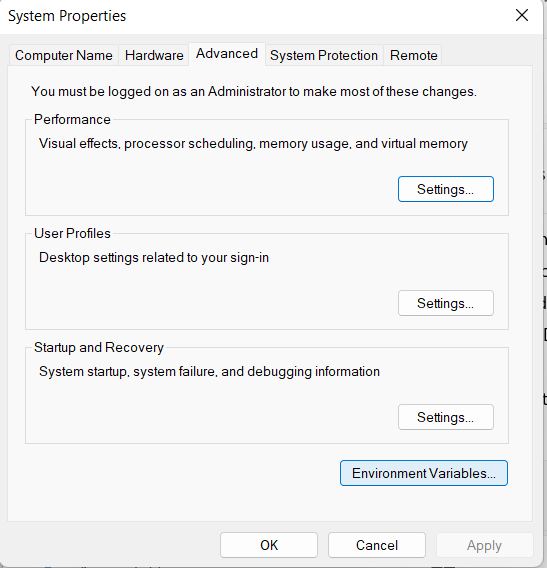
Step 3: Select Environment Variables from the System Properties window. The Environment Variables dialogue box appears.
Java Xmx

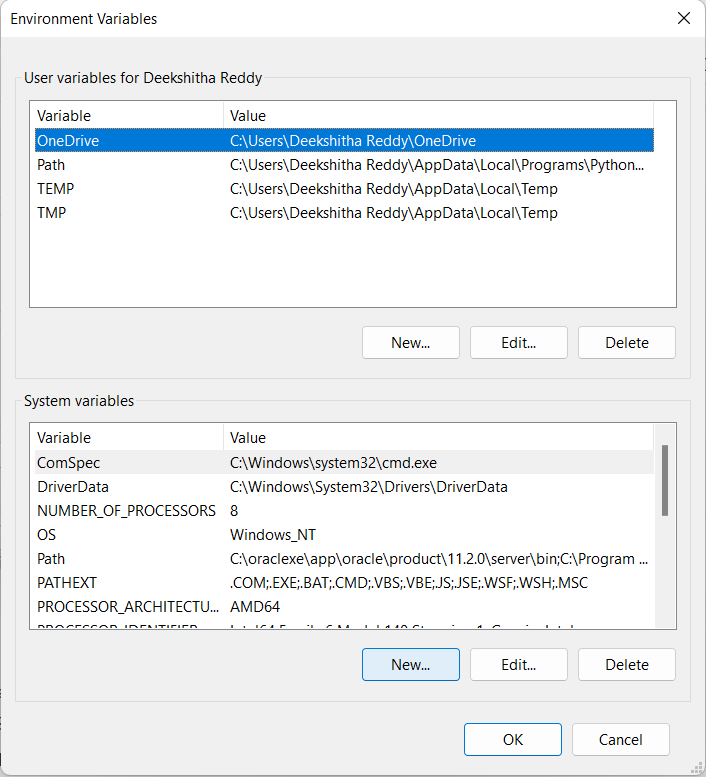
Step 4: Select the New button under System Variables in the Environment Variables
Java Xmx

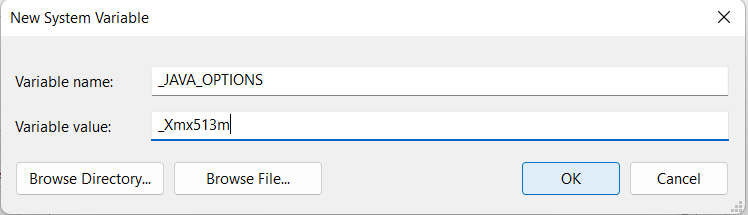
Step 5: Enter the variable names _JAVA OPTIONS and -Xmx512m in the window. Any number can be used in place of 512. Click the OK button three times after that.
Java Xmx

The maximum heap size is now set at 512M.

The same thing can be done if you're using the Eclipse IDE by specifying the VM parameters.

Why is it necessary to increase the heap size?

The well-known java.lang.OutOfMemoryError will be raised if the Java process has used more memory than the -Xmx maximum Java heap size.

Other Arguments on the Command Line Connection to Memory

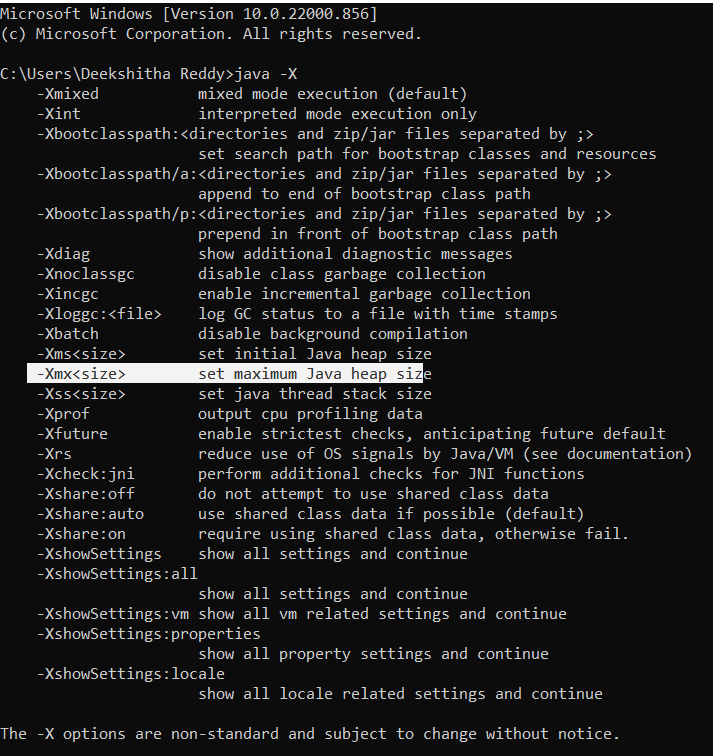
Java offers extra tools for managing the memory used by Java applications. The java -X command can be used to display the memory options that are available. It demonstrates the variety of memory management choices.
Java Xmx

There are four command-line options for Java application memory in the aforementioned result.

  • Disable class garbage collection with -Xnoclassgc.
  • The command sets the Java heap's starting size with the argument -Xmssize>. It has a 2M default size (2097152 bytes). The file should have a size of at least 1024 bytes (1KB). It must be a number greater than 1024.
  • -Xmx: Maximum Java heap size can be set.
  • Set the Java thread stack size with the -Xss command-line option.

Examples

Let's look at some Xmx-based examples.

  • Heap starts expanding from 2MB to 80MB with the -Xms2m -Xmx80m command.
  • The heap starts at 70 MB and will never increase. -Xms70m -Xmx70m
  • The heap starts at 40 MB and increases to the default maximum size using the -Xms40m option.
  • -Xmx256m: Heap increases to a maximum of 256 MB from a pre-set beginning amount.

Related Topics

Longest Odd Even Subsequence in Java

In order to solve the Java problem known as the longest odd-even subsequence, one must identify a sequences in a non-negative array having size s that alternately includes odd and...

6 minutes read.

Anagram Program in Java using String

Anagram Program in Java Anagrams are those words that are generated by rearrangement of the letters of another phrase or word. Usually, while doing the rearrangement, the original letters are used...

8 minutes read.

Java vs DotNET

Before understanding the differences between DotNET and Java, one must know about Java and DotNET. Java Java is a general-purpose programming language that is class-based and object-oriented, with minimal implementation dependencies. Regardless of...

9 minutes read.

Types of Statements in Java

In natural languages, statements and sentences are roughly equivalent. In general, statements are similar to valid English sentences. We will talk about a statement in Java and the different kinds...

11 minutes read.

Java Math max() Method

The max() method of Math class returns the greater of two arguments. The arguments can be of double, float, int or long data type. Syntax: public static double max(double a, double b)public...

2 minutes read.

Java Private keyword

A Java access modifier is a private keyword. It can be used to inner classes, methods, and variables. It is the type of access modifier that is most constrained. Privately declared...

4 minutes read.

Bottom view of a binary tree in Java

The lowest nodes in their horizontal distance are present and referred to as the bottom view of a binary tree. The horizontal distance between the nodes of a binary tree...

4 minutes read.

Design of JDBC

Java applications may interface using database systems from many vendors using the Java Database Connectivity (JDBC) Application Software Interface (API) from Sun Microsystem. To connect spreadsheets, JDBC and database drivers...

3 minutes read.

Java Serialization

JAVA SERIALIZATION Serialization is a process by which objects can be represented as a sequence of bytes. These bytes have information about object's data, object's type and datatypes of members in...

3 minutes read.

How to convert String to String array in Java

A String in Java is a thing that indicates a collection of letters. We must include the String class from java.lang package if we want to be using strings. An...

5 minutes read.

Palindrome Partitioning problem in Java

In this article, you will be acknowledged about partitioning of the palindrome. It can be done in many ways. This article makes sure every method is discussed. Palindrome If a string remains...

6 minutes read.

Difference between final, finally, and finalize()

Difference between final, finally, and finalize() In Java, final, finally and finalize sound similar they are totally different in functionality. Final and finally are the two keywords but the finalize is...

4 minutes read.

Java Class Keyword

We know that java is object-oriented programming language which contains the essential key concepts such as classes and objects etc to have clear idea about the object-oriented programming.Java is mainly...

3 minutes read.

Byte to Hex in Java

Java exclusively uses byte data types to store in a byte array, which is an array. Each component of a byte array has a default value of 0. Hex String -...

3 minutes read.

How to Split String by Comma in Java

strsplit() technique permits you to break a string given the explicit Java string delimiter. The Java string split property is frequently a space or a comma(,) that you want to...

7 minutes read.

Spliterator in Java 8

In this tutorial, we will understand the meaning of spliterator in java 8. It is just like any other iterator available in java used to traverse the elements of either...

4 minutes read.

&& Operator in Java

“ && ” is the conditional - And operator in Java. In Java, it is an example of a logical operator. In Java, the “ & ” operator has two...

3 minutes read.

Construct the Largest Number from the Given Array in Java

In this section, we will create a Java programme that will enable you to locate the greatest integer in an array. The programme will begin comparing the array's numbers with...

3 minutes read.

Java Generate Random String

Java Generate Random String In this tutorial, we will learn about to generate random string in Java. Random generation strings mean any string will be generated, which does not follow any...

7 minutes read.

How to Convert long to String in Java

How to Convert long to String in java It is used if we have to display a long number in the text field because everything is displayed as a String. A...

3 minutes read.