
What is a Silicon Chip?
A silicon chip is a microscopic silicon component found inside computers. It has electronic circuits holding much data or conducting logical or mathematical computations. An integrated circuit comprised mostly of silicon is referred to as a silicon chip. It is a single silicon crystal, typically a few millimeters across, and used to manufacture transistors, networks, and other electronic parts. It has a huge capacity for transistors. You can build Boolean gates using transistors as switches and microprocessor chips using Boolean gates.
Jack Kilby and Robert Noyce, two American electrical engineers, created the silicon chip in 1961. Their invention transformed and simplified technology, opening the door for the birth of the contemporary computer. The majority of electrical devices up until the advent of the chip were built using bulky, power-hungry vacuum tube technology. Although transistors still required wiring to circuit boards, they solved the issue. Kilby and Noyce came up with the solution almost simultaneously, fusing different parts into a semiconductor integrated circuit.
The cost of the simplest silicon chips isn't falling much or at all, even though the capabilities of complicated silicon processors are increasing quickly. For decades, these have remained at 5–10 cents. There is no reason to think that the most basic chips will become considerably less expensive in the future because the cost of a chip factory and research to increase output are rising rapidly. The fact that these chips are the first to be rationed and to see price increases during a chip famine, in which demand exceeds supply, is another cause for concern.
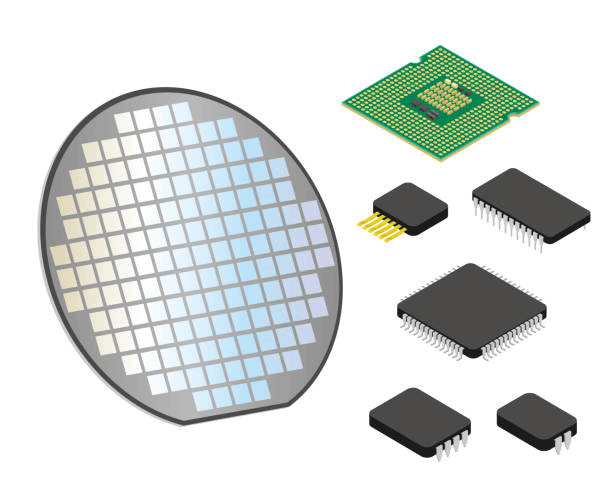
How are Silicon Chips made from silicon?
- Pure silicon crystals are created using the “Czochralski” method, which employs electric arc furnaces to transform raw materials (mostly quartz rock) into metallurgical grade silicon.
- Silicon is converted into a liquid, distilled, and then reformed into rods to remove impurities.
- The polysilicon rods are then cut into pieces and put into a unique oven that is gas-purged with argon to remove any air. The oven melts the chunks when heated to over 2,500° Fahrenheit.
- A small seed crystal is put into the liquid silicon after the chunks have melted, and the molten silicon is then spun in a crucible.
- The seed is gradually drawn out of the molten silicon while the device spins and cools, forming one big crystal. Weighing more than a few hundred pounds frequently.
- The big silicon crystal is subsequently examined using X-rays to confirm its purity.
- If the crystal is flawless, it is divided into thin wafers, like the one pictured on this page.
- Each wafer is buffered after being cut to remove any contaminants that might have been introduced during the cutting process.
- When all buffering is finished, the wafer is placed into a device that etches the circuit design onto the silicon. The technique used to etch these patterns is known as photolithography.
- Photolithography first paints the wafer with photosensitive chemicals that solidify when exposed to light to expose the wafer to the chip design layer using UV light.
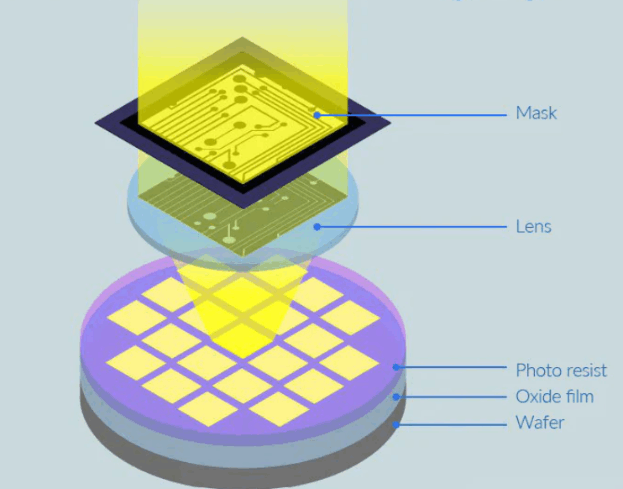
- The leftover photosensitive chemicals are washed away after exposure, leaving only the chip design. Since each chip design includes numerous levels, the photolithography process is repeated until all layers have been created. The layer can then be heated, bombarded with ionized plasma, or soaked in metals once the chemicals have been removed.
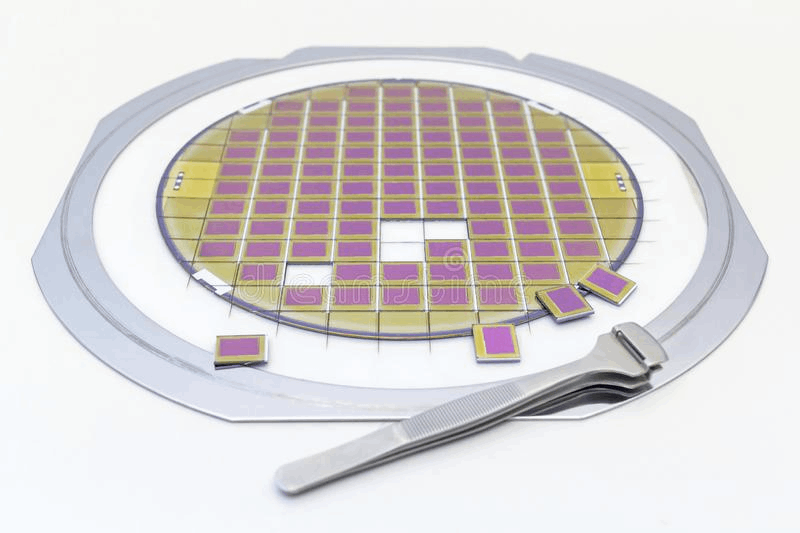
- Finally, the wafer is cut into individual silicon chips.
Why are Silicon Chips used in Computers?
Although silicon does not have the best electronic characteristics, it is nonetheless employed in place of other materials due to its affordability and abundance. It contributes to the overall affordability of your devices and frequently acts as a barrier to substituting alternative materials. But a lot of work is being done globally to find materials that are as good as or better than silicon.
Semiconductors are typically used as building blocks for electronic gadgets. They are necessary if you want a gadget that can operate in both the on and off states at room temperature. Since metals conduct electrons, turning them off would be challenging, and since insulators do not conduct electrons, turning them on would be equally challenging. Semiconductor materials have characteristics that are just in the middle. Such a semiconductor includes silicon. Although it is not the best electronic content, it is enough. Therefore, silicon chips are used in Computers.
Applications of Silicon Chip
Almost all technologies require a specific type of processing unit built on electronics.
We incorporate quick and automatic functions into the system employing electronics. Chips with silicon (or semiconductor) bases are used in these applications.
Consumer products are real word examples, like
- Mobile/PCs/tablets & TVs
- medical devices (thermometer/X-ray/MRI/ECG/EEG machines)
- coffee/washing machines, lift.
Security appliances
- camera/thermal cameras
- Scanners (eye/thumb)
Industry applications, like
- communication units (satellites, mobile towers)
- automatic luxury cars (Tesla)
- automation in machines that use in food & medicine manufacturing etc.