
What is AM?
AM may refer to any of the following:
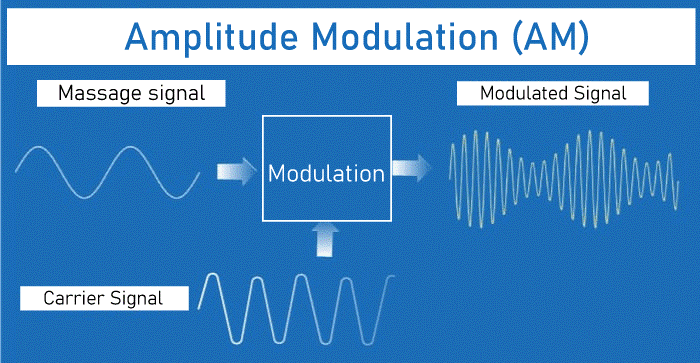
- When referring to audio or a signal, amplitude modulation (AM) is a method of transmitting information using radio waves. In AM, the information to be transferred is used to modulate the amplitude, or height, of the radio wave. The resulting radio signal contains both the original data and the carrier frequency of the radio wave. AM is used in various applications, including radio broadcasting, two-way radio, and military communications. It is relatively simple and inexpensive to implement. Still, it is susceptible to interference and has relatively low efficiency compared to other modulation methods, such as frequency modulation (FM) and phase modulation (PM).
- In terms of time, A.M. is short for ante meridiem, which in Latin means "before the middle of the day" and can also signify "after midnight" when used in a time context. Between 11:59 PM midnight and 11:59 PM noon is the time in question. In other terms, A.M. stands for "afternoon" and "night," while P.M.
History of AM
AM was first demonstrated in the late 19th century by Alexander Popov and Oliver Lodge. Popov developed an early form of AM called spark-gap transmission, in which the information was encoded by the duration and intensity of sparks produced by an electrical discharge. Lodge developed a method of AM using a continuous sine wave as the carrier wave, which is the basis for modern AM.
How AM Works
In AM, the information to be transmitted is used to modulate the amplitude of the carrier wave. The carrier wave is a continuous sine wave with a specific frequency, and the spiral's amplitude represents the signal's strength. The process of modulating the carrier wave is called encoding.
The modulated wave is sent through an amplifier to transmit an AM signal and then broadcast using an antenna. Another antenna receives the signal, which converts the radio waves back into an electrical signal. The electrical signal is then demodulated, or decoded, to recover the original information.
Types of AM
There are two types of AM: double-sideband (DSB) and single-sideband (SSB).
1) Double-sideband AM (DSB-AM)
In DSB-AM, the modulated signal is transmitted with both the upper and lower sidebands of the carrier wave. The sidebands contain the original information that was encoded onto the carrier wave. DSB-AM is relatively simple to implement, but it is inefficient because it uses twice the bandwidth of the carrier wave to transmit the same amount of information.
2) Single-sideband AM (SSB-AM)
In SSB-AM, only one of the sidebands is transmitted, either the upper or the lower sideband. This allows for more efficient bandwidth use, as only half the carrier wave is used to send the same amount of information. However, SSB-AM requires more complex equipment to encode and decode the signal.
Advantages and Disadvantages of AM
Advantages
- AM is relatively simple and inexpensive to implement.
- AM signals can travel long distances and penetrate through objects, making them suitable for long-range communications.
Disadvantages
- AM is susceptible to interference from other signals, such as electrical noise and radio signals. This can make the received signal weak or distorted.
- AM has relatively low efficiency compared to other modulation methods, such as FM and PM. This means it requires more bandwidth to transmit the same amount of information.
Applications of AM in Computer Networks
AM is used in a variety of applications in computer networks, including:
Radio broadcasting: AM is used to transmit radio signals over long distances, allowing people to listen to radio programs on their radios or other devices.
Two-way radio communication: AM is used in two-way radios, such as walkie-talkies, to allow people to communicate over short distances.
Military communications: AM is used in military communications to transmit messages over long distances and to transmit signals to and from military aircraft.
Amateur radio: AM is used in amateur radio, also known as "ham radio," as a way for hobbyists to communicate with each other using radio equipment.
Limitations of AM
While AM has many practical applications, it also has several limitations that make it less suitable for certain situations. These limitations include the following:
Susceptibility to interference: AM signals are susceptible to interference from other signs, such as electrical noise and radio signals. This can make the received signal weak or distorted, which is problematic when clear communication is critical.
Low efficiency: AM is less efficient than other modulation methods, such as FM and PM, requiring more bandwidth to transmit the same amount of information. This can be a problem in situations where bandwidth is limited or expensive.
Limited audio quality: AM could be better suited for transmitting high-quality audio, as the audio quality tends to be lower than FM. This makes it less suitable for high-quality audio applications, such as music broadcasting.